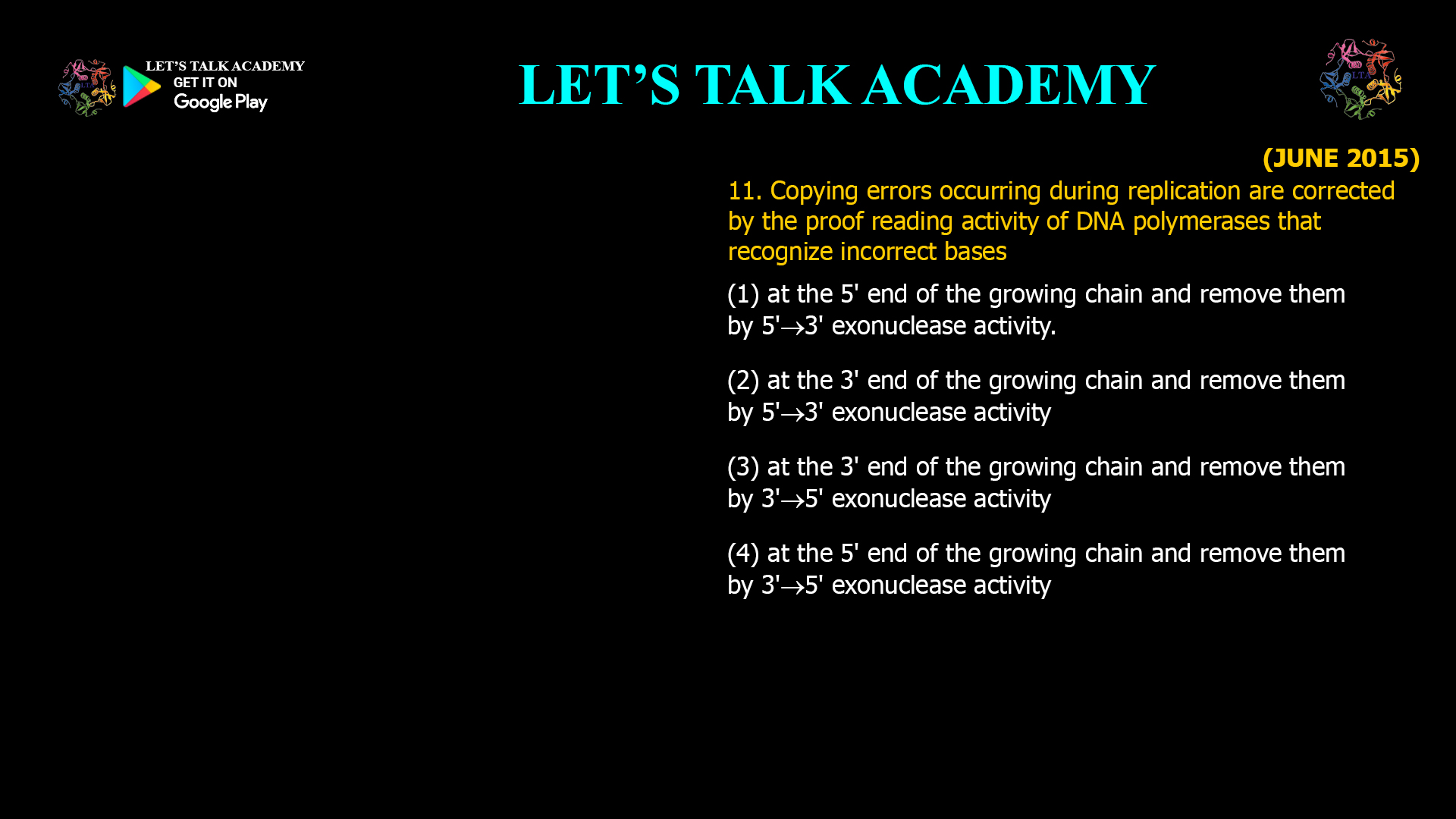
11. Copying errors occurring during replication are corrected by the proof reading activity of DNA polymerases that recognize incorrect bases
(1) at the 5′ end of the growing chain and remove them by 5’à3’exonuclease activity.
(2) at the 3′ end of the growing chain and remove them by 5’à3’exonuclease activity
(3) at the 3′ end of the growing chain and remove them by 3’à5’exonuclease activity
(4) at the 5′ end of the growing chain and remove them by 3’à5’exonuclease activity
Introduction
DNA replication is a highly accurate process, but occasional errors occur when incorrect nucleotides are incorporated into the growing DNA strand. To maintain genetic fidelity, DNA polymerases possess an intrinsic proofreading activity that detects and corrects these mistakes. This proofreading function relies on the 3′→5′ exonuclease activity, which excises mismatched bases from the 3′ end of the newly synthesized DNA strand, allowing the polymerase to replace them with the correct nucleotides.
The Role of DNA Polymerase Proofreading
During DNA synthesis, DNA polymerases add nucleotides to the 3′ hydroxyl end of the growing strand in the 5′→3′ direction. Occasionally, a wrong nucleotide is incorporated, leading to a mismatch. The polymerase then pauses and shifts the DNA strand from its polymerase active site to its exonuclease active site.
-
Recognition of Incorrect Bases: The enzyme detects distortions caused by mismatched base pairs at the 3′ terminus.
-
Exonuclease Activity: The 3′→5′ exonuclease activity removes the incorrect nucleotide by cleaving the phosphodiester bond from the 3′ end backward.
-
Resumption of Polymerization: After excision, the DNA strand returns to the polymerase site, and the correct nucleotide is incorporated.
This proofreading mechanism significantly enhances replication fidelity by reducing the error rate by 100- to 1000-fold.
Directionality of Exonuclease Activity
-
3′→5′ Exonuclease Activity:
This is the proofreading function intrinsic to most replicative DNA polymerases. It removes nucleotides from the 3′ end of the growing DNA strand, moving backward (opposite to the direction of synthesis). -
5′→3′ Exonuclease Activity:
Some polymerases, like DNA polymerase I, have 5′→3′ exonuclease activity used primarily for removing RNA primers during lagging strand synthesis, not for proofreading.
Why 3′→5′ Exonuclease Activity Is Essential
The 3′→5′ exonuclease proofreading activity is crucial for genetic stability because:
-
It corrects misincorporated nucleotides before DNA synthesis continues.
-
It prevents mutations from being permanently fixed in the genome.
-
It acts as a first line of defense against replication errors, complementing mismatch repair systems.
Summary Table
| Option | Description | Correctness |
|---|---|---|
| (1) | Recognizes incorrect bases at 5′ end and removes by 5′→3′ exonuclease activity | Incorrect |
| (2) | Recognizes incorrect bases at 3′ end and removes by 5′→3′ exonuclease activity | Incorrect |
| (3) | Recognizes incorrect bases at 3′ end and removes by 3′→5′ exonuclease activity | Correct |
| (4) | Recognizes incorrect bases at 5′ end and removes by 3′→5′ exonuclease activity | Incorrect |
Correct Answer
(3) at the 3′ end of the growing chain and remove them by 3′→5′ exonuclease activity
Conclusion
DNA polymerases maintain the integrity of genetic information through their intrinsic proofreading activity. This involves recognizing incorrect bases at the 3′ end of the newly synthesized DNA strand and excising them using 3′→5′ exonuclease activity. This process is essential for minimizing replication errors and ensuring faithful DNA replication.
Keywords: DNA polymerase proofreading, 3′→5′ exonuclease activity, DNA replication fidelity, mismatch correction, DNA synthesis, exonuclease directionality, replication errors, molecular biology, genetic stability


34 Comments
Manisha choudhary
July 25, 2025🙏🏻 🌞 sir
Diksha chhipa
July 29, 2025DNA pol 1 have 5to 3 prime exonuclease activity which is used for removing of rna primer.while dna pol 3 have 3to 5prime exonuclease activity which is used in proof reading.it prevent binding of wrong nt.
Mansukh Kapoor
July 29, 2025The correct answer is 3 , that error occured at the 3′ end of the new strand and it is corrected by 3′—5′ exonuclease acti8
Pratibha Sethiya
July 29, 2025Correct option is option (3)
DNA polymerase 1,2,3 have proof reading activity
This activity relies on 3′-5′ exonuclease activity , which recognised the mismatch bases and remove them from 3′ end of the newly synthesized DNA strand and allowing polymerase to correct the base pair
Khushi Agarwal
July 29, 2025Proof reading activity is always recognised incorrect bases at 3′ to 5′ exonuclease
Payal gaur
July 29, 2025Error on 3′ end of new synthesized DNA then 3′ to 5′ exonuclease work for proof reading activity.
anurag giri
July 29, 2025Ans 3 proof reading activity at growing chain 3’ end remove unwanted nucleotide and save cell from mutation
Vanshika Sharma
July 29, 2025Ans 3 is answer dna pol 1 ,2,3 have proof reading activity so it recognises the mismatch bases and remove 3’end of newly synthesized DNA
Surbhi Rajawat
July 29, 2025Answer is 3. Among all the polymerases in prokaryotes pol 1, 2 and 3 have proof reading. That is they read the wrong bases at 3 prime end and remove them by exonuclease activity
HIMANI FAUJDAR
July 29, 2025Answer : 3 ,3′-5′ exonucleus activity show proofreading activity which removes the incorrect bases.
Heena
July 29, 2025Dna pol 3 with proofreading activity works in 3-5 direction with exonuclease activity on 3’end
Priti Khandal
July 29, 2025Right option is c because 3 5 exonucleus activity is 3 ‘per hoti h
Priya Khandal
July 29, 2025The correct answer is third 3 to 5 prime activity from 3 stand
shruti sharma
July 29, 2025ans is 3
Neelam Sharma
July 29, 2025Done
Monika jangid
July 29, 2025Ans is 3 bcoz proof reading function on 3′ to 5′ exonuclease read mismatch bases from 3′ end and replace them with correct nucleotide
Priya Dhakad
July 30, 2025The answer is 3 because 3′-5′ exonuclease have proof reading activity which recognise incorrect bases on 3’end
Sneha Kumawat
July 30, 2025True feeding activity 3’end per hoti hai and correct base hatane ke liye 3′ to 5′ nucleus activity use hoti hai
Payal Gaur
July 30, 2025(3) At the 3′ end of the growing chain and remove them 3′ to 5′ exonuclease (proof reading )
Aafreen
July 30, 2025Ans-3 pol-1,2,3 have proof reading activity, that’s why they read and remove the incorrect bases
Aafreen
July 30, 2025Ans-3 pol-1,2,3 have proof reading activity that’s why they read and remove incorrect bases
Niti tanwar
July 30, 2025Answer is c proof reading activity 3′-5′ exonuclease
Deepika Sheoran
July 30, 2025Proof reading always detects and removes incorrect bases using the 5’_3′
Exonuclease activity
Khushi Vaishnav
July 31, 2025Recognizes incorrect bases at 3′ end and removes by 3′→5′ exonuclease activity
Avni
July 31, 2025proofreading function relies on the 3′→5′ exonuclease activity at 3′ end
Khushi Mehra
July 31, 2025Dna polymerase 3 have 3′-5′ exonuclease activity which occur proof reading and remove the incorrect base by adding correct complementary base.
Dipti Sharma
July 31, 2025The correct Answer is 3.
Pol 1, 2 and 3 have proof reading. activity in prokaryotes so they recognize incorrect bases at 3′ end and remove them by 3′→5′ exonuclease activity.
Aman Choudhary
July 31, 2025Option 3 is correct answer proofreading activity is 3′-5′ exonuclease
Dharmpal Swami
August 1, 2025Incorrect bp recognise at 3′ growing chain
Proofreading -3′ to 5′
Mahima Sharma
August 2, 20253’end 3′-5′ exonuclease activity
Vijay Marmat
August 2, 2025Done ✔️ 3
Soniya Shekhawat
August 3, 2025Proof reading activity of DNA polymerase in 3′ -5′ exonuclease at remove incorrect nucleotide at 3’end .
Deepika Sheoran
November 6, 2025Proof reading always detects and removes incorrect bases using the 5′-3′ Exonuclease Activity.
Komal Sharma
November 17, 2025DNA polymerases maintain the integrity of genetic information through their intrinsic proofreading activity. This involves recognizing incorrect bases at the 3′ end of the newly synthesized DNA strand and excising them using 3′→5′ exonuclease activity. This process is essential for minimizing replication errors and ensuring faithful DNA replication.