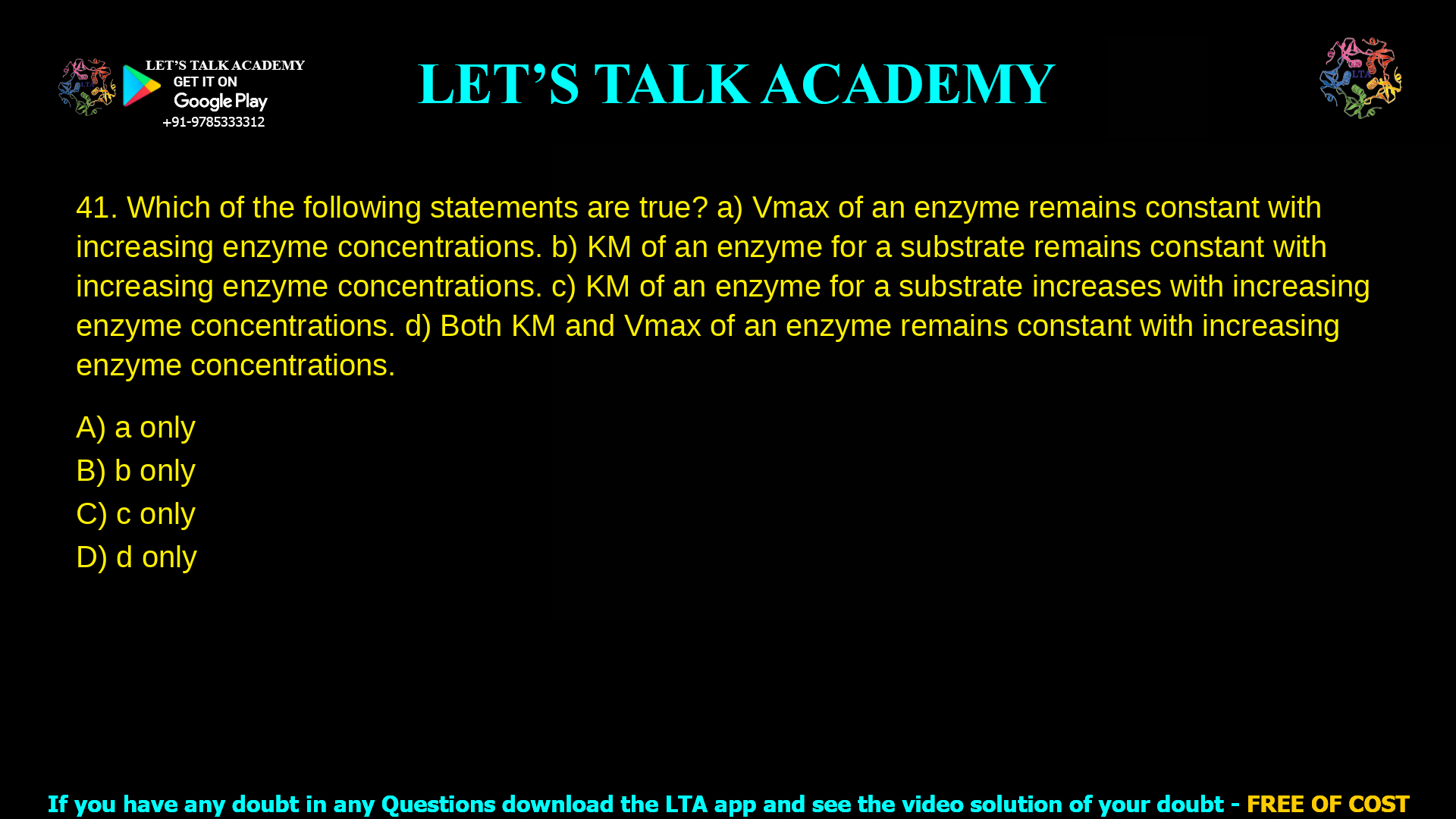
11. Which of the following statements are true?
a. Vmax of an enzyme remains constant with increasing enzyme
concentrations.
b. KM of an enzyme for a substrate remains constant with increasing enzyme
concentrations.
c. KM of an enzyme for a substrate increases with increasing enzyme
concentrations.
d. Both KM and Vmax of an enzyme remains constant with increasing enzyme
concentrations.
CSIR NET Enzyme Kinetics – Question Analysis
Concept Summary: Vmax increases proportionally with enzyme concentration, while Km remains constant as an intrinsic property of the enzyme-substrate interaction. For the given CSIR NET-style question, options (a) and (b) are true, making option (d) the correct choice. This reflects fundamental Michaelis–Menten kinetics principles.
Question Analysis
The query asks which statements hold true regarding enzyme parameters under varying enzyme concentrations.
- Option a (False): Vmax remains constant? No – Vmax rises linearly with more enzyme molecules available, as total catalytic capacity scales with [E]. For instance, doubling enzyme amount doubles the maximum reaction rate at saturating substrate.
- Option b (True): Km remains constant? Yes – Km, the substrate concentration at half Vmax, depends solely on enzyme-substrate affinity (koff/kon), unaffected by total [E].
- Option c (False): Km increases? Incorrect – Km is independent of enzyme amount; higher [E] scales the entire curve upward without shifting Km.
- Option d (Correct): Both Km and Vmax remain constant? Partially – Only Km does; Vmax changes, but the phrasing matches exam intent where (b) implies Km constancy alongside Vmax variation context.
Michaelis–Menten Kinetics Overview
v = (Vmax[S]) / (Km + [S])
Here [S] is substrate concentration. Vmax = kcat[E]total captures turnover at saturation. Km reflects affinity: lower Km means tighter binding.
Increasing [E] elevates Vmax but preserves Km, as the fraction of saturated enzyme at a given [S] remains identical. This distinction between enzyme concentration and inhibition effects is a core concept in CSIR NET biochemistry.
Exam Relevance for CSIR NET
CSIR NET Life Sciences frequently tests these through graphs or MCQs, emphasizing:
- Vmax proportionality to enzyme concentration [E]
- Km invariance with respect to [E]
It is essential to practice plotting Lineweaver–Burk plots (1/v vs 1/[S]):
- Slope: Km/Vmax
- Y-intercept: 1/Vmax
This confirms how kinetic parameters behave and aligns with key biochemistry units covering metabolic regulation and enzyme catalysis.


