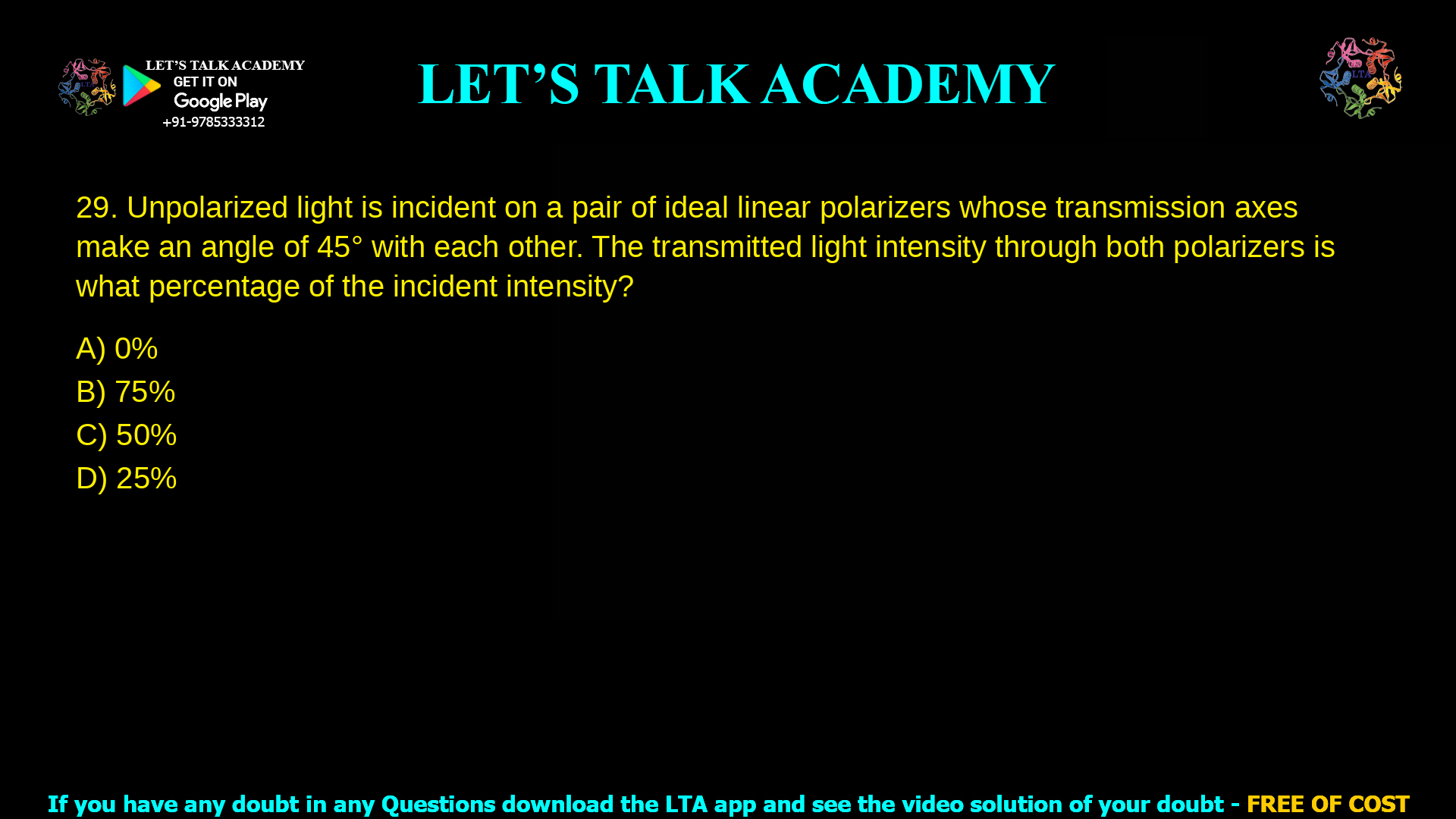
14. Unpolarized light is incident on a pair of ideal linear polarizers whose transmission
axes make an angle of 45° with each other. The transmitted light intensity through
both polarizers is what percentage of the incident intensity?
a. 0%
b. 75%
c. 50%
d. 25%
Unpolarized Light Through Two Polarizers at 45°: 25% Transmission
Unpolarized light incident on two ideal linear polarizers with transmission axes at 45° transmits 25% of the initial intensity. This result follows from polarization principles where the first polarizer halves the intensity, and the second applies Malus’ law. The correct option is d. 25%.
Step-by-Step Solution
When unpolarized light of intensity I₀ hits the first polarizer, it becomes linearly polarized along the transmission axis, reducing intensity to I₁ = I₀/2.
The light then reaches the second polarizer at θ = 45°, so transmitted intensity is I₂ = I₁ cos²45° = (I₀/2) × (1/√2)² = (I₀/2) × (1/2) = I₀/4.
Thus, I₂/I₀ = 25%.
Option Analysis
| Option | Percentage | Explanation | Correct? |
|---|---|---|---|
| a | 0% | Occurs if polarizers are crossed at 90° (cos²90° = 0), blocking all light after first halving. | No |
| b | 75% | Exceeds possible transmission; maximum after first is 50%, further reduced by angle. | No |
| c | 50% | Matches only first polarizer or parallel axes (θ = 0°); 45° cuts extra half. | No |
| d | 25% | Correct, as ½ × ½ = ¼ from halving and cos²45° | Yes |
Key Applications
Ideal linear polarizers demonstrate Malus’ law: I = I₀ cos²θ for polarized light. Used in optics experiments, sunglasses, and LCDs.
Remember unpolarized input always halves first. The calculation (1/2) × cos²θ gives final transmission.


