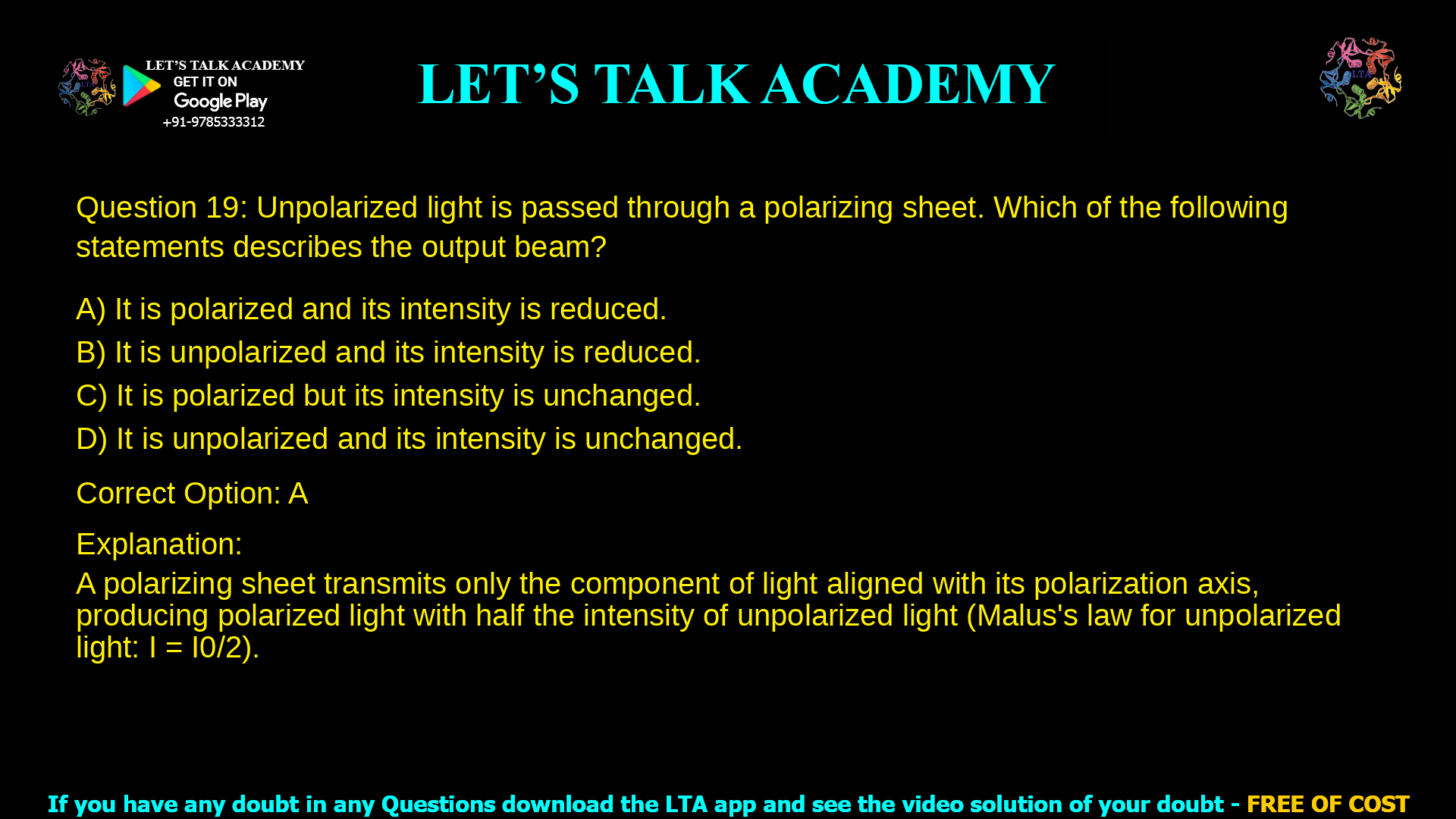
4. Unpolarized light is passed through a polarizing sheet. Which of the following
statements describes the output beam?
a. It is polarized and its intensity is reduced.
b. It is unpolarized and its intensity is reduced.
c. It is polarized but its intensity is unchanged.
d. It is unpolarized and its intensity is unchanged.
Unpolarized light passing through a polarizing sheet becomes polarized with reduced intensity, making option a correct.
Option Analysis
Unpolarized light vibrates in all planes randomly. A polarizing sheet allows only vibrations parallel to its transmission axis to pass, converting it to linearly polarized light along that axis. Intensity halves because only half the light aligns on average with the axis, per the polarization transmission factor of 1/2 for unpolarized incident light.
-
a. Polarized, intensity reduced: Correct, as explained—light polarizes and intensity drops to I/2.
-
b. Unpolarized, intensity reduced: Wrong; the sheet enforces single-plane vibration, polarizing the output.
-
c. Polarized, intensity unchanged: Wrong; half the light gets absorbed or blocked, reducing intensity.
-
d. Unpolarized, intensity unchanged: Wrong on both counts—no polarization change and no intensity preservation.
When unpolarized light polarizing sheet output beam behavior is examined, the light emerges polarized with half its original intensity. This fundamental optics principle appears in competitive exams, testing Malus’ law basics where unpolarized light’s random vibrations get filtered.
Physics Behind Polarization
Unpolarized light from sources like sunlight has electric fields oscillating in all directions equally. A polarizing sheet (polaroid) transmits only the component parallel to its axis, yielding plane-polarized light. Mathematically, transmitted intensity I=I02, where I0 is incident intensity, since cos2θ averages to 1/2 over all angles.
Practical Applications
Polarizing sheets reduce glare in sunglasses and LCD screens by blocking specific vibrations. In experiments, rotating the sheet modulates intensity from 0 to I/2 maximum. This setup confirms the output beam is always polarized post-single sheet.
Exam Tips
For CSIR NET or similar, remember: single polarizer halves unpolarized intensity and polarizes it. Multiple sheets involve sequential Malus’ law applications.


