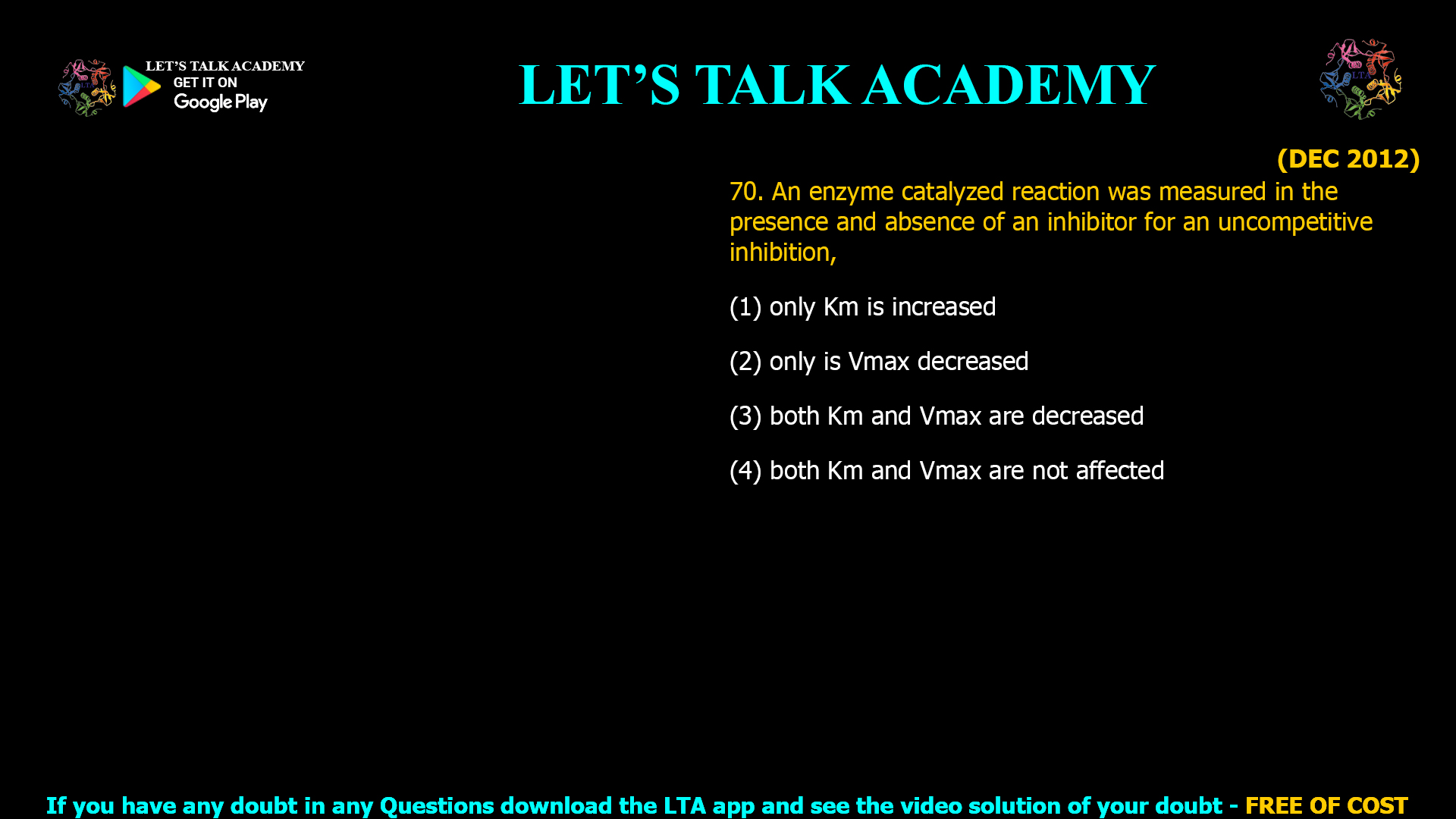
(DEC 2012)
70. An enzyme catalyzed reaction was measured in the presence and absence of an inhibitor for an uncompetitive inhibition,
(1) only Km is increased
(2) only is Vmax decreased
(3) both Km and Vmax are decreased
(4) both Km and Vmax are not affected
The correct answer is (3) both Km and Vmax are decreased.
Introduction
Enzyme inhibition is a vital aspect of biochemical regulation and drug action, with uncompetitive inhibition being a distinct mode where the inhibitor binds exclusively to the enzyme-substrate (ES) complex. This unique binding mode causes simultaneous decreases in both the Michaelis constant (Km) and the maximum reaction velocity (Vmax), distinguishing uncompetitive inhibition from other types. This article elaborates on the mechanism and kinetic consequences of uncompetitive inhibition to clarify how and why Km and Vmax both decrease.
Mechanism of Uncompetitive Inhibition
-
The uncompetitive inhibitor binds only to the enzyme-substrate complex (ES), forming an inactive ESI complex.
-
This binding prevents product formation, trapping the enzyme in an inactive state.
-
Because the inhibitor binds after substrate binding, it does not affect substrate affinity in a typical way but lowers the apparent Km due to shift in equilibrium.
Effects on Kinetic Parameters
-
Decrease in Vmax:
-
The effective concentration of active enzyme is reduced because some enzyme is locked in the inactive ESI complex, lowering the maximum achievable reaction rate.
-
-
Decrease in apparent Km:
-
The inhibitor binding shifts equilibrium towards ES complex formation, effectively increasing enzyme’s apparent affinity for substrate, reducing Km.
-
Mathematical Relationships
-
Modified Michaelis-Menten equation with inhibitor:
V=(Vmax/(1+[I]/Ki))[S](Km/(1+[I]/Ki))+[S]
-
Both Vmax and Km are divided by the same factor, lowering their observable values in kinetics.
Distinguishing Uncompetitive Inhibition Graphs
-
Lineweaver-Burk plots show parallel lines for inhibited and uninhibited reactions.
-
Both slopes and intercepts change proportionally, reflecting simultaneous decreases in Km and Vmax.
Comparison Table of Inhibition Types
| Inhibition Type | Km Effect | Vmax Effect | Inhibitor Binding Site |
|---|---|---|---|
| Competitive | Increases | Unchanged | Active site |
| Non-competitive | Unchanged | Decreases | Allosteric site |
| Uncompetitive | Decreases | Decreases | Enzyme-substrate complex (ES) |
Biological and Pharmaceutical Implications
-
Uncompetitive inhibitors can be highly effective at high substrate concentrations because they bind exclusively to ES.
-
Their distinct kinetic signature aids in identifying binding modes and designing targeted inhibitors.
Conclusion
In uncompetitive inhibition, both Km and Vmax decrease due to inhibitor binding the ES complex, trapping the enzyme-substrate form and preventing product formation. Option (3) both Km and Vmax are decreased correctly describes this inhibition type.
This detailed review strengthens biochemical understanding of inhibition kinetics, aiding students and researchers in enzyme characterization and drug discovery.


55 Comments
yashika
September 12, 2025Both km vmax decrease for uncompetitive
Mahima Sharma
September 17, 2025Both km and Vmax are decreases
Kirti Agarwal
September 12, 2025In uncompetative inhibitors affinity increase for ESI complex so Km is reduced
Vmax is always decrease in uncompetative
Khushi Vaishnav
September 12, 2025Both Km and Vmax are decreased
anjani sharma
September 12, 2025In uncompetative inhibition both v max and km decrease
Sakshi yadav
September 12, 2025Both km and vmax decrease
Bharti yadav
September 12, 2025Km and Vmax are decreased
Varsha Tatla
September 13, 2025Both are decrease
Savita Garwa
September 13, 2025(3) both Km and Vmax are decreased.
Kajal
September 13, 2025Option 3 is correct as both km and vmax decreases in uncompetitive binding
Gupta isha
September 14, 2025Both km &vmax are decreased
Kanica Sunwalka
September 13, 2025in uncompetitive inhibition both km and v max – decreases
Aakansha sharma Sharma
September 13, 2025both Km and Vmax are decreased.
Rishita
September 13, 2025Both km and vmax decrease
Pratibha Jain
September 14, 2025correct answer is option (3)
both Km and Vmax are decreased.
Santosh Saini
September 14, 2025In uncompetitive inhibition both the Vmax and Km decreased
Anju
September 14, 2025Ans: 3
Both km and Vmax are decrease
Aartii sharma
September 14, 2025Both vmax and km is decreased
Dharmpal Swami
September 14, 2025Both km and Vmax.are decreased
Konika Naval
September 14, 2025both Km and Vmax are decreased.
Pooja
September 14, 2025Option c is correct
both Km and Vmax are decreased
Pallavi Ghangas
September 14, 2025In uncomfortable inhibition both we VMax and km decrease
Deepika sheoran
September 14, 2025Both Vmax & Km are decreased.
Deepika sheoran
September 14, 2025Both Vmax & Km are decreased.
Ankita Pareek
September 14, 2025Both km and v max decreased
Palak Sharma
September 14, 2025(3) both Km and Vmax are decreased.
Vijay kumar Meena
September 14, 2025Km and Vmax are decreased and affinity increase
Ajay Sharma
September 14, 2025Both , km and Vmax are decreased
Gupta isha
September 14, 2025Both km &vmax are decreased
HIMANI FAUJDAR
September 14, 2025Ans In uncompetitive inhibition both Km and Vmax decrease due to inhibitor binding the ES complex and Prevent Product formation.
Priya dhakad
September 14, 2025In uncompetitive inhibition, both vmax and km decrease.
Sakshi Kanwar
September 14, 2025The inhibitor binds after substrate binding, it does not affect substrate affinity in a typical way but lowers the apparent Km and Vmax
Soniya Shekhawat
September 15, 2025The uncompetitive inhibitor binds only to the enzyme-substrate complex (ES), forming an inactive ESI complex so km and vmax is Decrease
Vanshika Sharma
September 15, 2025Both km and Vmax are decreased
Devika
September 15, 2025Both km and Vmax are decreased
Mohd juber Ali
September 15, 2025Both Vmax and Km are decrease
Lokesh Kumawat
September 15, 2025Both km and Vmax are decreased
Bhawna Choudhary
September 15, 2025Both km and vmax is decreased in uncompetitive inhibition
Mansukh Kapoor
September 15, 2025The correct answer is option 3rd
Both Km and Vmax are decreased
Aafreen Khan
September 16, 2025In uncompetitive inhibition the inhibitor binds to ES complex and form ESI complex
So both km and Vmax decreases
Anjana sharma
September 16, 2025Both km and vmax decreased in uncompetitive inhibition
Nilofar Khan
September 16, 2025correct answer is (3) both Km and Vmax are decreased.
Tanvi Panwar
September 16, 2025Both Km and Vmax. are decreased.
Payal Gaur
September 16, 2025Both km and Vmax are decrease
priti khandal
September 17, 2025both vmax and km is decrease
Khushi Agarwal
September 17, 2025Correct Answer: 3both Km and Vmax are decreased Uncompetitive inhibition me inhibitor sirf ES complex ko block karta hai ← substrate nikal hi nahi pata, isliye enzyme “trap” ho jata hai values (Km aur Vmax) gir jaati hain. ← dono
Simran Saini
September 17, 2025Both Km and Vmax are decreased.
Avni
September 17, 2025correct answer is (3) both Km and Vmax are decreased.
Sonal Nagar
September 19, 2025Option 3
Asha Gurzzar
September 19, 2025Both km and vmax decrease
Minal Sethi
September 19, 2025both km and vmax are decreased
Muskan Yadav
September 19, 2025both Km and Vmax are decreased.
Kajal
September 25, 2025The correct answer is (3) both Km and Vmax are decreased
Priti khandal
September 29, 2025C is right
Sachin kant sharma
September 29, 2025Uncompetative:- km or vmax both decrease