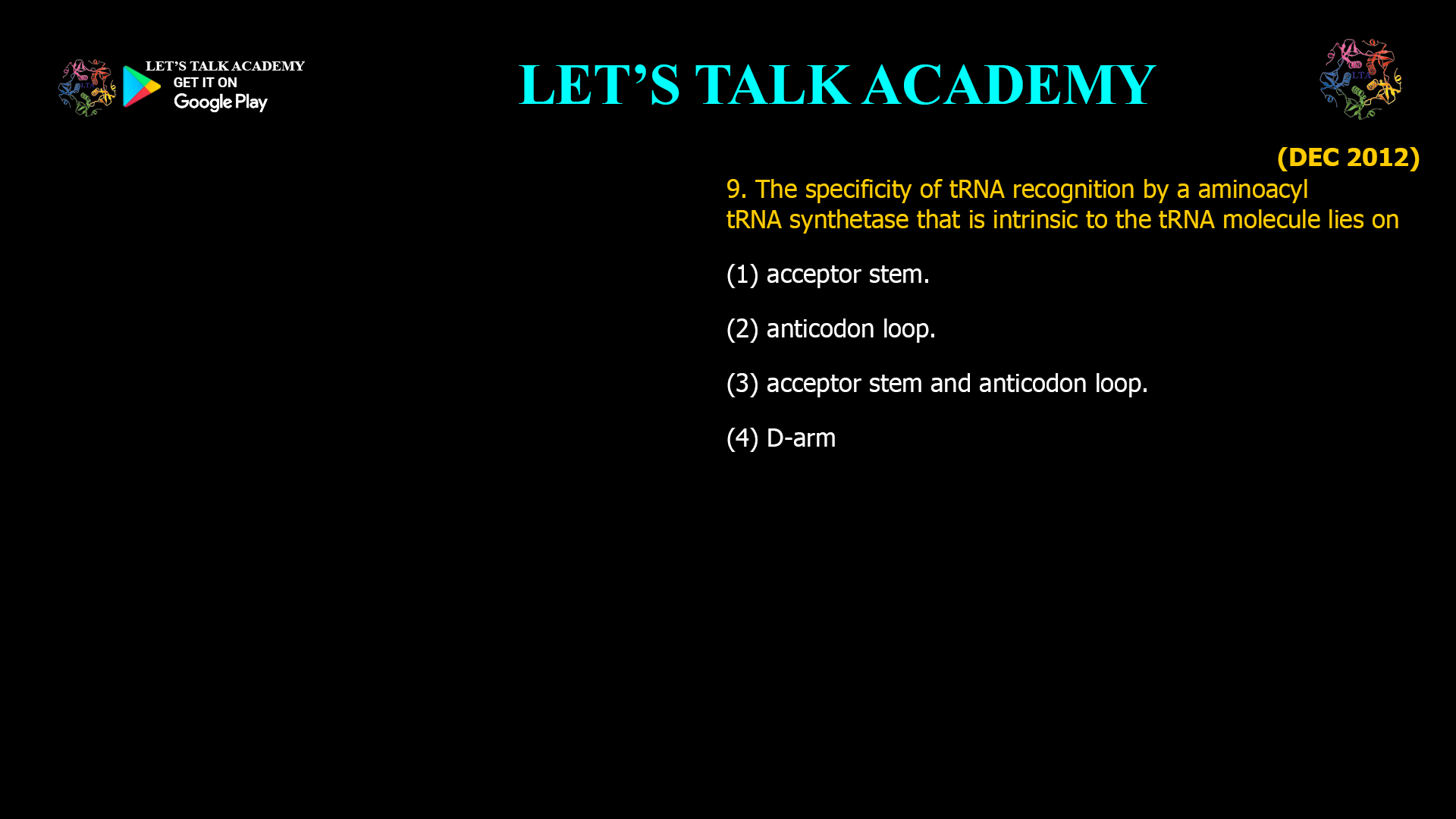
9. The specificity of tRNA recognition by a aminoacyl tRNAsynthetase that is intrinsic to the tRNA molecule lies on
(1) acceptor stem.
(2) anticodon loop.
(3) acceptor stem and anticodon loop.
(4) D-arm
Specificity of tRNA Recognition by Aminoacyl-tRNA Synthetase: Role of Acceptor Stem and Anticodon Loop
Aminoacyl-tRNA synthetases (aaRSs) are essential enzymes that charge tRNAs with their cognate amino acids, ensuring accurate translation of the genetic code into proteins. The specificity of tRNA recognition by aaRSs is a finely tuned process that relies on structural elements intrinsic to the tRNA molecule.
Key Structural Determinants for tRNA Recognition
-
Acceptor Stem:
The acceptor stem, located at the 3′ end of the tRNA, is a critical identity element. It includes the last few base pairs and the universally conserved CCA tail where the amino acid is attached. The acceptor stem interacts directly with the active site of the synthetase and provides class-specific recognition patterns. -
Anticodon Loop:
The anticodon loop contains the anticodon triplet that base pairs with the mRNA codon during translation. Many aaRSs also recognize specific nucleotides within the anticodon loop, contributing to tRNA identity and ensuring correct amino acid charging. -
Combined Role:
Most aminoacyl-tRNA synthetases use a combination of identity elements located in both the acceptor stem and the anticodon loop to achieve high specificity. This dual recognition helps prevent mischarging of tRNAs.
Supporting Evidence
-
Structural and biochemical studies show that aaRSs bind along the L-shaped tRNA structure, contacting both the acceptor stem and anticodon loop.
-
Mutagenesis experiments altering bases in either region can disrupt recognition and aminoacylation efficiency.
-
Crystallographic data of aaRS-tRNA complexes reveal distinct interaction patterns depending on the synthetase class and tRNA species.
Why Other tRNA Regions Are Less Critical
-
D-arm:
While important for tRNA tertiary structure and stability, the D-arm generally plays a lesser role in direct recognition by aaRSs compared to the acceptor stem and anticodon loop.
Summary Table
| tRNA Region | Role in aaRS Recognition |
|---|---|
| Acceptor Stem | Major identity element, interacts with active site |
| Anticodon Loop | Provides codon specificity, recognized by many aaRSs |
| D-arm | Structural role, minor role in recognition |
Correct Answer
(3) acceptor stem and anticodon loop
Keywords for SEO Optimization
-
Aminoacyl-tRNA synthetase specificity
-
tRNA identity elements
-
Acceptor stem recognition
-
Anticodon loop role in tRNA charging
-
Protein synthesis accuracy
-
tRNA-synthetase interaction
-
Translation fidelity mechanisms
-
tRNA structure and function
-
Aminoacylation process
-
Genetic code translation
Conclusion
The specificity of tRNA recognition by aminoacyl-tRNA synthetases depends primarily on a combination of structural features located in the acceptor stem and anticodon loop of the tRNA molecule. These regions provide essential identity determinants that guide the synthetase to correctly charge the tRNA with its cognate amino acid, maintaining the fidelity of protein synthesis.
Correct answer: (3) acceptor stem and anticodon loop


10 Comments
Kirti Agarwal
November 1, 2025Acceptor loop and anticodon loop
Sakshi yadav
November 3, 2025Anticodon loop
Neha Yadav
November 3, 2025acceptor stem and anticodon loop
Kajal
November 4, 2025Correct answer: (3) acceptor stem and anticodon loop
Mohd juber Ali
November 4, 2025Option 3 acceptor stem and anticodon loop
Deepika Sheoran
November 4, 2025Anticodon loop
anjani sharma
November 4, 2025Anticodon loop
Dipti Sharma
November 4, 2025acceptor stem and anticodon loop
Heena Mahlawat
November 5, 2025Acceptor stem and anticodon loop
Sakshi Kanwar
December 6, 2025acceptor stem and anticodon loop