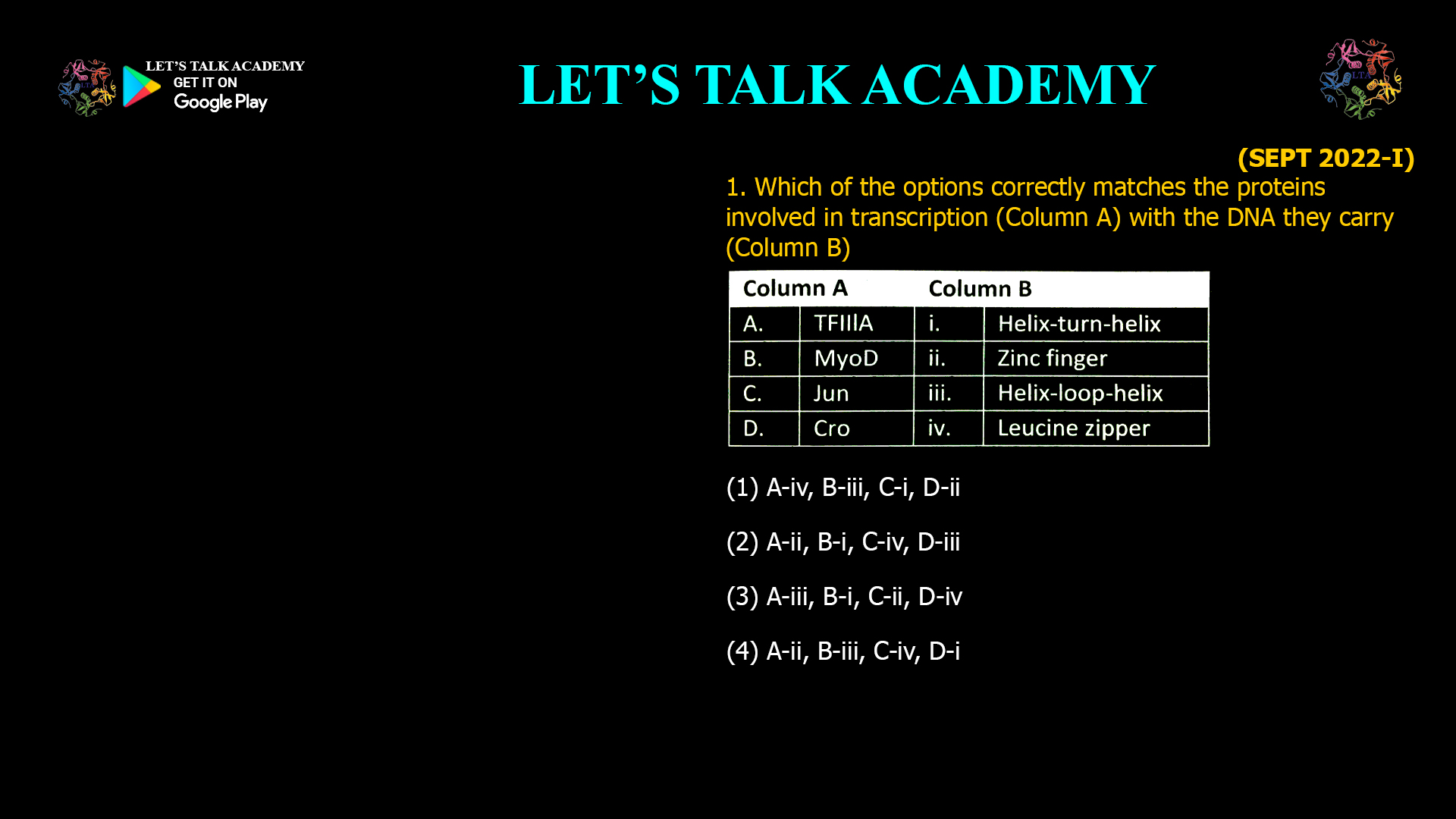
1. Which of the options correctly matches the proteins involved in transcription (Column A ) with the DNA they carry ( Column B)
Column A Column B
A. TFIIIA i. Helix-turn-helix
B. MyoD ii. Zinc finger
C. Jun iii. Helix-loop-helix
D. Croiv. Leucine Zipper
(1) A-iv, B-iii, C-i, D-ii
(2) A-ii, B-i, C-iv, D-iii
(3) A-iii, B-i, C-ii, D-iv
(4) A-ii, B-iii, C-iv, D-i
Introduction
Transcription factors are essential proteins that regulate gene expression by binding to specific DNA sequences. Their ability to recognize and bind DNA is determined by specialized structural motifs known as DNA-binding domains. Understanding these domains is crucial for deciphering how genes are turned on or off in response to cellular signals. This article explores the correct matching of four well-known transcription factors—TFIIIA, MyoD, Jun, and Cro—to their respective DNA-binding domains, providing insights into the molecular basis of gene regulation.
Overview of Transcription Factors and DNA-Binding Domains
Transcription factors are modular proteins that typically contain a DNA-binding domain, a dimerization domain, and a transactivation domain. The DNA-binding domain is responsible for recognizing and binding to specific DNA sequences, while the dimerization domain allows the protein to pair with another transcription factor, enhancing its regulatory capacity. The transactivation domain interacts with other components of the transcriptional machinery to modulate gene expression.
There are several types of DNA-binding domains, each with a unique structure and mechanism of DNA recognition. The most common include:
-
Helix-turn-helix (HTH)
-
Zinc finger
-
Helix-loop-helix (HLH)
-
Leucine zipper
Each of these domains is found in different transcription factors, enabling a diverse array of regulatory mechanisms.
Matching Transcription Factors to DNA-Binding Domains
1. TFIIIA – Zinc Finger
TFIIIA is a transcription factor involved in the regulation of 5S ribosomal RNA genes. It is a classic example of a zinc finger protein. Zinc fingers are small, modular domains that use zinc ions to stabilize their structure. Each zinc finger consists of a short α-helix and two β-strands, with a zinc ion coordinated by cysteine and histidine residues. The α-helix interacts with the major groove of DNA, allowing the protein to recognize specific sequences.
Correct Match:
A. TFIIIA – ii. Zinc finger
2. MyoD – Helix-Loop-Helix
MyoD is a key transcription factor in muscle cell differentiation. It belongs to the helix-loop-helix (HLH) family of transcription factors. HLH proteins contain two α-helices separated by a loop. The longer helix is responsible for DNA binding, while the loop provides flexibility. HLH proteins often dimerize, which is essential for their function.
Correct Match:
B. MyoD – iii. Helix-loop-helix
3. Jun – Leucine Zipper
Jun is a component of the AP-1 transcription factor complex, which plays a role in regulating genes involved in cell proliferation and differentiation. Jun uses a leucine zipper motif for dimerization. The leucine zipper consists of a stretch of amino acids with leucine residues at regular intervals, forming a coiled-coil structure. This allows Jun to pair with other leucine zipper proteins, such as Fos, to form a functional transcription factor complex.
Correct Match:
C. Jun – iv. Leucine zipper
4. Cro – Helix-Turn-Helix
Cro is a bacteriophage lambda protein that regulates the switch between lysogenic and lytic cycles. It uses a helix-turn-helix (HTH) motif to bind DNA. The HTH domain consists of two α-helices separated by a short turn. The second helix (the recognition helix) fits into the major groove of DNA, enabling sequence-specific binding.
Correct Match:
D. Cro – i. Helix-turn-helix
Summary Table
| Transcription Factor | DNA-Binding Domain |
|---|---|
| TFIIIA | Zinc finger |
| MyoD | Helix-loop-helix |
| Jun | Leucine zipper |
| Cro | Helix-turn-helix |
Biological Significance
Understanding the relationship between transcription factors and their DNA-binding domains is fundamental to molecular biology. Each domain confers unique properties to the transcription factor, enabling it to recognize specific DNA sequences and regulate gene expression in response to cellular signals. For example:
-
Zinc finger proteins like TFIIIA are involved in the regulation of ribosomal RNA genes, ensuring proper ribosome biogenesis.
-
HLH proteins like MyoD are essential for cell fate determination, particularly in muscle development.
-
Leucine zipper proteins like Jun are critical for integrating extracellular signals into changes in gene expression.
-
HTH proteins like Cro are used by bacteriophages to control their life cycles, demonstrating the versatility of these domains.
Practical Applications
Knowledge of DNA-binding domains is applied in various fields, including biotechnology and medicine. For example:
-
Zinc finger nucleases are engineered proteins used for targeted genome editing.
-
HLH and leucine zipper domains are studied for their roles in cancer and developmental disorders.
-
HTH domains are explored for their potential in synthetic biology and the design of novel regulatory circuits.
Conclusion
The correct matching of transcription factors to their DNA-binding domains is essential for understanding gene regulation. In the context of the given options:
-
TFIIIA is matched to the zinc finger domain.
-
MyoD is matched to the helix-loop-helix domain.
-
Jun is matched to the leucine zipper domain.
-
Cro is matched to the helix-turn-helix domain.
Therefore, the correct option is:
(4) A-ii, B-iii, C-iv, D-i
This knowledge is foundational for students and researchers in molecular biology, genetics, and related fields, providing a clear framework for understanding how transcription factors recognize and regulate their target genes.


