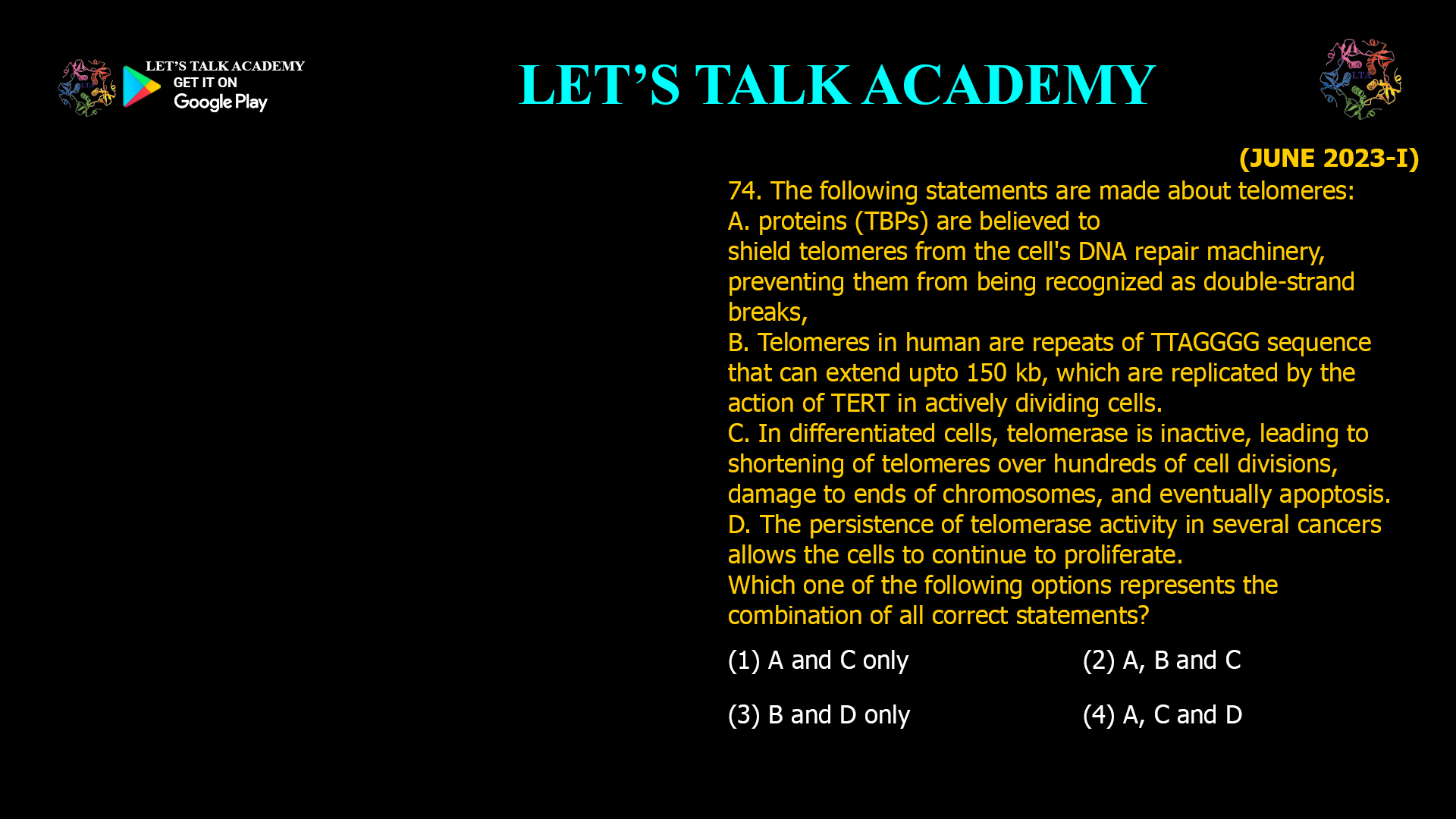
The following statements are made about telomeres:
A. proteins (TBPs) are believed to shield telomeres from the cell’s DNA repair machinery, preventing them from being recognized as double-strand breaks,
B. Telomeres in human are repeats of TTAGGGG sequence that can extend upto 150 kb, which are replicated by the action of TERT in actively dividing cells.
C. In differentiated cells, telomerase is inactive, leading to shortening of telomeres over hundreds of cell divisions, damage to ends of chromosomes, and eventually apoptosis.
D. The persistence of telomerase activity in several cancers allows the cells to continue to proliferate.
Which one of the following options represents the combination of all correct statements?
(1) A and C only (2) A, B and C
(3) B and D only (4) A, C and D
Introduction
Telomeres are specialized DNA-protein structures located at the ends of linear eukaryotic chromosomes. They protect chromosome termini from degradation, prevent recognition as DNA breaks, and maintain genomic stability. Telomeres consist of repetitive DNA sequences and associated proteins that form a protective cap, essential for proper chromosome function and cellular longevity.
Key Functions and Characteristics of Telomeres
A. Telomere-Binding Proteins (TBPs) Shield Telomeres
Telomere-binding proteins, collectively known as the shelterin complex, bind specifically to telomeric DNA sequences. This complex includes proteins such as TRF1, TRF2, POT1, TIN2, RAP1, and TPP1. Shelterin protects telomeres by:
-
Preventing activation of the DNA damage response at chromosome ends.
-
Inhibiting inappropriate repair activities that could mistakenly treat telomeres as double-strand breaks.
-
Maintaining telomere structure and length regulation.
B. Telomeric DNA Sequence and Length in Humans
Human telomeres consist of tandem repeats of the sequence 5′-TTAGGG-3′, repeated approximately 3000 times, which can extend up to about 10–15 kilobases in length. This repetitive sequence is highly conserved across vertebrates and forms a guanine-rich 3′ single-stranded overhang essential for telomere function.
C. Telomerase and Telomere Replication
Telomeres are replicated by the enzyme telomerase, a ribonucleoprotein complex with reverse transcriptase activity. Telomerase extends the 3′ end of telomeres in actively dividing cells, such as germ cells, stem cells, and certain immune cells, by adding TTAGGG repeats using its intrinsic RNA template. This activity compensates for the shortening that occurs during DNA replication.
D. Telomerase Inactivity in Differentiated Cells Leads to Telomere Shortening
In most differentiated somatic cells, telomerase is inactive or expressed at very low levels. As a result, telomeres progressively shorten over successive cell divisions. Critically short telomeres trigger DNA damage responses leading to cellular senescence or apoptosis, contributing to aging and limiting cellular lifespan.
E. Telomerase Activity in Cancer Cells
Many cancer cells reactivate or upregulate telomerase, enabling them to maintain telomere length and proliferate indefinitely. This persistent telomerase activity is a hallmark of cancer, contributing to cellular immortality and tumor progression.
Evaluating the Statements
| Statement | Correctness | Explanation |
|---|---|---|
| A. TBPs shield telomeres from DNA repair machinery | Correct | Shelterin complex prevents telomeres from being recognized as DNA breaks |
| B. Human telomeres are TTAGGG repeats up to 150 kb, replicated by TERT | Partially Correct | Human telomeres are TTAGGG repeats but typically up to ~10–15 kb, not 150 kb; replicated by telomerase (TERT) |
| C. Telomerase inactive in differentiated cells leads to telomere shortening and apoptosis | Correct | Telomerase inactivity causes telomere shortening, triggering senescence/apoptosis |
| D. Telomerase activity in cancers allows continued proliferation | Correct | Telomerase enables cancer cells to avoid senescence and divide indefinitely |
Correct Combination of Statements
(4) A, C and D
Summary
-
Telomeres are repetitive DNA sequences (TTAGGG in humans) at chromosome ends, protected by shelterin proteins that prevent DNA damage recognition.
-
Telomerase enzyme, containing TERT, extends telomeres in actively dividing cells but is inactive in most differentiated cells, leading to telomere shortening and eventual cell senescence.
-
Persistent telomerase activity in cancer cells allows them to maintain telomere length and proliferate indefinitely.
-
The claim that human telomeres can extend up to 150 kb is an overestimation; typical lengths are approximately 10–15 kb.
Keywords
telomeres, telomere-binding proteins, shelterin complex, TTAGGG repeats, telomerase, TERT, telomere shortening, cellular senescence, apoptosis, cancer proliferation, chromosome stability
Final answer:
(4) A, C and D


22 Comments
Priti khandal
July 27, 2025Done air
Surbhi Rajawat
July 29, 2025Options A C D are correct. As telomeres are shielded by TBPs, basically sheltered from cutting, the telomerase enzyme is inactive or not present in differentiated cells and it is the very reason that the cells become cancerous
Pratibha
July 29, 2025Correct option is option (4)
Statement B is incorrect bcz telomerase in human are repeats of TTAGGG sequence ,repeated approximately 3000 times, which can extend up to about 10–15 kilobases in length. This repetitive sequence is highly conserved across vertebrates and forms a guanine-rich 3′ single-stranded overhang essential for telomere function.
Kajal
July 29, 2025Done sir
anurag giri
July 29, 2025A-c-d statement correct telomeres are shelterd by Tbps and telomerase not present in diffrentiated cell and these cell have telomeres activity its canserous
Anisha jakhar
July 29, 2025Correct statements are A,C and D.
Alec Joseph
July 29, 2025correct ans is A C and D
Nice explanation sir.
Dipti Sharma
July 29, 2025Correct answer : 4 A,C,D
Because
Only one statement is incorrect- Human telomeres are TTAGGG repeats but upto 10 to 15 kb not 150kb replicated by TERT
Soniya Shekhawat
July 30, 2025Correct Answer is A,C,D
Santosh Saini
July 30, 2025Statement A,C,D are correct and only one statement is incorrect because human telomere are TTAGGG repeat approximately 10 to 15 kb not 150kb replicate by TERT
Payal Gaur
July 30, 2025A,C and D correct TBPs (sheltrin complex) protect the telomere part. Telomerase enzyme inactive then shortening of DNA fast. Telomerase active then uncontrolled growth of cell and cancer cause. And in human telomere sequence is TTAGGG.
Shivani panwar
July 30, 2025Correct answer is 4th
HIMANI FAUJDAR
July 31, 2025Correct answer is A,C and D TBP present for protecting the telomerase and shortening of telomerase can lead to apoptosis. When telomerase in active form then cells divided and cause cancer.
Deepshikha choudhary
July 31, 2025correct option is 4
Khushi Agarwal
July 31, 2025Statement A,C,D are correct
In option b there is 6 bp not 7 bp which is repeated and length is approx 5-15kb not 150 kb
Vanshika Sharma
July 31, 2025Opt A C D
Manisha choudhary
August 1, 2025Done sir 👍🏻
Telomerase binding proteins sheltering complex bnati h jo DNA repair mechanism k through DNA ko double strand break read krne s rokta h
Human m Telomere sequence 5′ TTAGGG 3′ hota h or iski length 5/10-15 kb tk hi hoti h approximate 3000 repeat hote h
100 kb tk telomere ki length mice m hoti h
Persistent activity telomere ki cancerous cell ko immortal bnati h
Somatic cell m telomere yaa too absent hota h yaa bht hi km present hota h isliye devision ki ek limit hoti use heyflick limit bolte h division s telomere ki length km hoti jaati h
Mohini
August 2, 2025Option 4 is correct.
Varsha Tatla
August 3, 2025Correct answer combination a,c d
Aafreen Khan
August 23, 2025Options A C D are correct
Nilofar Khan
August 23, 2025Correct answer is( d )
A.proteins are believed to shield telomeres from the cell’s DNA repair machinery, preventing them from being recognized as double-strand breaks,
C. In differentiated cells, telomerase is inactive, leading to shortening of telomeres over hundreds of cell divisions, damage to ends of chromosomes, and eventually apoptosis.
D. The persistence of telomerase activity in several cancers allows the cells to continue to proliferate.
Deepika Sheoran
November 7, 2025Option 4 th is correct