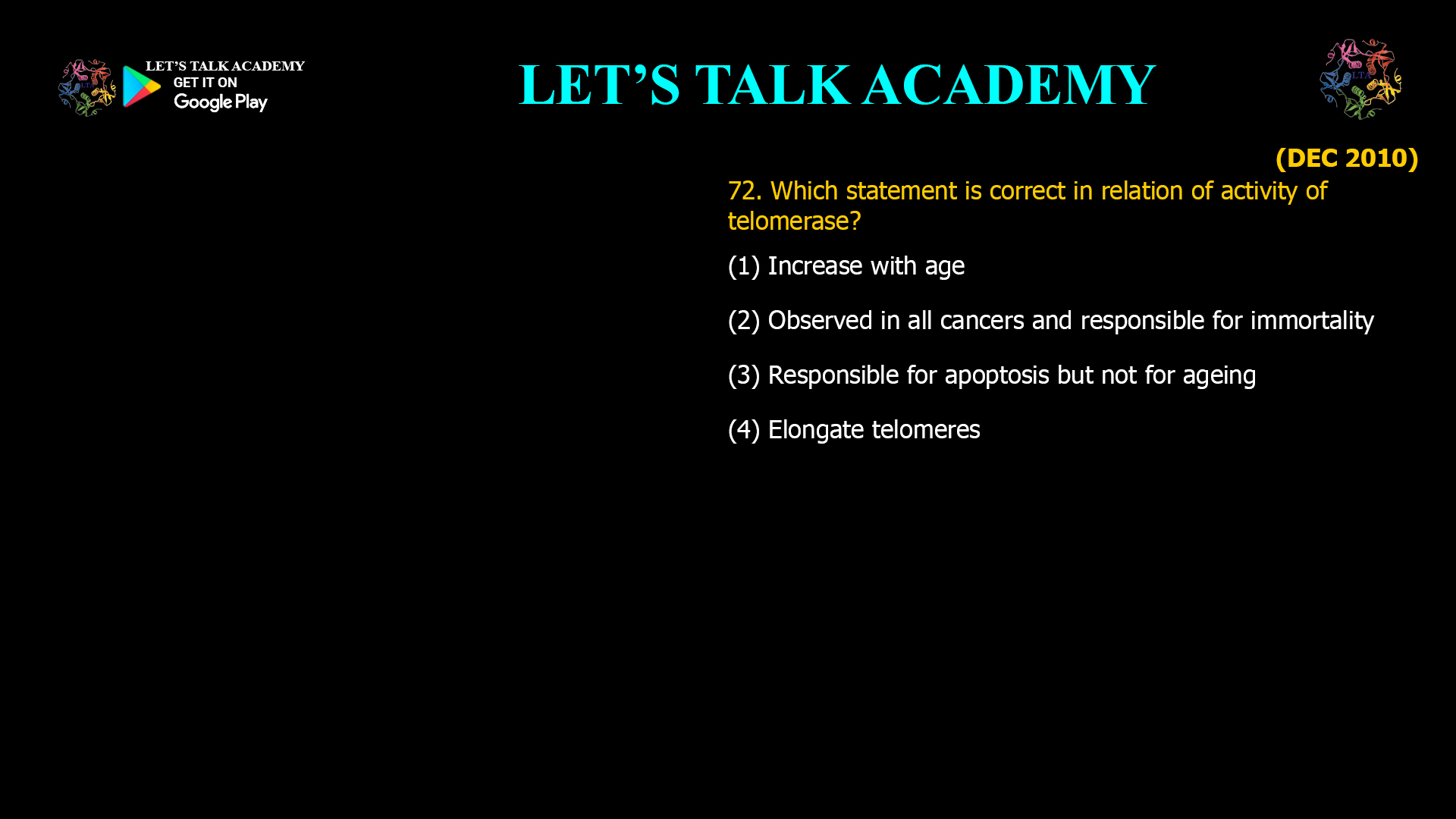
- Which statement is correct in relation of activity of telomerase?
(1) Increase with age
(2) Observed in all cancers and responsible for immortality
(3) Responsible for apoptosis but not for ageing
(4) Elongate telomeres
Introduction
Telomerase is a specialized enzyme complex that maintains the length of telomeres — the protective caps at the ends of chromosomes. Its activity is intricately linked to cellular aging, cancer progression, and genome stability. Understanding the dynamics of telomerase activity provides insights into age-related diseases and cancer biology.
What Is Telomerase Activity?
Telomerase is an RNA-dependent DNA polymerase that adds repetitive nucleotide sequences to the ends of chromosomes, compensating for the shortening that occurs during DNA replication. This activity is crucial for maintaining telomere length and, consequently, the replicative capacity of cells.
Analysis of the Statements
-
Telomerase activity increases with age
-
Incorrect. In most human somatic cells, telomerase activity is low or absent and does not increase with age. Instead, telomeres progressively shorten as cells divide, contributing to aging and cellular senescence.
-
-
Telomerase activity is observed in all cancers and responsible for immortality
-
Partially correct but not absolute. Telomerase activity is detected in over 85% of malignant tumors, enabling cancer cells to maintain telomere length and achieve replicative immortality. However, some cancers use alternative lengthening mechanisms, so telomerase is not universally active in all cancers.
-
-
Telomerase is responsible for apoptosis but not for aging
-
Incorrect. Telomerase prevents apoptosis and cellular aging by maintaining telomere length. Telomere shortening, not telomerase activity, triggers apoptosis and senescence.
-
-
Telomerase elongates telomeres
-
Correct. The primary function of telomerase is to add telomeric repeats to chromosome ends, thereby elongating telomeres and maintaining genome stability.
-
Telomerase and Aging
-
Telomerase activity is generally low in most somatic cells, leading to gradual telomere shortening with each cell division.
-
Shortened telomeres signal replicative senescence or apoptosis, contributing to the aging process and age-related diseases.
-
Stem cells and certain immune cells retain telomerase activity to support tissue renewal.
-
Studies suggest that maintaining telomerase activity or telomere length may delay aging phenotypes.
Telomerase and Cancer
-
Reactivation of telomerase is a hallmark of many cancers, granting cells the ability to divide indefinitely.
-
Telomerase expression correlates with tumor progression and poor prognosis in various cancers.
-
Targeting telomerase is a promising therapeutic strategy in oncology.
Summary Table
| Statement | Correctness | Explanation |
|---|---|---|
| Telomerase activity increases with age | Incorrect | Activity generally declines or remains low with age |
| Telomerase activity observed in most cancers; causes immortality | Mostly correct | Present in >85% cancers, enabling unlimited division |
| Telomerase causes apoptosis but not aging | Incorrect | Telomerase prevents apoptosis and delays aging |
| Telomerase elongates telomeres | Correct | Primary function is telomere extension |
Conclusion
The correct statement regarding telomerase activity is that it elongates telomeres (option 4). Telomerase plays a pivotal role in maintaining chromosome ends, thereby influencing cellular aging and cancer development. While telomerase activity is low in most normal somatic cells and does not increase with age, it is reactivated in the majority of cancers, contributing to cellular immortality. Understanding telomerase dynamics is essential for developing anti-aging and cancer therapies.
Keywords
telomerase activity, telomere elongation, aging, cellular senescence, cancer immortality, telomere shortening, replicative senescence, telomerase in cancer, genome stability, telomerase regulation
Final answer:
(4) Elongate telomeres


30 Comments
Priya khandal
July 27, 2025Done sir
Surbhi Rajawat
July 29, 2025Correct option is D that telomeres are elongated by telomerase but it is also true that high telomerase activity is found in most cancerous cells
Priya dhakad
July 29, 2025The correct answer is D , telomeres are elongated by telomerase
Priya dhakad
July 29, 2025The correct answer is D , telomeres are elongated by telomerase .
Priya dhakad
July 29, 2025The correct answer is D
anurag giri
July 29, 2025Option 2-4 are correct bcoz cancerous cell have telomeres activity and telomeres primary function is telomeres extension
Pratibha
July 29, 2025Correct option is option( 4 ) Elongate telomeres
It adds DNA to the ends of chromosomes and prevent shortening .
Kajal
July 29, 2025Option 4 is correct
Telomerase function is to add telomeric repeats to chromosome end
Khushi Agarwal
July 29, 2025Option 4 is correct answer
It extends the dna strand
Anisha jakhar
July 29, 2025Correct answer is D. Telomerase elongate the telomere.
Aman Choudhary
July 29, 2025Option 4 is correct telomerase extend telomere
Dipti Sharma
July 29, 2025Although option 2 also seems correct but as in explanation, telomerase not present in all cancerous cells but only upto 85% so option 4 is correct .
Juber Khan
July 30, 2025Firstly I select the right option 2 but after read solution 🙂~ telomerase activity is detected in 85% of malignant tumors.. telomerase is not active in all cancer cell
Telomere elongation= cell immortality
Shivani
July 30, 2025Option 2 is seems correct but as per explanation telomerase activity detected upto 85 % cancerous cells but not in all. Primary function of telomerase is telomer extention so option 4 is correct.
Santosh Saini
July 30, 2025Option 4 is correct be. Telomerase synthesize repetitive seq. For extension of telomere
Soniya Shekhawat
July 30, 20254th is also true that telomerse extend telomeres that is primary function but statement 2 is also correct but only 85%cancerous cell have telomeres is present and remaining is not present so more correct is 4 th option
Mansukh Kapoor
July 30, 2025The correct answer is option 4th because telomerase have the primary function to maintain the ends of telomere
Payal Gaur
July 30, 20254. elongate telomere
Niti Tanwar
July 30, 2025Answer is 4 elongate telomerse
Manisha choudhary
July 30, 2025Done sir 👍🏻
Telomerase kaa primary function telomere ko elongate Krna h
Malignant tumors (cancer) m approximate 85% tk telomere ki activity dekhi gyi h pr kuch cancer m cell alternative mechanism k through telomere ki length ko bnaye rkhti h isliye y statment partially sahi universally nhi
Somatic cell yaa too telomerase absent hota h yaa bht low hota pr age k sath increase nhi hota h
SURAJ SIR KI LINE M
Y too blunder h 😁
HIMANI FAUJDAR
July 31, 2025Correct answer is 4 , Telomerase responsible for elongate the telomere.
Vanshika Sharma
July 31, 2025Opt 4;8# correct bcz telomerase is play primary role to add telomeric repeat at the end of dna
Mohini
August 2, 2025Option 4: telomerase elongates the telomere. Telomerase activity does not increase with age, and it is also involved in the regulation of apoptosis and aging. Telomerase activity is detectable in most cancers but not in all cancers.
Mahima Sharma
August 3, 2025Telomerase elongate telomear
Deepika sheoran
August 4, 2025Option 4th is correct answer
Because elongate telomere.
Deepika sheoran
August 7, 2025Option 4th is correct answer
Elongate telomere
Deepika sheoran
August 8, 2025Elongate telomeres
Aafreen Khan
August 23, 20254- Elongate Telomeres bcoz Primary function is telomere extension
Nilofar Khan
August 23, 2025Correct answer is (4) Elongate telomeres
Deepika Sheoran
November 7, 2025Elongate telomeres.