When species express a suite of correlated traits (e.g., behavior, morphology, function), within a given context or across contexts, it is referred to as (1) A syndrome (2) Trait flexibility […]

No posts found.
When species express a suite of correlated traits (e.g., behavior, morphology, function), within a given context or across contexts, it is referred to as (1) A syndrome (2) Trait flexibility […]
Which of the following is NOT the function of dispersal behaviour in which organisms move away from their natal homes? (1) Tracking resource availability (2) Providing mating opportunities (3) Preventing […]
Measurement of distance based on counting steps or number of vertical bars by insects for navigation is called (1) Path integration. (2) Allocentric coding. (3) Odometry. (4) Alignment image-matching. […]
The mechanism by which ants find their way back to the nests after searching and finding food is: (1) Migration (2) Topographical mapping (3) Piloting (4) Path integration What […]
Homing pigeons, when released at a place far away from their home, use earth’s magnetic field or the sun as navigational cues and choose the right direction to fly. To […]
Starling birds orient themselves by sunlight during migration. If they are kept in captivity with artificial light source form one direction, then (1) They will stop migration (2) They will […]
Which of the following is the major environmental cue for migration of birds during winter? (1) Duration of day length (2) Earth magnetism (3) Falling temperature (4) Land marks […]
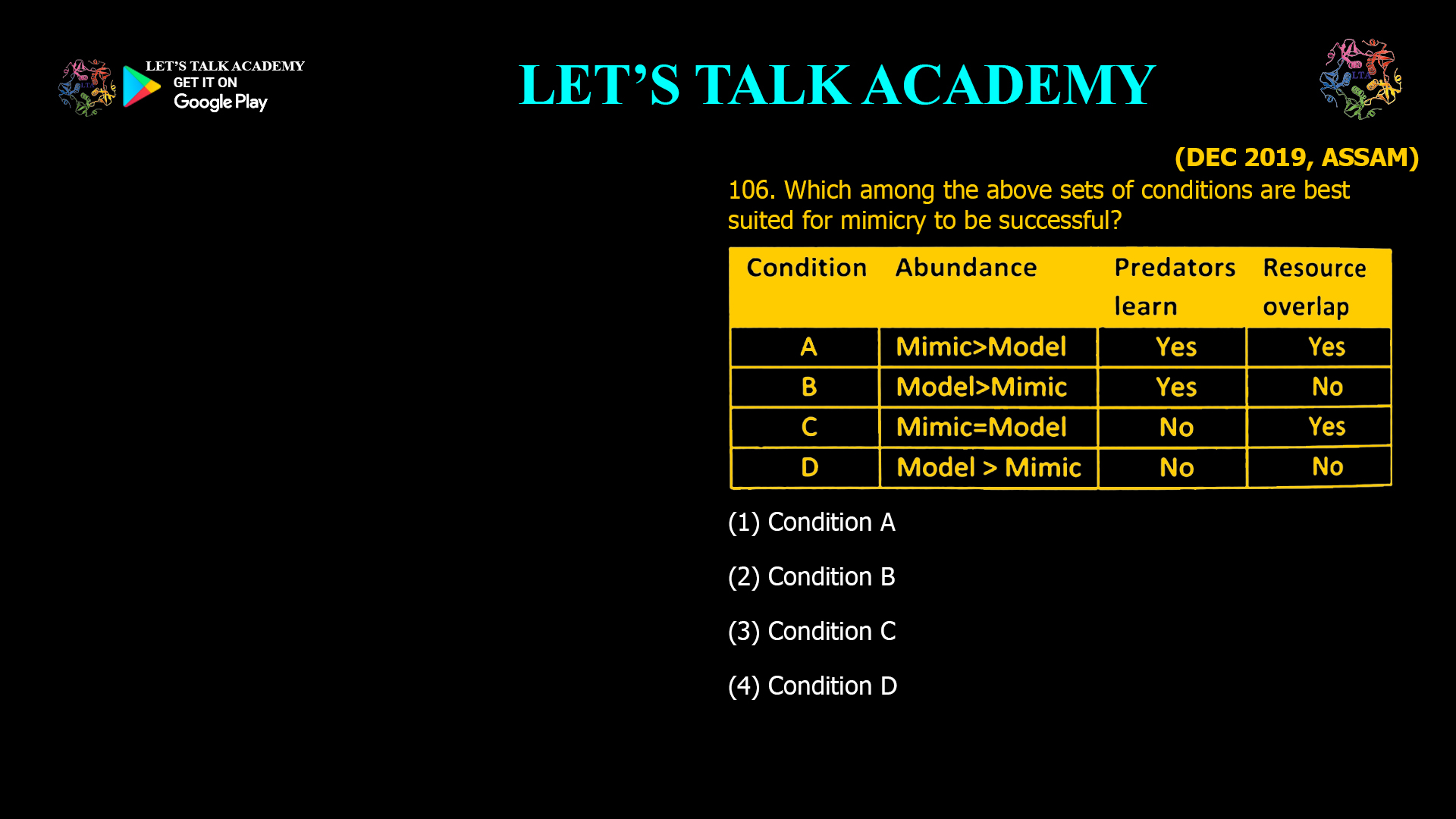
Which among the above sets of conditions are best suited for mimicry to be successful? (1) Condition A (2) Condition B (3) Condition C (4) Condition D Key Factors […]
The Population of the Non-poisonous butterflies have the same the color pattern as some highly poisonous butterflies. Assume that the population of non- poisonous butterflies is higher than the poisonous […]
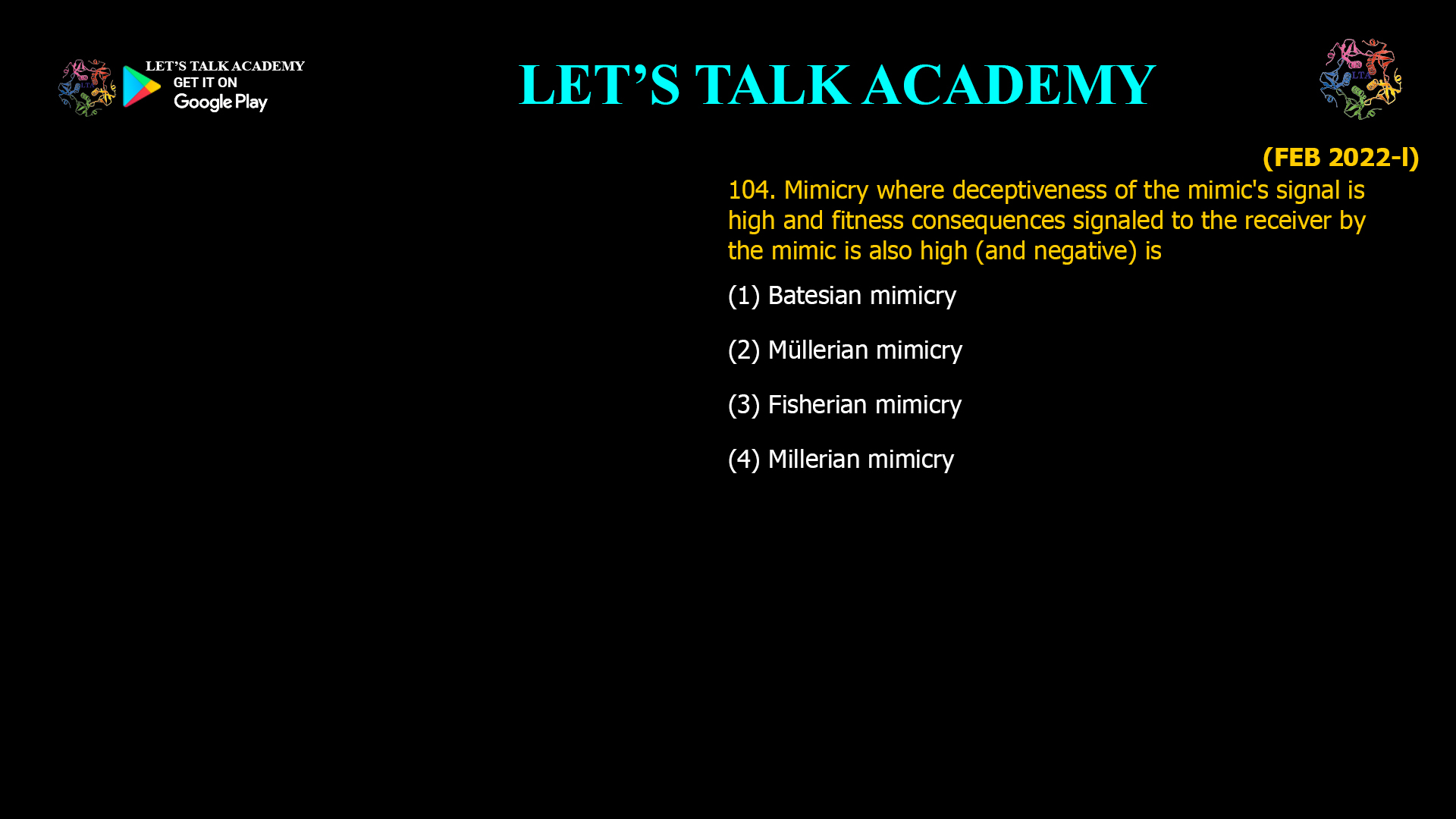
Mimicry where deceptiveness of the mimic’s signal is high and fitness consequences signaled to the receiver by the mimic is also high (and negative) is (1) Batesian mimicry (2) Müllerian […]


