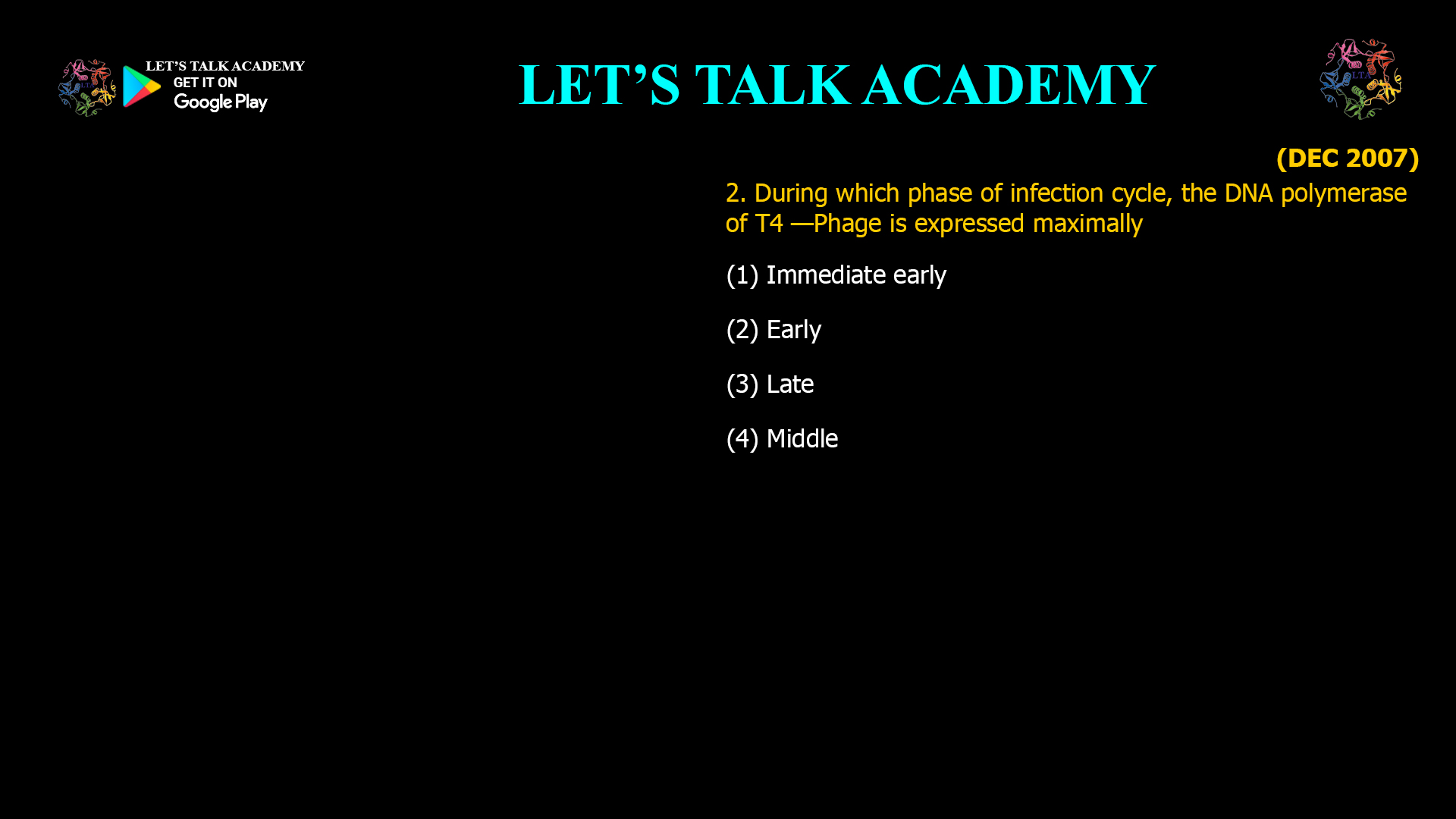
2. During which phase of infection cycle, the DNA polymerase ofT4 —Phage is expressed maximally
(1) Immediate early (2) Early
(3) Late (4) Middle
Bacteriophage T4 is a well-studied virus that infects Escherichia coli and orchestrates a complex infection cycle involving tightly regulated gene expression. One critical enzyme in this process is the DNA polymerase, which replicates the phage genome to produce progeny viruses. Understanding when DNA polymerase is expressed maximally during the T4 infection cycle provides insight into viral replication strategies.
Phases of T4 Infection Cycle
The T4 infection cycle is divided into phases based on the timing of gene expression:
-
Immediate Early Phase: Genes expressed immediately after infection, often involved in taking over host machinery.
-
Early Phase: Genes expressed soon after immediate early genes, including those involved in DNA replication.
-
Middle Phase: Transitional genes preparing for structural protein synthesis.
-
Late Phase: Genes encoding structural proteins and assembly factors for new phage particles.
DNA Polymerase Expression in T4 Infection
DNA polymerase is essential for replicating the phage DNA. According to studies and molecular data:
-
DNA polymerase expression peaks during the early phase of infection.
-
This timing aligns with the need to replicate the phage genome before assembling new viral particles.
-
Early gene expression includes DNA replication enzymes such as DNA polymerase, primase, and helicase.
-
After DNA replication is underway, middle and late genes focus on structural proteins and packaging.
Supporting Evidence
-
Research shows that DNA replication begins approximately 10 minutes after infection, coinciding with early gene expression.
-
The DNA polymerase holoenzyme complex, including the catalytic subunit gp43, is synthesized during this early phase.
-
Early expression ensures sufficient enzyme availability for rapid genome replication.
Why Other Phases Are Less Likely
-
Immediate Early: Focuses on regulatory proteins, not DNA replication enzymes.
-
Middle: Involves transition genes, not maximal DNA polymerase expression.
-
Late: Primarily structural genes; DNA replication is mostly complete.
Summary Table
| Phase | DNA Polymerase Expression | Role in Infection Cycle |
|---|---|---|
| Immediate Early | Low | Regulatory proteins |
| Early | Maximal | DNA replication enzymes expressed |
| Middle | Moderate | Transition to structural gene expression |
| Late | Low | Structural proteins and assembly |
Conclusion
The DNA polymerase of bacteriophage T4 is expressed maximally during the early phase of the infection cycle. This timing ensures that the phage genome is replicated efficiently before the production of structural proteins and assembly of new virions in the later stages.
Correct Answer:
(2) Early


1 Comment
Santosh Saini
November 3, 2025Early phase