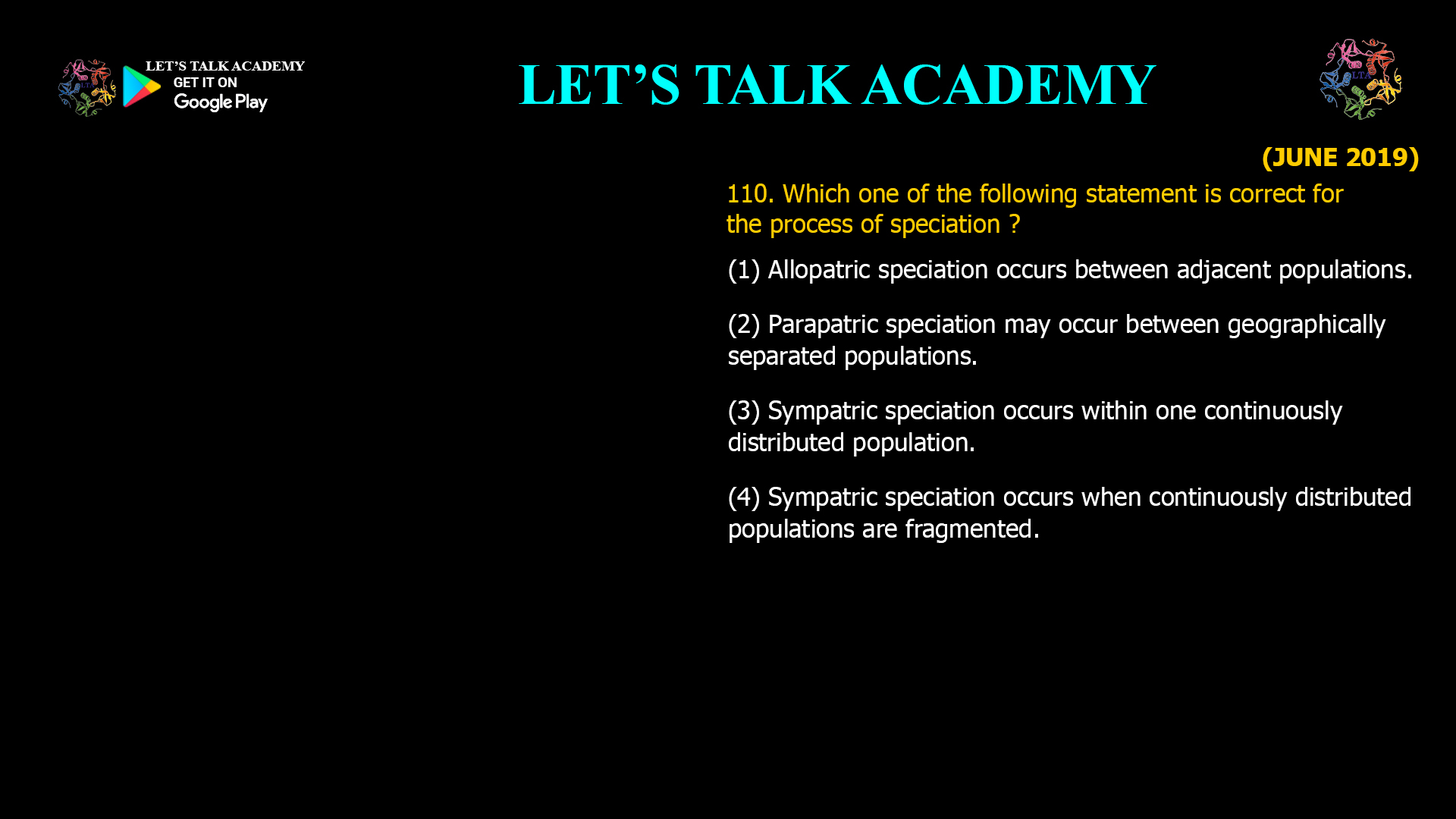
- Which one of the following statement is correct for the process of speciation ?
(1) Allopatric speciation occurs between adjacent populations.
(2) Parapatric speciation may occur between geographically separated populations.
(3) Sympatric speciation occurs within one continuously distributed population.
(4) Sympatric speciation occurs when continuously distributed populations are fragmented.What is Sympatric Speciation?
Sympatric speciation is the evolutionary process by which new species arise from a single ancestral species while inhabiting the same geographic region. In other words, the population is not split by any physical barrier; instead, new species evolve within one continuous population. This is in contrast to allopatric speciation, where physical barriers such as mountains, rivers, or oceans separate populations, leading to divergence.
How Does Sympatric Speciation Occur?
Sympatric speciation typically involves mechanisms that reduce gene flow within a population, even though all individuals live in the same area. Some common mechanisms include:
-
Genetic mutations: Sudden genetic changes, such as polyploidy (especially in plants), can instantly create reproductive isolation.
-
Behavioral changes: Differences in mating preferences, feeding habits, or activity patterns can lead to reproductive isolation.
-
Ecological specialization: Individuals may exploit different resources or niches within the same environment, leading to divergent evolution.
Example: Polyploidy in Plants
Polyploidy is a common cause of sympatric speciation in plants. When an error during cell division results in offspring with extra sets of chromosomes, these polyploid individuals can become reproductively isolated from the original population. They can only mate with other polyploids, not with the diploid ancestors, leading to the rapid formation of a new species—all within the same geographic area.
Example: Cichlid Fish in African Lakes
In some African lakes, cichlid fish have diversified into hundreds of species, all living in the same body of water. Differences in feeding strategies, coloration, and mating behaviors have led to reproductive isolation and the emergence of new species without geographic separation.
Why is Sympatric Speciation Important?
Sympatric speciation challenges the traditional view that physical barriers are necessary for the formation of new species. It demonstrates that evolutionary forces such as natural selection, sexual selection, and genetic drift can drive speciation even when populations are not physically separated. This has profound implications for our understanding of biodiversity, adaptation, and the mechanisms of evolution.
Comparing Different Types of Speciation
To better understand sympatric speciation, let’s compare it with other forms:
Type of Speciation Geographic Separation? Example Mechanism Example Organisms Allopatric Yes Physical barriers (mountains, rivers) Darwin’s finches, squirrels Parapatric Partial (adjacent populations with limited gene flow) Environmental gradients Grasses on mine tailings Sympatric No Polyploidy, behavioral/ecological shifts Cichlid fish, plants Correct Statement About Speciation
Given the options:
-
Allopatric speciation occurs between adjacent populations.
-
Parapatric speciation may occur between geographically separated populations.
-
Sympatric speciation occurs within one continuously distributed population.
-
Sympatric speciation occurs when continuously distributed populations are fragmented.
The correct statement is:
Sympatric speciation occurs within one continuously distributed population.
This means that new species can evolve from a single ancestral population without any physical separation, solely through genetic, behavioral, or ecological mechanisms that lead to reproductive isolation.
Why Other Statements Are Incorrect
-
Option 1: Allopatric speciation requires a physical barrier, not just adjacency.
-
Option 2: Parapatric speciation occurs in populations that are adjacent but not completely separated.
-
Option 4: Sympatric speciation does not involve fragmentation; it happens within a continuous population.
The Significance of Sympatric Speciation in Evolution
Sympatric speciation highlights the complexity and flexibility of evolutionary processes. It shows that nature can generate new species even in the absence of obvious barriers, contributing to the rich tapestry of life we see today. This process is especially important in environments where physical barriers are absent but ecological or behavioral diversity is high.
Conclusion
Sympatric speciation is a remarkable evolutionary process that allows new species to emerge within a single, continuously distributed population. By understanding how sympatric speciation works, we gain deeper insight into the mechanisms of evolution and the origins of biodiversity. Whether through genetic mutations, ecological specialization, or behavioral changes, sympatric speciation reminds us that the forces of evolution are always at work—sometimes in the most unexpected places.
Correct answer:
(3) Sympatric speciation occurs within one continuously distributed population. -