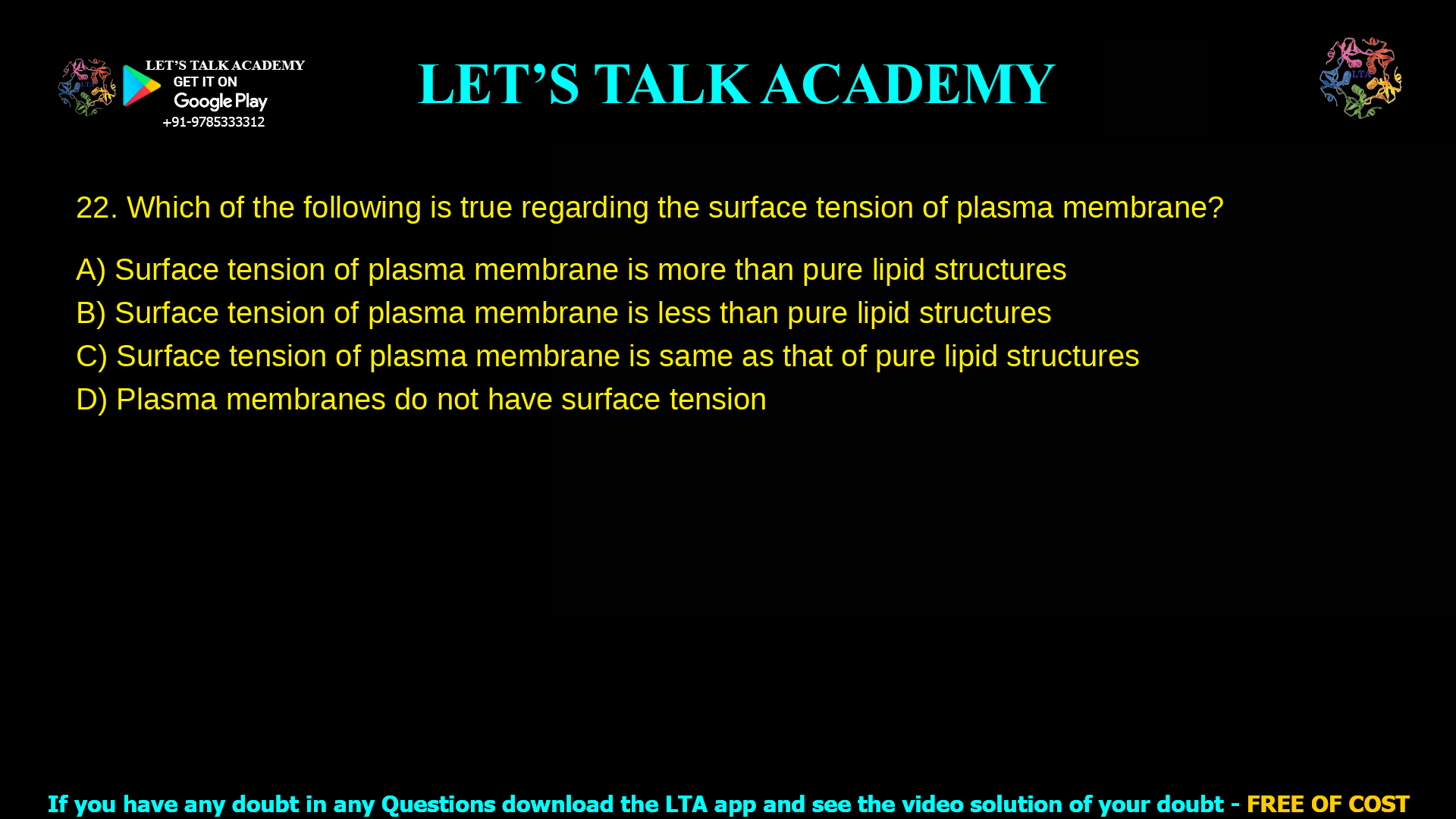
7. Which of the following is true regarding the surface tension of plasma membrane?
a. Surface tension of plasma membrane is more than pure lipid structures
b. Surface tension of plasma membrane is less than pure lipid structures
c. Surface tension of plasma membrane is same as that of pure lipid structures
d. Plasma membranes do not have surface tension
The correct answer is: b. Surface tension of plasma membrane is less than pure lipid structures.
Introduction
Surface tension of biological membranes is a key biophysical property that influences membrane stability, curvature, and function in living cells. Comparing the plasma membrane with pure lipid bilayers helps explain why biological membranes behave differently from idealized lipid systems in model experiments.
Concept of surface tension in membranes
Surface tension in the context of cell membranes refers to the effective in-plane tension acting within the lipid bilayer plus contributions from its interaction with the underlying cytoskeleton. In pure lipid bilayers or vesicles, surface tension is largely determined by lipid packing and interfacial energy at the lipid–water boundary, whereas in real plasma membranes proteins and cytoskeletal attachments modify this behavior.
In many theoretical treatments, an ideal lipid bilayer in water tends toward a state of very low or near-zero surface tension because lipids rearrange to minimize free energy and optimize packing. In contrast, actual cell membranes experience additional mechanical constraints such as membrane-to-cortex attachment and protein crowding, which alter the effective tension distribution, but the average cohesive surface tension of the plasma membrane is still considered lower than that of “pure” lipid monolayers or simple lipid–air interfaces.
Why the correct option is (b)
Statement (b): Surface tension of plasma membrane is less than pure lipid structures – this is considered true in the context of basic cell biology MCQs. Pure lipid structures like artificial lipid monolayers or simple bilayers at interfaces often exhibit higher interfacial or surface tension because they lack proteins, carbohydrates, and cytoskeletal coupling that can buffer and redistribute mechanical stress.
Biological plasma membranes are complex, containing lipids, cholesterol, integral and peripheral proteins, and cytoskeletal attachments, all of which reduce and regulate effective surface tension compared with simple, pure lipid phases. These additional components make the membrane more compliant and capable of local deformation without requiring as high a cohesive surface tension as a pure lipid interface.
Why option (a) is incorrect
Statement (a): Surface tension of plasma membrane is more than pure lipid structures – this is not correct for standard exam-level reasoning. In simple model systems, pure lipid monolayers or bilayers at interfaces can display relatively high interfacial tension, because the only contributors are lipid–lipid and lipid–medium interactions.
In contrast, the cell plasma membrane is a regulated, composite structure; proteins, cytoskeletal attachments, and membrane reservoirs (like folds and invaginations) allow area changes with less increase in effective tension, so the plasma membrane is not typically described as having greater surface tension than pure lipid structures.
Why option (c) is incorrect
Statement (c): Surface tension of plasma membrane is same as that of pure lipid structures – this is also incorrect. Pure lipid systems and biological plasma membranes differ in composition (lipid-only vs lipid–protein–carbohydrate), organization, and mechanical coupling, so their surface tensions cannot be assumed to be identical.
Experimental and theoretical studies show that the presence of proteins, cholesterol, and cytoskeleton changes both the magnitude and spatial distribution of membrane tension compared with pure lipid bilayers or monolayers. Therefore, equating their surface tensions ignores key structural and functional differences between model lipid films and true cellular membranes.
Why option (d) is incorrect
Statement (d): Plasma membranes do not have surface tension – this is clearly false. Cell membranes exhibit measurable effective membrane tension that influences processes such as endocytosis, exocytosis, mechanosensitive channel activity, and cell shape changes.
Membrane surface tension arises from in-plane lipid tension and membrane–cytoskeleton adhesion; it is a central parameter in mechanobiology and is routinely quantified using techniques such as tether pulling and micropipette aspiration. Thus, plasma membranes certainly do possess surface tension, though it is dynamic, regulated, and often lower than that of idealized pure lipid interfaces.
Short exam-oriented summary
-
Correct option: (b) Surface tension of plasma membrane is less than pure lipid structures.
-
Pure lipid structures: higher interfacial/surface tension due to simple lipid-only interface.
-
Plasma membrane: complex lipid–protein–cytoskeleton system with regulated, generally lower effective surface tension compared with pure lipid structures.


