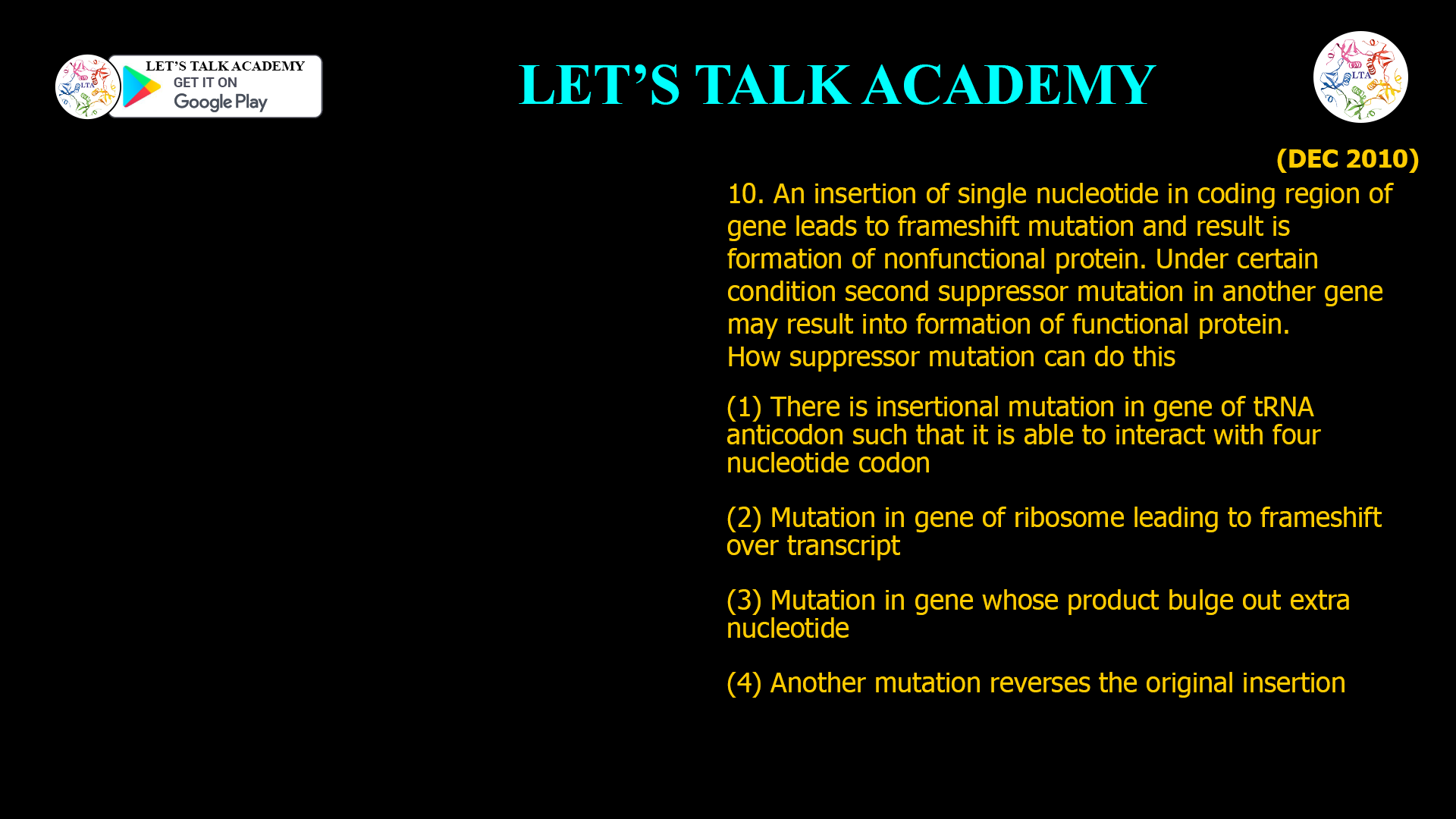
10. An insertion of single nucleotide in coding region of gene leads to frameshift mutation and result is formation of nonfunctional protein. Under certain condition second suppressor mutation in another gene may result into formation of functional protein. How suppressor mutation can do this
(1) There is insertional mutation in gene of tRNA anticodon such that it is able to interact with four nucleotide codon
(2) Mutation in gene of ribosome leading to frameshift over transcript
(3) Mutation in gene whose product bulge out extra nucleotide
(4) Another mutation reverses the original insertion
Introduction:
Frameshift mutations caused by a single nucleotide insertion in a gene’s coding region disrupt the reading frame, leading to nonfunctional proteins. However, under certain conditions, a second suppressor mutation in another gene can restore the production of a functional protein by compensating for the original frameshift. This article explains how suppressor mutations achieve this by examining different molecular mechanisms, including tRNA changes, ribosomal mutations, product interactions, and reverse mutations.
Explanation of Options:
-
Insertional mutation in tRNA anticodon gene enabling interaction with four-nucleotide codon:
This type of suppressor mutation allows a tRNA molecule’s anticodon to read four nucleotides instead of the usual three. This extra nucleotide recognition can compensate for the frameshift by realigning the reading frame during translation, effectively restoring correct amino acid sequence after the frameshift site. It is a classic example of an intergenic suppressor that rescues the frameshift by translational recoding. -
Mutation in ribosomal gene leading to frameshift over transcript:
A mutation in the ribosomal components could induce a programmed frameshift during translation, forcing the ribosome to shift the reading frame deliberately. This can counteract the original frameshift mutation but in practice is less common and may disrupt overall translation fidelity, potentially causing more harm than benefit. -
Mutation in gene whose product bulges out extra nucleotide:
This mechanism involves a gene product that modifies the mRNA or nascent transcript by bulging out or looping out the extra nucleotide inserted in the original gene. By physically removing or ignoring the extra nucleotide during translation, the reading frame is restored, enabling the synthesis of a functional protein despite the insertion. -
Another mutation reverses the original insertion:
This is a direct reversion or compensatory mutation where a second mutation deletes the originally inserted nucleotide. If this second mutation occurs near the first and removes the extra base, the original reading frame is restored, leading to a functional protein. This type of suppressor mutation is often intragenic but can also occur intergenically if it affects interacting sequences.
Choosing the Correct Answer:
The best-known mechanism by which a suppressor mutation rescues a frameshift caused by a single nucleotide insertion is typically through the first option—an insertional mutation in the gene coding for the tRNA anticodon that enables it to read four nucleotides instead of three. This altered tRNA restores the reading frame during translation without reversing the original mutation directly.
Hence, option (1) is the correct answer.
This is because suppressor mutations often work by compensating translationally (such as altered tRNA decoding), rescuing phenotypic effects without changing the original mutation. Options (2) and (3) are less frequently observed natural mechanisms, and (4) describes a true reverse mutation rather than a suppressor mutation.
References to fundamental principles of suppressor mutations show they either restore reading frames at the translational level or via compensatory deletions/insertions nearby.
This detailed insight aids students and educators preparing for genetics exams, especially those focusing on mutations and gene expression regulation.
If you want, I can also provide a structured SEO article format with headings and bullet points.


