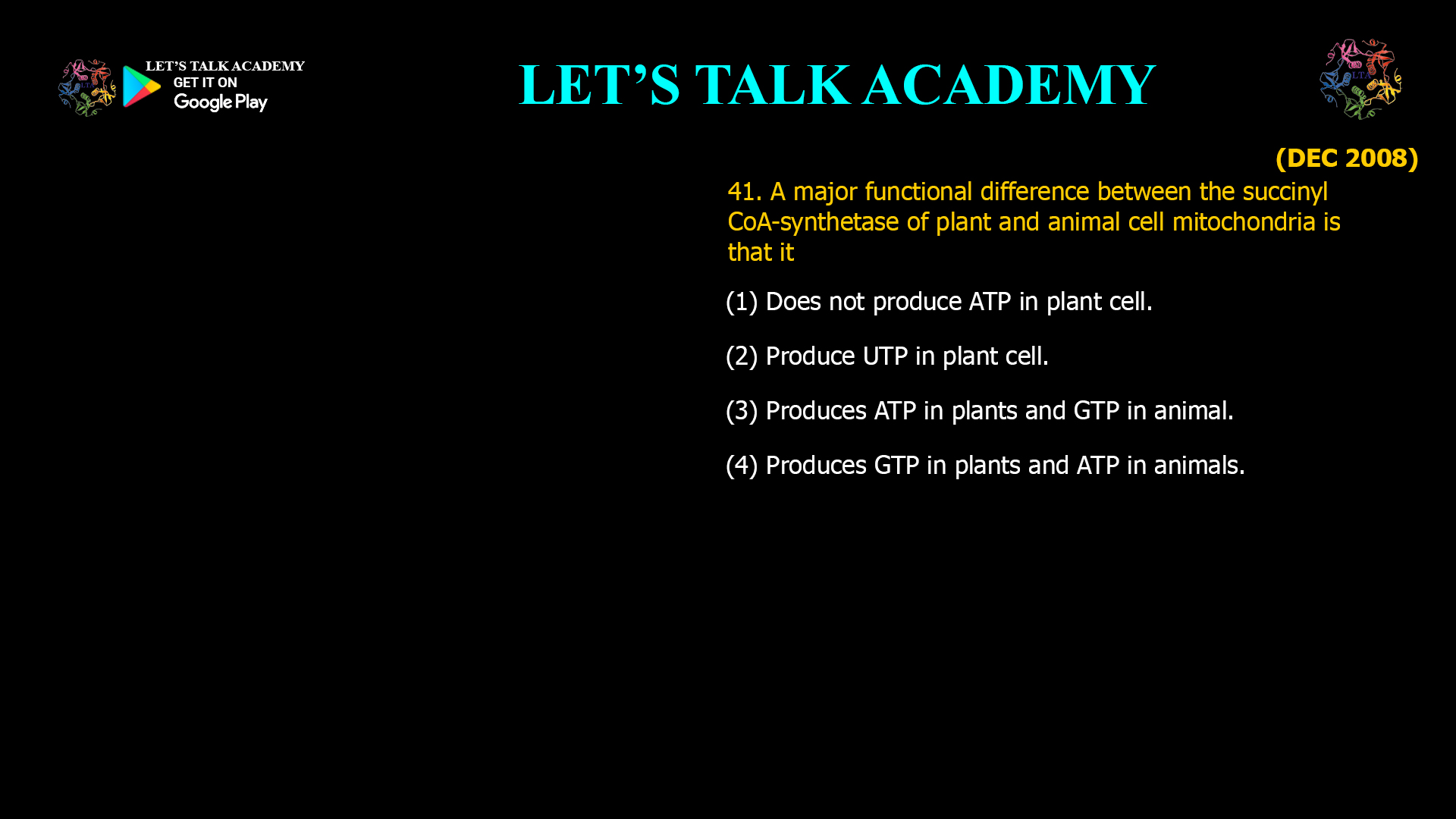
- A major functional difference between the succinyl CoA-synthetase of plant and animal cell mitochondria is that it
(1) Does not produce ATP in plant cell.
(2) Produce UTP in plant cell.
(3) Produces ATP in plants and GTP in animal.
(4) Produces GTP in plants and ATP in animals.Succinyl-CoA synthetase (SCS) is a critical enzyme in the tricarboxylic acid (TCA) cycle that catalyzes the substrate-level phosphorylation step converting succinyl-CoA to succinate. A notable functional difference exists between the enzyme in plant and animal mitochondria concerning the type of nucleoside triphosphate produced during this reaction.
This article explains this difference and its metabolic significance.
Succinyl-CoA Synthetase and Nucleoside Triphosphate Production
-
SCS catalyzes the reversible reaction:
Succinyl-CoA+NDP+Pi↔Succinate+CoA+NTP
where NDP is a nucleoside diphosphate (ADP or GDP) and NTP is the corresponding nucleoside triphosphate (ATP or GTP).
-
The enzyme facilitates substrate-level phosphorylation, generating either ATP or GTP depending on the isoform and organism.
Differences Between Plants and Animals
-
In plants:
Succinyl-CoA synthetase primarily produces ATP during the conversion of succinyl-CoA to succinate in mitochondria. This ATP contributes directly to the cellular energy pool. -
In animals:
Two isoforms of SCS exist: one specific for ATP and another specific for GTP. The GTP-producing isoform is prevalent in tissues involved in anabolic metabolism (e.g., liver, kidney), while the ATP-specific isoform is found in tissues with high oxidative metabolism (e.g., heart, skeletal muscle). -
This difference reflects tissue-specific metabolic demands and regulatory mechanisms.
Summary Table
Organism Nucleoside Triphosphate Produced by SCS Notes Plants ATP Major isoform in plant mitochondria Animals GTP (anabolic tissues), ATP (catabolic tissues) Isoform expression varies by tissue Conclusion
The major functional difference between succinyl-CoA synthetase in plant and animal mitochondria is that it:
-
Produces ATP in plants
-
Produces GTP in animals
This distinction highlights metabolic specialization across species and tissues.
Correct answer: (3) Produces ATP in plants and GTP in animal
title: Major Functional Difference Between Succinyl-CoA Synthetase in Plant and Animal Mitochondria
slug: succinyl-coa-synthetase-plant-vs-animal-mitochondria
meta-description: Explore how succinyl-CoA synthetase differs between plants and animals, producing ATP in plants and GTP in animals, and understand the implications for energy metabolism.
Succinyl-CoA synthetase (SCS) is a critical enzyme in the tricarboxylic acid (TCA) cycle that catalyzes the substrate-level phosphorylation step converting succinyl-CoA to succinate. A notable functional difference exists between the enzyme in plant and animal mitochondria concerning the type of nucleoside triphosphate produced during this reaction.
This article explains this difference and its metabolic significance.
Succinyl-CoA Synthetase and Nucleoside Triphosphate Production
-
SCS catalyzes the reversible reaction:
Succinyl-CoA+NDP+Pi↔Succinate+CoA+NTP
where NDP is a nucleoside diphosphate (ADP or GDP) and NTP is the corresponding nucleoside triphosphate (ATP or GTP).
-
The enzyme facilitates substrate-level phosphorylation, generating either ATP or GTP depending on the isoform and organism.
Differences Between Plants and Animals
-
In plants:
Succinyl-CoA synthetase primarily produces ATP during the conversion of succinyl-CoA to succinate in mitochondria. This ATP contributes directly to the cellular energy pool. -
In animals:
Two isoforms of SCS exist: one specific for ATP and another specific for GTP. The GTP-producing isoform is prevalent in tissues involved in anabolic metabolism (e.g., liver, kidney), while the ATP-specific isoform is found in tissues with high oxidative metabolism (e.g., heart, skeletal muscle). -
This difference reflects tissue-specific metabolic demands and regulatory mechanisms.
Summary Table
Organism Nucleoside Triphosphate Produced by SCS Notes Plants ATP Major isoform in plant mitochondria Animals GTP (anabolic tissues), ATP (catabolic tissues) Isoform expression varies by tissue Conclusion
The major functional difference between succinyl-CoA synthetase in plant and animal mitochondria is that it:
-
Produces ATP in plants
-
Produces GTP in animals
This distinction highlights metabolic specialization across species and tissues.
Correct answer: (3) Produces ATP in plants and GTP in animal
-


26 Comments
Kirti Agarwal
September 18, 2025Produce ATP in plants and GTP in qnimals
Neha Yadav
September 20, 2025Produces ATP in plants and produces GTP (anabolic tissue ) and ATP ( catabolic tissue )in animals
Bhawna Choudhary
September 21, 2025Produces ATP in plants and GTP in animal
Sonal Nagar
September 22, 2025Produces ATP in plants and GTP in animal
Option 3
Aafreen Khan
September 23, 2025Produces ATP in plants and GTP in animal
In Animals GTP in anabolic tissues ATP in catabolic tissues.
Dharmpal Swami
September 23, 2025Produce ATP in Plants and GTP in animals
Pallavi Ghangas
September 23, 2025Produces ATP in plants
Produces GTP in animals
Aakansha sharma Sharma
September 23, 2025(3) Produces ATP in plants and GTP in animal.
Roopal Sharma
September 24, 20253rd option is correct atp in plants and gtp in animals
Heena Mahlawat
September 24, 2025Produces GTP in animals and ATP in plants
Nilofar Khan
September 24, 2025A major functional difference between the succinyl CoA-synthetase of plant and animal cell mitochondria is that it produce GTP in animal and produce ATP in plants
Deepika sheoran
September 24, 2025Produce ATP in plants and GTP in Animals.
Minal Sethi
September 24, 2025Produces ATP in plants and GTP in animal.
Mohd juber Ali
September 25, 2025Produces ATP in plants and GTP in animal
Muskan singodiya
September 25, 2025Produce ATP in plant
Produce GTP in animal
Soniya Shekhawat
September 25, 2025Produces ATP in plants and gtp in animal
Kavita Choudhary
September 26, 2025Produse ATP is plant and GTP in animals ATP is catabolic tissue and GTP is anabolic
Avni
September 26, 2025Correct answer: (3) Produces ATP in plants and GTP in animal
Varsha Tatla
September 27, 2025SS co A or produce ATP in plant >Pin animal
Arushi Saini
September 27, 2025Produces ATP in plants and GTP in animal
Payal Gaur
September 27, 2025Produce ATP in plants and GTP in animals
Kajal
October 2, 2025Produce ATP in plants and GTP in animals
Muskan Yadav
October 3, 2025Correct answer: (3) Produces ATP in plants and GTP in animal.
Santosh Saini
October 5, 2025Succinyl Co-A synthetase produce ATP during conversion of succinyl Co-A to succinate in plants , but in animals GTP is anabolic and ATP is catabolic
Khushi Vaishnav
October 7, 2025Produces ATP in plants and GTP in animal
Sakshi Kanwar
November 26, 2025Produces ATP in plants and produces GTP (anabolic tissue ) and ATP ( catabolic tissue )in animals