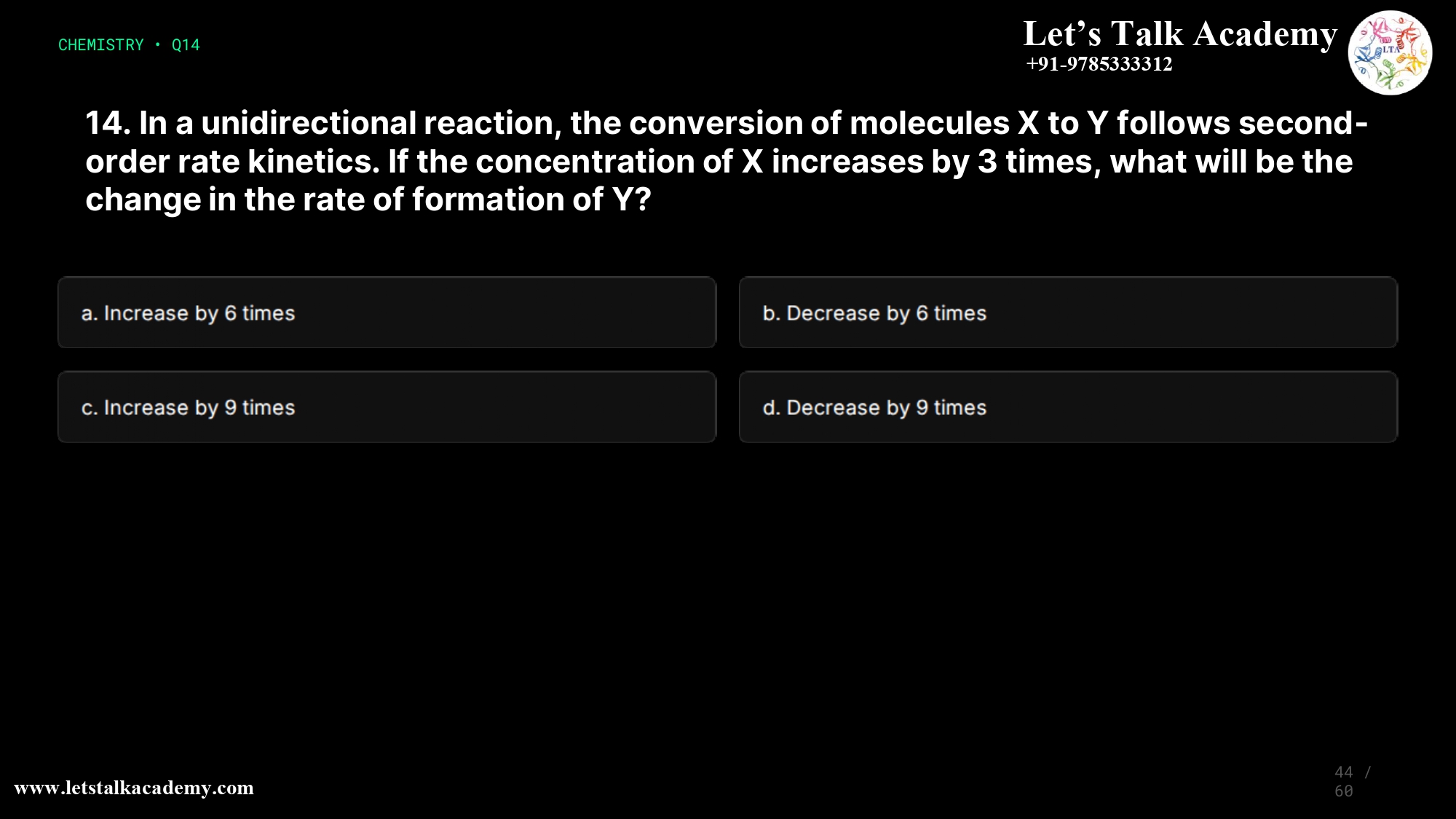
14. In a unidirectional reaction, the conversion of molecules X to Y follows second-order
rate kinetics. If the concentration of X increases by 3 times, what will be the change in
the rate of formation of Y?
a. Increase by 6 times
b. Decrease by 6 times
c. Increase by 9 times
d. Decrease by 9 times
The correct answer is c. Increase by 9 times. For the unidirectional reaction X → Y following second-order rate kinetics, the rate law is rate = k[X]², where rate equals the rate of Y formation. Initial rate R₁ = k[x]² with [X] = x. When [X] triples to 3x, new rate R₂ = k(3x)² = k·9x² = 9R₁, so the rate increases 9-fold.
Rate Law Derivation
Second-order kinetics for single reactant means rate depends on [X] squared, typical for bimolecular steps or enzyme saturation at high substrate. Ratio R₂/R₁ = {[3x]²}/[x]² = 9 confirms exact 9x increase, independent of k value. Biological examples include DNA strand association or some oxidase reactions.
Option Analysis
-
a. Increase by 6 times: Incorrect; implies mixed first/second-order (3×2), not pure second-order.
-
b. Decrease by 6 times: Wrong; higher [X] accelerates second-order rates, never slows.
-
c. Increase by 9 times: Correct; (3)² = 9 from rate law.
-
d. Decrease by 9 times: Impossible; inverse kinetics (zero-order) unrelated.
| Order | [X] ×3 Effect | Rate Law | CSIR NET Example |
|---|---|---|---|
| Zero | No change (×1) | rate = k | Enzyme saturation |
| First | ×3 | rate = k[X] | Many decays |
| Second | ×9 | rate = k[X]² | This MCQ |
| Third | ×27 | rate = k[X]³ | Rare trimolecular |


