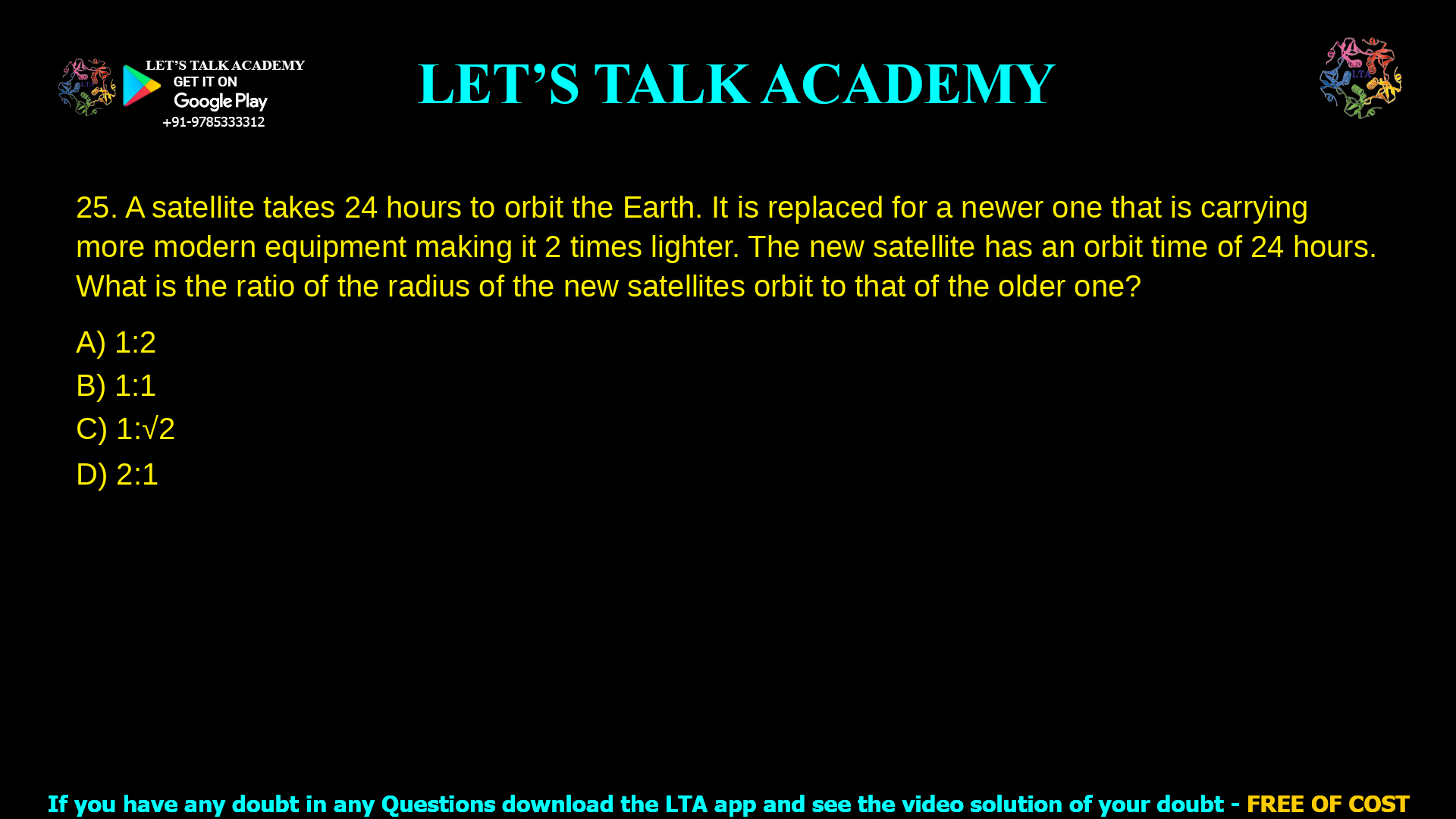
10. A satellite takes 24 hours to orbit the Earth. It is replaced for a newer one that is
carrying more modern equipment making it 2 times lighter. The new satellite has an
orbit time of 24 hours. What is the ratio of the radius of the new satellites orbit to that
of the older one?
a. 1:2
b. 1:1
c. 1:√2
d. 2:1
Satellite Orbit Radius Ratio: Mass Effect on 24-Hour Orbits Explained
Satellite orbital period depends solely on orbit radius, not satellite mass. For two satellites with identical 24-hour periods around Earth, their orbit radii remain equal despite one being lighter.
Core Physics Principle
Kepler’s third law for circular orbits states that T² ∝ r³, where T is the orbital period and r is the orbital radius from Earth’s center.
The full relation is given by:
T = 2π √(r³ / GM)
Here, G is the gravitational constant and M is Earth’s mass. Satellite mass cancels out in derivations from Newton’s law of gravity and centripetal force, so lighter satellites maintain the same radius for the same period.
Step-by-Step Solution
- Both satellites have
T₁ = T₂ = 24 hours. - For the old satellite at radius
r₁:T₁² = (4π² / GM) × r₁³ - For the new (half-mass) satellite at radius
r₂:T₂² = (4π² / GM) × r₂³ - Since
T₁ = T₂, we haver₁³ = r₂³. - Therefore,
r₂ / r₁ = 1.
Option Analysis
| Option | Statement | Correctness | Reason |
|---|---|---|---|
| a | 1:2 | ❌ Incorrect | Suggests new radius half of old; ignores mass independence. |
| b | 1:1 | ✅ Correct | Periods equal → radii equal per Kepler’s law. |
| c | 1:√2 | ❌ Incorrect | Implies ~41% radius change; unrelated to mass. |
| d | 2:1 | ❌ Incorrect | Suggests doubled radius; contradicts T² ∝ r³. |
Key Takeaways for Exams
- Geostationary satellites require 24-hour periods at approximately 42,000 km from Earth’s center.
- Orbital speed formula:
v = √(GM / r), independent of satellite mass. - Lighter satellites are easier to launch but orbit identically for the same period.


