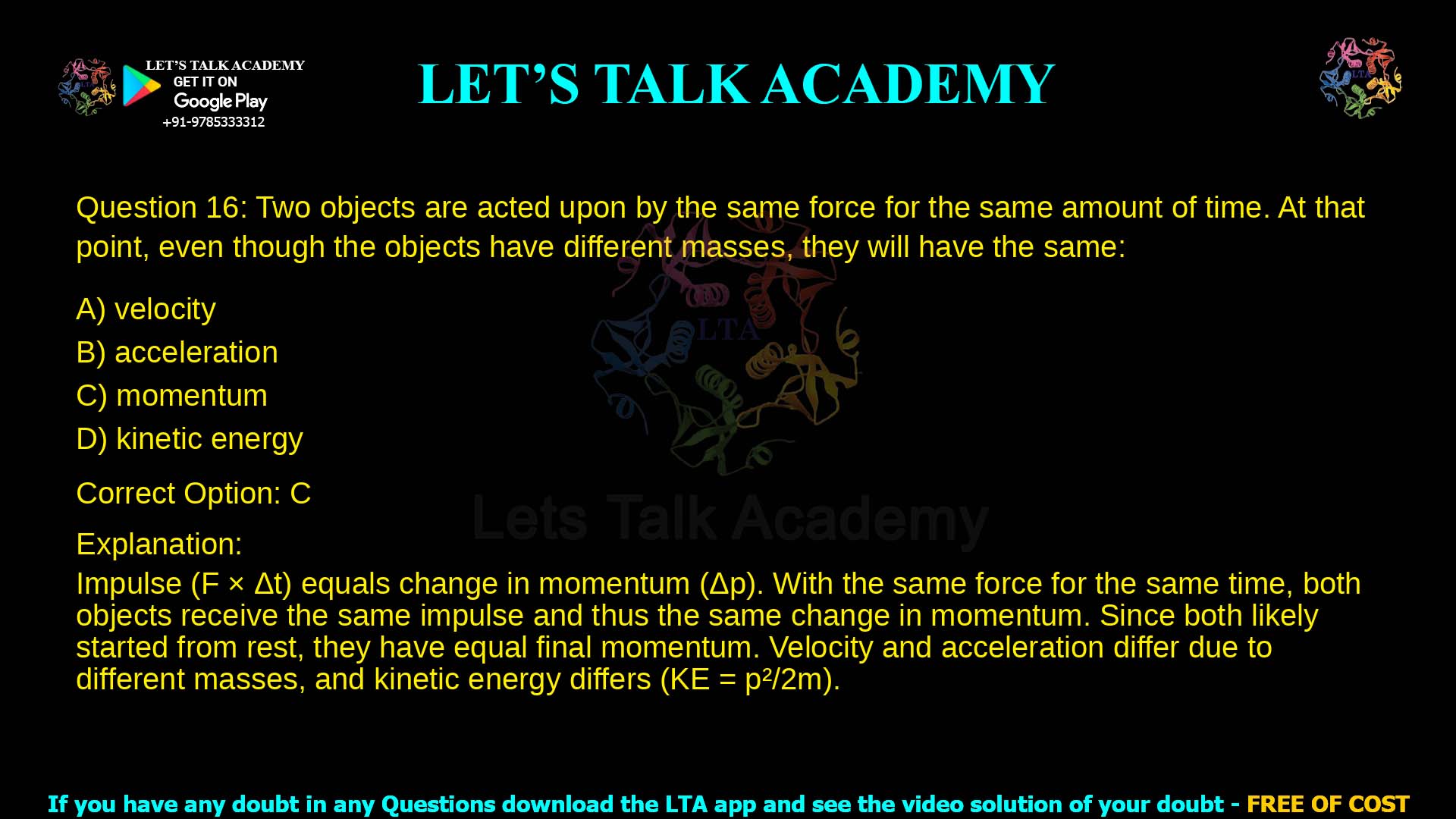
1. Two objects are acted upon by the same force for the same amount of time. At that
point, even though the objects have different masses, they will have the same:
a. velocity
b. acceleration
c. momentum
d. kinetic energy
Same Force Same Time Different Masses: What Remains Equal?
Two objects with different masses, subjected to the same force for equal time, gain identical change in momentum due to the impulse-momentum theorem, where impulse
J = FΔt = Δp. The correct answer is momentum. This principle arises from Newton’s second law, as force equals the rate of change of momentum.
Option Analysis
Velocity:
Final velocity v = FΔt / m varies inversely with mass, so the lighter object gains more velocity. Different masses yield different velocities.
Acceleration:
Acceleration a = F / m is greater for the smaller mass, as it inversely depends on mass. Thus, accelerations differ.
Momentum:
Change in momentum Δp = FΔt remains the same, independent of mass, assuming initial rest. Both objects acquire equal momentum.
Kinetic Energy:
Kinetic energy KE = (FΔt)² / 2m is larger for the heavier mass due to the inverse mass dependence. Energies differ.
Key Physics Concept
The impulse-momentum theorem states Δp = FΔt, proving that equal impulse produces equal momentum change regardless of mass. This applies in collisions and real-world scenarios like sports impacts.
Exam Relevance
For CSIR NET Life Sciences or physics sections, master this concept through impulse theorem proofs and numericals on force-time graphs. Practice distinguishes it from acceleration (mass-dependent) or energy (quadratic velocity reliance).


