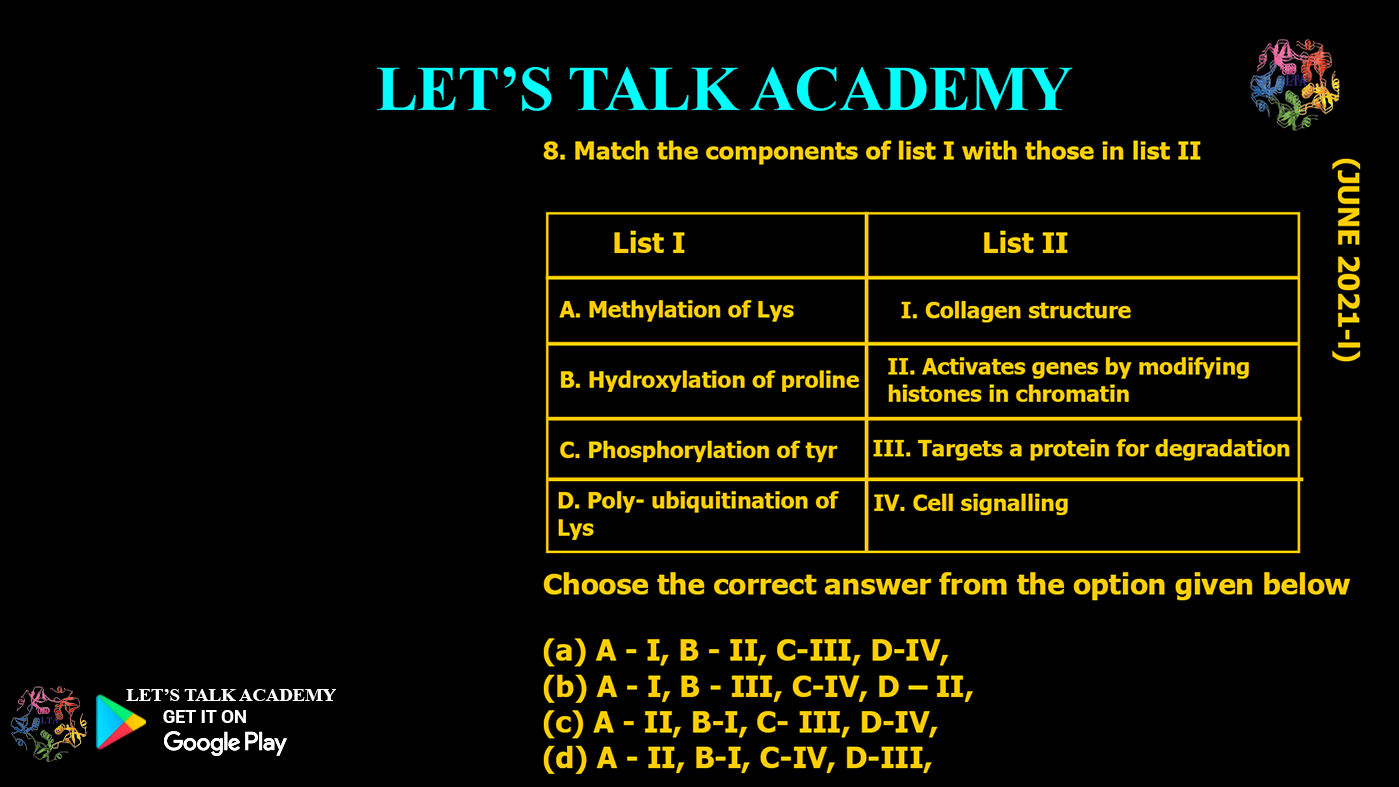
8. Match the components of list I with those in list II
List I List II
A. Methylation of Lys I. Collagen structure
B. Hydroxylation of proline II. Activates genes by modifying histones in chromatin
C. Phosphorylation of tyr III. Targets a protein for degradation
D. Poly- ubiquitination of Lys IV. Cell signalling
(a) A – I, B – II, C-III, D-IV,
(b) A – I, B – III, C-IV, D – II,
(c) A – II, B-I, C- III, D-IV,
(d) A – II, B-I, C-IV, D-III,
Introduction
Protein modifications are essential post-translational processes that regulate protein function, stability, and interaction. These modifications allow cells to respond rapidly to changes in the environment and maintain cellular homeostasis. In this article, we’ll explore the specific roles of methylation of lysine, hydroxylation of proline, phosphorylation of tyrosine, and poly-ubiquitination of lysine in biological systems.
Matching Protein Modifications with Their Functions
Here’s a breakdown of how different post-translational modifications relate to their specific biological roles:
| List I (Modification) | List II (Function) |
|---|---|
| A. Methylation of Lysine | II. Activates genes by modifying histones in chromatin |
| B. Hydroxylation of Proline | I. Collagen structure |
| C. Phosphorylation of Tyrosine | IV. Cell signalling |
| D. Poly-ubiquitination of Lysine | III. Targets a protein for degradation |
✅ Correct Match: (d) A – II, B – I, C – IV, D – III
Detailed Explanation
-
Methylation of Lysine (A → II)
Lysine methylation, particularly on histone tails, is a key epigenetic mechanism. It modifies chromatin structure and regulates gene expression—either activating or repressing transcription depending on the site of methylation. This process plays a critical role in development, differentiation, and cellular response to environmental signals. -
Hydroxylation of Proline (B → I)
This modification is vital in stabilizing the triple-helix structure of collagen, the most abundant protein in the human body. Prolyl hydroxylase enzymes add hydroxyl groups to proline residues, enabling the formation of stable hydrogen bonds within the collagen helix—essential for skin, bone, and connective tissue integrity. -
Phosphorylation of Tyrosine (C → IV)
Phosphorylation of tyrosine residues is a key event in signal transduction pathways, especially those involving receptor tyrosine kinases (RTKs). When ligands bind to RTKs, they trigger autophosphorylation of tyrosine residues, initiating cascades that regulate cell growth, differentiation, metabolism, and apoptosis. -
Poly-ubiquitination of Lysine (D → III)
The attachment of multiple ubiquitin molecules to a lysine residue marks a protein for degradation by the 26S proteasome. This is a tightly regulated process that ensures the removal of damaged, misfolded, or excess proteins—critical for maintaining protein homeostasis and preventing disease.
Conclusion
Understanding protein modifications and their biological roles is fundamental to molecular biology and biotechnology. Each modification serves a precise function, from gene expression and structural support to cell communication and protein turnover. Grasping these processes helps in fields like drug development, disease research, and therapeutic interventions.


4 Comments
Pallavi gautam
April 22, 2025Done sir 👍
Akshay mahawar
April 24, 2025Done 👍
Vaidehi Sharma
April 30, 2025Done Sir 👍
yogesh sharma
May 8, 2025Done sir ✅