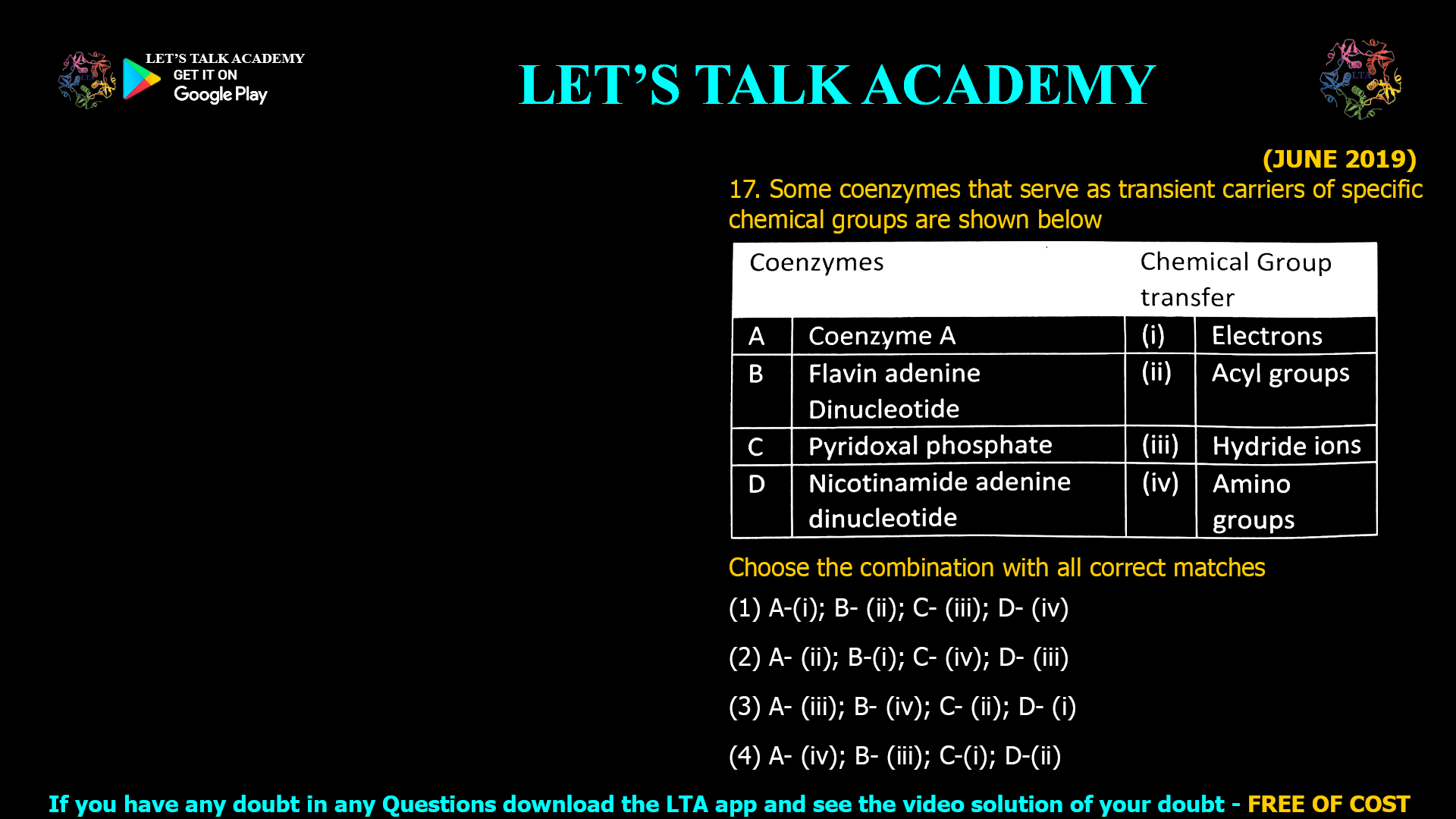
The correct answer is (2) A-(ii), B-(i), C-(iv), D-(iii).
Introduction
Coenzymes are vital non-protein molecules that partner with enzymes to catalyze a wide range of biological reactions. They often serve as temporary carriers of functional groups, atoms, or electrons, facilitating crucial transformations in cellular metabolism. Mastery of which coenzyme transfers which group is essential for biochemistry, physiology, and exam success.
Detailed Coenzyme Functions and Their Matched Groups
Column-Wise Analysis
| Coenzyme | Function (Correct Match) | Explanation |
|---|---|---|
| Coenzyme A (A) | (ii) Acyl groups | Transfers acyl groups; fundamental for energy metabolism and biosynthesis. Forms thioester (acetyl-CoA, acyl-CoA) intermediates. |
| Flavin adenine dinucleotide (B) | (i) Electrons | Transfers electrons and hydrogen atoms during oxidation-reduction reactions. Essential in electron transport chain and metabolic oxidation steps. |
| Pyridoxal phosphate (C) | (iv) Amino groups | Active form of vitamin B6; acts as a carrier for amino groups, facilitating transamination, deamination, and decarboxylation in amino acid metabolism. |
| Nicotinamide adenine dinucleotide (D) | (iii) Hydride ions | Transfers hydride ions (H−) as part of redox reactions in metabolism (glycolysis, Krebs cycle, fatty acid oxidation). NAD/NADH system is central to cellular energy production. |
How These Coenzymes Work
Coenzyme A (Acyl Group Carrier)
-
Contains a reactive thiol (-SH) group that forms high-energy thioester bonds with acyl groups.
-
Central to the citric acid cycle, fatty acid metabolism, and synthesis of essential biomolecules.
FAD (Electron Carrier)
-
Accepts and donates electrons during redox reactions as part of flavoproteins.
-
Integral in the mitochondrial electron transport chain for ATP generation.
Pyridoxal Phosphate (Amino Group Carrier)
-
Acts as a coenzyme in enzymes involved in amino acid catabolism and transformation.
-
Forms a Schiff base with substrate amino acids, enabling transfer of amino groups between molecules.
NAD/NADP (Hydride Ion Carrier)
-
Functions as electron transporter via hydride transfer in metabolic pathways.
-
Shuttles reducing equivalents from catabolic to anabolic pathways—a core of metabolic regulation.
Importance in Metabolic Pathways
-
Coenzyme A enables the transfer and activation of carbon fragments for synthesis and breakdown.
-
FAD and NAD (and their reduced/oxidized forms) maintain the flow of electrons and fuel energy conversion.
-
Pyridoxal phosphate ensures the versatile modifications needed for protein and nitrogen metabolism.
-
The specific chemical group transfer capability of each coenzyme is vital for metabolic efficiency and regulation.
Clinical and Research Applications
-
Vitamin deficiencies manifest as metabolic blockages due to impaired coenzyme function (e.g., B vitamin deficiency syndromes).
-
Drug design: Inhibitors often target coenzyme binding sites for disease treatment.
-
Diagnostic tests measure coenzyme activities to assess metabolic and organ health.
Table Summary: Correct Matches
| Coenzyme | Chemical Group Transferred | Correct Pair |
|---|---|---|
| Coenzyme A | Acyl groups | A-(ii) |
| Flavin adenine dinucleotide (FAD) | Electrons | B-(i) |
| Pyridoxal phosphate | Amino groups | C-(iv) |
| Nicotinamide adenine dinucleotide (NAD) | Hydride ions | D-(iii) |
Conclusion
The functional matching of coenzymes with their respective transient chemical group transfers is fundamental in understanding enzyme-catalyzed metabolic processes.
-
Coenzyme A: Acyl groups (A-ii)
-
FAD: Electrons (B-i)
-
Pyridoxal phosphate: Amino groups (C-iv)
-
NAD: Hydride ions (D-iii)
This knowledge anchors advanced studies in biochemistry, supports clinical diagnostics, and is critical for success in life sciences and medical examinations.


34 Comments
Aakansha sharma Sharma
September 12, 2025Coenzyme A= acyl group
Falvin adenine dinucleotide= hydrogen atom
Pyridoxal phosphate= amino group
Thiamine pyrophosphate= aldehyde group
Aakansha sharma Sharma
September 12, 2025Coenzyme A= acyl group
Falvin adenine dinucleotide= electrons
Pyridoxal phosphate= amino group
Nicotinamide adenine dinucleotide= hydride ions
Varsha Tatla
September 12, 2025For nicotinamide adenine dinucleotides – H-bonding
2nd Option combination will be right 👍🏿
Kanica Sunwalka
September 13, 2025option 2 is correct
Heena Mahlawat
September 13, 2025Co enzyme A is acyl group carrier
NAD is hydride ion carrier
FAD is electron carrier
Pyridoxal phosphate is amino group carrier
Roopal Sharma
September 13, 2025Option 2 is correct
Mansukh Kapoor
September 13, 2025The correct answer is option 2nd
Neha Yadav
September 13, 2025Coenzyme A – Acyl gp
FAD- electron
Pyridoxal phosphate – Amino grp
NAD – hydride grp
Kirti Agarwal
September 13, 2025Opt 2
Bhawna Choudhary
September 13, 2025Option 2nd is correct answer
Santosh Saini
September 13, 2025Coenzyme A =Acyl group , FAD=Electrons , Pyridoxal phosphate=Amino group , NAD= Hydride ions
Aafreen Khan
September 14, 20252nd option is correct answer
Dharmpal Swami
September 14, 20252nd option correct
Pooja
September 14, 2025Option b is correct
Ayush Dubey
September 14, 2025A-(ii), B-(i), C-(iv), D-(iii).
Vanshika Sharma
September 14, 2025Opt 2
Anurag Giri
September 14, 2025The correct answer is option 2nd
Kajal
September 14, 2025Option 2is correct
Mitali saini
September 14, 2025The correct answer is (2) A-(ii), B-(i), C-(iv), D-(iii).
Rishita
September 14, 2025A-(ii), B-(i), C-(iv), D-(iii).
Anju
September 14, 2025Ans: option 2
Payal Gaur
September 14, 2025Option B. Transfer acyl group and convert in to actyl co A .
FAD accept electron and hydrogen form FADH2.
Pyridoxal phosphate form of amino group.
Accept hydrogen ion NAD convert in to NADH.
Sonal nagar
September 14, 2025Option 2nd.
Arushi Saini
September 14, 2025Option 2 is correct
HIMANI FAUJDAR
September 14, 2025Ans correct answer is 2
Coenzyme A =Acyl group
FAD=Electrons
Pyridoxal phosphate=Amino group
NAD= Hydride ions
anjani sharma
September 14, 2025Coenzyme A= acyl group
Falvin adenine dinucleotide= electrons
Pyridoxal phosphate= amino group
Nicotinamide adenine dinucleotide= hydride ions
Deepika sheoran
September 15, 2025Option 2nd is correct
yashika
September 15, 2025Pyridoxal phosphate,.।।। amino group
Simran Saini
September 15, 2025Option 2.
Coenzyme A= acyl group
Flavin adenine dinucleotide= electrons
Pyridoxal phosphate= amino group
Nicotinamide adenine dinucleotide= hydride ions
Khushi Vaishnav
September 15, 2025Coenzyme A-Acyl groups
FAD-Electrons
Pyridoxal phosphate-Amino groups
NAD-Hydride ions
Minal Sethi
September 16, 2025CoA – Acyl group
FAD – Electrons
Pyridoxal phosphate – Amino group
NAD – Hydride ions
Muskan Yadav
September 17, 2025Coenzyme A: Acyl groups
FAD: Electrons
Pyridoxal phosphate: Amino groups
NAD: Hydride ions
so correct option is 2 ) A-(ii), B-(i), C-(iv), D-(iii)
Yogita
September 17, 2025Option 2 is correct answer
Palak Sharma
September 21, 2025CoA – Acyl group
FAD – Electrons
Pyridoxal phosphate – Amino group
NAD – Hydride ions