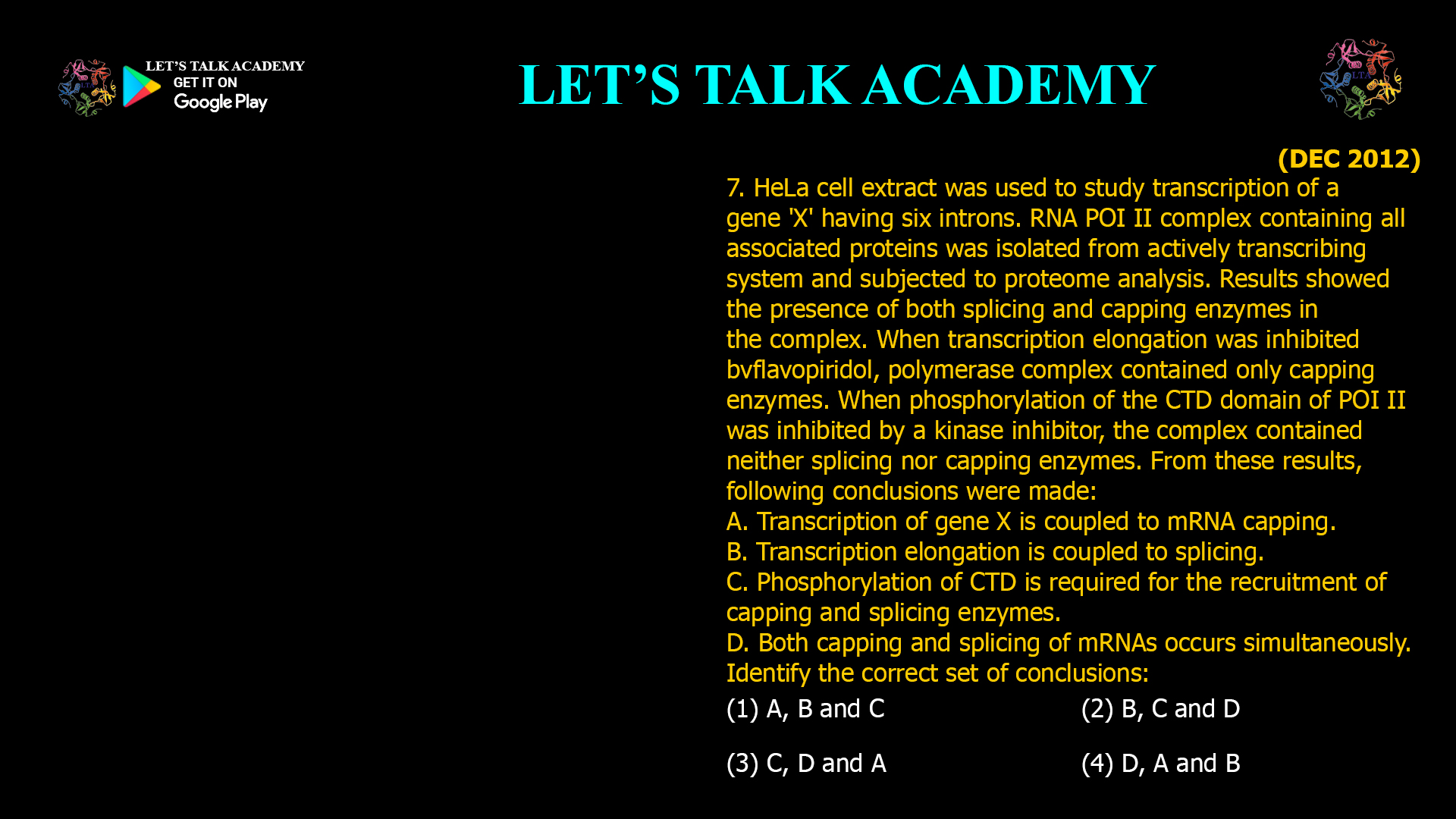
7. HeLa cell extract was used to study transcription of a gene ‘X’ having six introns. RNA POI II complex containing all associated proteins was isolated from actively transcribing system and subjected to proteome analysis. Results showed the presence of both splicing and capping enzymes in the complex. When transcription elongation was inhibited bvflavopiridol, polymerase complex contained only capping enzymes. When phosphorylation of the CTD domain of POI II was inhibited by a kinase inhibitor, the complex contained neither splicing nor capping enzymes. From these results, following conclusions were made:
A. Transcription of gene X is coupled to mRNA capping.
B. Transcription elongation is coupled to splicing.
C. Phosphorylation of CTD is required for the recruitment of capping and splicing enzymes.
D. Both capping and splicing of mRNAs occurs simultaneously.
Identify the correct set of conclusions:
(1) A, B and C
(2) B, C and D
(3) C, D and A
(4) D, A and B
Correct Conclusions from Study of RNA Polymerase II Complex and Coupling of Transcription with RNA Processing
Question Recap:
HeLa cell extract was used to study transcription of gene ‘X’ with six introns. RNA Pol II complexes from active transcription contained both splicing and capping enzymes. When elongation was inhibited, only capping enzymes were present; when CTD phosphorylation was inhibited, neither enzyme was present.
Conclusions:
A. Transcription of gene X is coupled to mRNA capping.
B. Transcription elongation is coupled to splicing.
C. Phosphorylation of CTD is required for recruitment of capping and splicing enzymes.
D. Both capping and splicing of mRNAs occur simultaneously.
Which set is correct?
(1) A, B and C
(2) B, C and D
(3) C, D and A
(4) D, A and B
Correct Answer:
(1) A, B and C
Detailed Explanation:
-
Conclusion A: Transcription is coupled to mRNA capping.
Supported by evidence that capping enzymes are present in the RNA Pol II complex during active transcription but absent when CTD phosphorylation is inhibited. The CTD phosphorylation recruits capping enzymes early in transcription (Ser5 phosphorylation). -
Conclusion B: Transcription elongation is coupled to splicing.
Splicing factors associate with the elongating RNA Pol II complex, and inhibition of elongation (by flavopiridol, a CDK9 inhibitor) leads to loss of splicing enzymes from the complex. This indicates splicing is coordinated with elongation phase. -
Conclusion C: Phosphorylation of CTD is required for recruitment of capping and splicing enzymes.
CTD phosphorylation, especially at Ser5 and Ser2, provides a platform for binding RNA processing factors including capping and splicing enzymes. Inhibition of CTD phosphorylation abolishes recruitment of both enzyme types. -
Conclusion D: Both capping and splicing occur simultaneously.
While capping occurs very early during transcription (near initiation), splicing generally occurs co-transcriptionally but not necessarily simultaneously with capping. The data show capping enzymes present even when elongation is blocked (no splicing enzymes), suggesting temporal separation rather than strict simultaneity.
Supporting Evidence from Search Results:
-
The CTD phosphorylation code orchestrates recruitment of processing enzymes at different transcription stages.
-
Capping enzyme recruitment depends on Ser5 phosphorylation early in transcription.
-
Splicing factors associate during elongation, linked to Ser2 phosphorylation.
-
Flavopiridol inhibition of elongation removes splicing factors but not capping enzymes.
Summary Table
| Conclusion | Supported by Data? | Explanation |
|---|---|---|
| A | Yes | Capping enzyme recruitment depends on CTD phosphorylation during transcription initiation. |
| B | Yes | Splicing enzymes associate during elongation; elongation inhibition removes them. |
| C | Yes | CTD phosphorylation is essential for recruitment of both capping and splicing enzymes. |
| D | No | Capping occurs early; splicing is co-transcriptional but not strictly simultaneous with capping. |
Final Conclusion
The correct set of conclusions is (1) A, B and C. Transcription of gene X is coupled to mRNA capping; elongation is coupled to splicing; and CTD phosphorylation is required for recruitment of both enzyme types. However, capping and splicing do not necessarily occur simultaneously.


7 Comments
Suman bhakar
June 4, 2025✅✅
Sonam Saini
October 29, 2025ABC is a right answer
Prami Masih
June 4, 2025👍👍
Rohittt
June 9, 2025Best 👍🏻
Manisha choudhary
November 4, 2025Option 1. A,B. And C statement s correct
Splicing coupled with elongation
Transcription of x gene coupled with m RNA capping
Phosphorylation of CTD is required for recruitment of capping and splicing enzymes
Heena Mahlawat
November 4, 2025A, B,C
Roopal Sharma
November 4, 2025A,B and C is correct