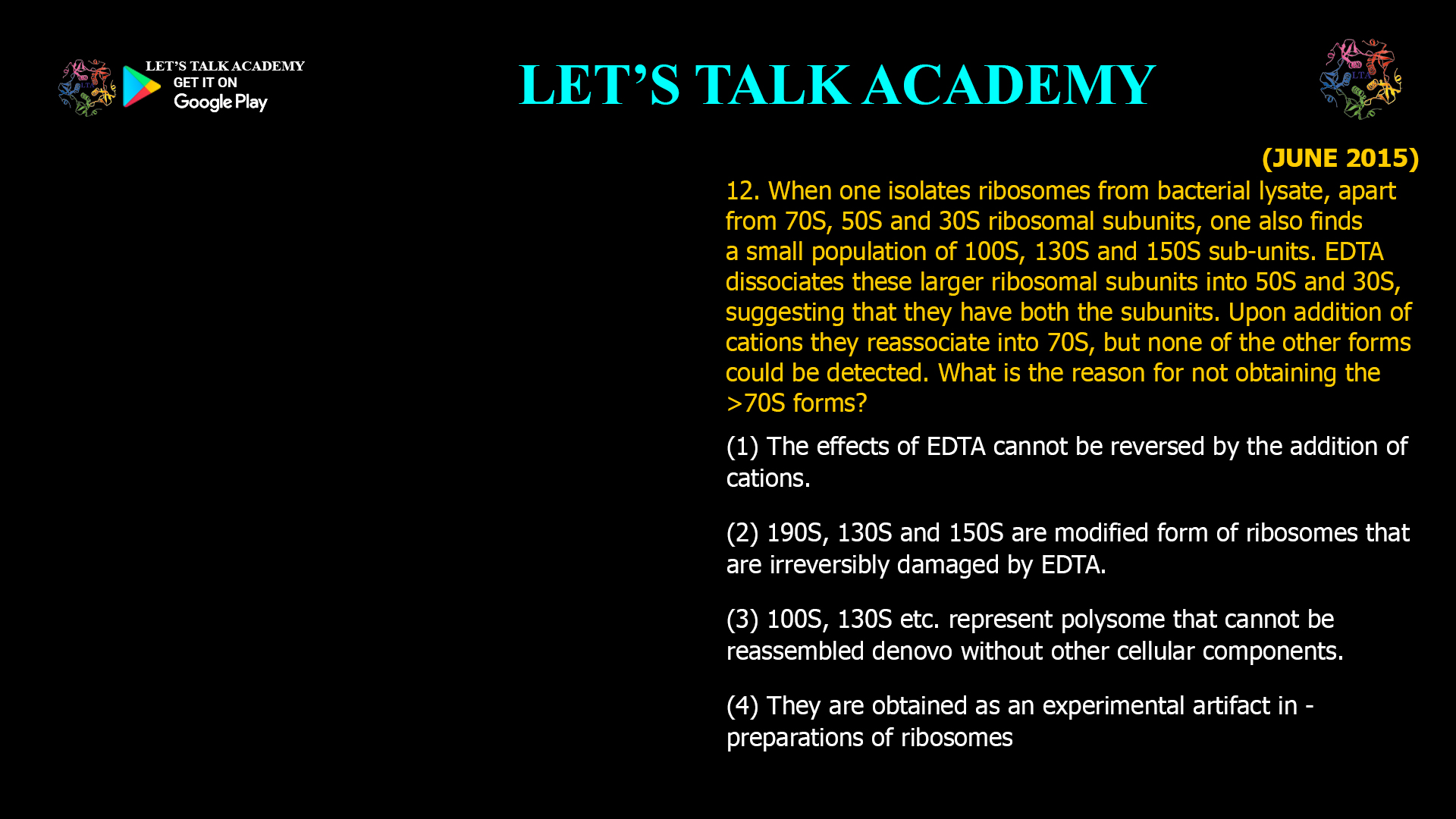
- When one isolates ribosomes from bacterial lysate, apart from 70S. 50S and 30S ribosomal subunits. One also finds a small population of 100S, 130S and 150S sub-units. EDTA dissociates these larger ribosomal subunits into 50S and 30S. suggesting that they have both the subunits. upon addition of cations they reassociate into 70S. but none of the other forms could be detected. What is the reason for not obtaining the >70S forms?
(1) The effects of EDTA cannot be reversed by the addition of cations.
(2) 190S, 130S and150S are modified form of ribosomes that are irreversibly damaged by EDTA.
(3) 100S, 130S etc. represent polysome that cannot be reassembled denovo without other cellular components.
(4) They are obtained as an experimental artifact in – preparations of ribosomes
When isolating ribosomes from bacterial lysates, scientists often detect not only the canonical 70S ribosomes and their 50S and 30S subunits but also larger complexes such as 100S, 130S, and 150S particles. These larger forms are believed to be polysomes or ribosome dimers/multimers associated with mRNA. Treatment with EDTA, a chelating agent that removes divalent cations like Mg²⁺, dissociates these larger complexes into 50S and 30S subunits. Upon readdition of cations, the 50S and 30S subunits reassociate into 70S ribosomes, but the larger polysome-like forms do not reappear.
Understanding why these >70S forms are not recovered after EDTA treatment and reassembly is key to interpreting ribosome isolation experiments and the nature of ribosomal complexes.
Role of EDTA in Ribosome Dissociation
-
EDTA chelates Mg²⁺ ions, which are essential for stabilizing ribosomal subunit interactions.
-
Removal of Mg²⁺ causes dissociation of 70S ribosomes into 50S and 30S subunits.
-
Larger complexes (100S, 130S, 150S) also dissociate into these subunits.
-
Upon Mg²⁺ readdition, 50S and 30S reassociate into 70S ribosomes.
Why Are Larger Complexes Not Reformed?
The key reason lies in the nature of these larger particles:
-
100S, 130S, and 150S complexes represent polysomes or ribosome aggregates bound to mRNA.
-
Polysomes are multiple ribosomes simultaneously translating a single mRNA molecule.
-
The formation and stability of polysomes depend on intact mRNA and associated translation factors.
-
EDTA treatment disrupts not only ribosome subunit interactions but also RNA integrity and the association of ribosomes with mRNA.
-
After dissociation, simply adding Mg²⁺ ions back does not restore the mRNA scaffold or translation factors necessary for polysome assembly.
-
Therefore, polysomes cannot be reassembled de novo in vitro without other cellular components such as mRNA and translation factors.
Why Other Options Are Less Likely
-
(1) EDTA effects cannot be reversed by cations: This is incorrect because 50S and 30S subunits do reassociate into 70S ribosomes upon cation addition.
-
(2) Larger particles are irreversibly damaged by EDTA: While EDTA can cause some RNA degradation over time, the main reason for failure to reassemble polysomes is the absence of mRNA and translation machinery, not irreversible damage.
-
(4) Larger forms are experimental artifacts: These larger complexes are well-characterized polysomes or ribosome dimers, not artifacts.
Summary Table
| Statement | Explanation | Correctness |
|---|---|---|
| (1) EDTA effects irreversible | Incorrect: 70S ribosomes reform with Mg²⁺ | |
| (2) Larger forms irreversibly damaged by EDTA | Incorrect: RNA degradation possible but not main cause | |
| (3) Larger forms are polysomes requiring mRNA and factors | Correct: Polysomes need mRNA and translation factors to form | |
| (4) Larger forms are artifacts | Incorrect: Larger forms represent real polysomes |
Correct Answer
(3) 100S, 130S etc. represent polysomes that cannot be reassembled de novo without other cellular components.
Conclusion
The absence of larger ribosomal forms (>70S) after EDTA treatment and cation-mediated reassociation is due to the nature of these complexes as polysomes. Polysomes require intact mRNA and associated translation factors to form and maintain their structure. EDTA disrupts these interactions, and simply adding Mg²⁺ back cannot restore the complex polysome architecture. This understanding is critical for interpreting ribosome isolation experiments and studying translation in vitro.


7 Comments
Neelam Sharma
October 31, 2025100S, 130S etc. represent polysome that cannot be reassembled denovo without other cellular components.
Kirti Agarwal
November 1, 2025Statement 3 is correct
MOHIT AKHAND
November 3, 2025Polysomes cannot be reassembled without the presence of mRNA and other cellular components, which is why the larger forms (>70S) cannot be detected after reassembly with cations.
Sakshi yadav
November 3, 2025polysomes cannot be reassembled de novo in vitro without other cellular components such as mRNA and translation factors.
Kajal
November 4, 2025Correct answer is (3) 100S, 130S etc. represent polysomes that cannot be reassembled de novo without other cellular components.
Dharmpal swami
November 4, 2025Statement 3 is correct answer
Deepika Sheoran
November 4, 2025Option 3 is correct answer.