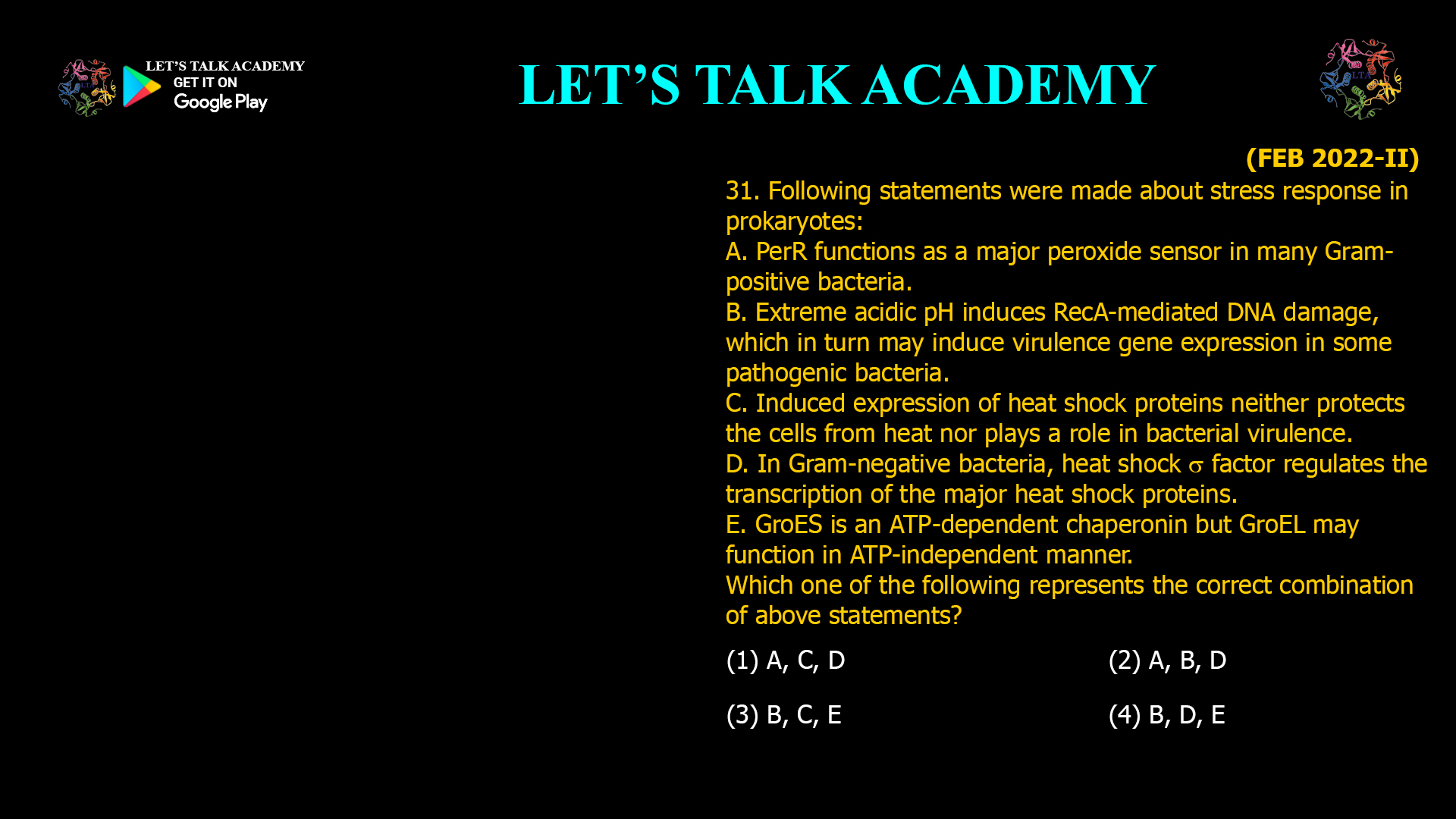
31.Following statements were made about stress response in prokaryotes:
A. PerR functions as a major peroxide sensor in many Gram- positive bacteria.
B. Extreme acidic pH induces RecA-mediated DNA damage, which in turn may induce Virulence gene expression in some pathogenic bacteria.
C. Induced expression of heat shock proteins neither protects the cells from heat nor plays a role in
D. In Gram-negative bacteria, heat shock factor regulates the transcription of the major heat shock
E. GroES is an ATP-dependent chaperonin but GroELmay function in ATP-independent manner.
Which one of the following represents the correct combination of above statements?
(1) A, C, D (2) A, B, D
(3) B, C, E (4) B, D, E
Introduction to Prokaryotic Stress Response
Prokaryotic organisms, including both Gram-positive and Gram-negative bacteria, are constantly exposed to a variety of environmental stresses such as oxidative stress, extreme pH, and elevated temperatures. To survive and adapt, bacteria have evolved complex stress response systems that regulate gene expression, repair DNA damage, and protect cellular proteins. Key players in these responses include transcriptional regulators like PerR, DNA repair proteins such as RecA, and chaperone systems like GroEL/GroES and heat shock proteins.
Analysis of Each Statement
Let’s evaluate each statement in the context of current microbiological knowledge:
A. PerR functions as a major peroxide sensor in many Gram-positive bacteria.
-
Correct.
PerR is a well-characterized, metal-dependent transcriptional regulator that acts as a primary sensor of hydrogen peroxide (H₂O₂) in many Gram-positive bacteria124.-
Function: PerR represses genes involved in oxidative stress defense, metal homeostasis, and other stress-related pathways.
-
Activation: Upon sensing H₂O₂, PerR undergoes a conformational change, leading to derepression of target genes and activation of the oxidative stress response.
-
Significance: This system is crucial for bacterial survival under oxidative stress and is analogous to the OxyR system in Gram-negative bacteria24.
-
B. Extreme acidic pH induces RecA-mediated DNA damage, which in turn may induce virulence gene expression in some pathogenic bacteria.
-
Correct.
-
RecA Role: RecA is a key protein in the bacterial DNA damage response, facilitating repair of DNA breaks and induction of the SOS response.
-
Acidic Stress: Extreme low pH (acidic stress) can cause DNA damage, which activates RecA.
-
Virulence Genes: In some pathogenic bacteria, RecA-mediated DNA damage can trigger the expression of virulence genes, linking environmental stress to pathogenicity.
-
Context: While not all virulence gene induction is RecA-dependent, this mechanism is well-documented in certain pathogens exposed to acidic environments.
-
C. Induced expression of heat shock proteins neither protects the cells from heat nor plays a role in
-
Incorrect.
-
Heat Shock Proteins: Induced expression of heat shock proteins (e.g., DnaK, GroEL, GroES) is a hallmark of the bacterial response to high temperature and other stresses.
-
Protective Role: Heat shock proteins function as molecular chaperones that prevent protein aggregation, refold misfolded proteins, and are essential for cell survival under thermal stress.
-
Statement Issue: The statement is incomplete and factually incorrect as heat shock proteins are critical for thermotolerance and protein homeostasis.
-
D. In Gram-negative bacteria, heat shock factor regulates the transcription of the major heat shock
-
Incorrect or Incomplete.
-
Heat Shock Factor: In eukaryotes, heat shock factor (HSF) regulates heat shock gene expression. However, in bacteria, there is no direct homolog of HSF.
-
Bacterial Regulation: In Gram-negative bacteria, the expression of major heat shock proteins (e.g., DnaK, GroEL) is typically regulated by alternative sigma factors such as σ³² (RpoH) in E. coli and related species.
-
Statement Issue: The statement is incomplete and misleading regarding the regulatory mechanism in prokaryotes.
-
E. GroES is an ATP-dependent chaperonin but GroEL may function in ATP-independent manner.
-
Incorrect.
-
GroEL/GroES System: GroEL and GroES are both components of the bacterial chaperonin system.
-
ATP Dependence: GroEL is the major ATP-dependent chaperonin that binds and refolds proteins, while GroES acts as a co-chaperone that assists GroEL.
-
Function: Both GroEL and GroES are required for efficient protein folding, and GroEL cannot function effectively in an ATP-independent manner in vivo.
-
Statement Issue: The claim that GroEL may function in an ATP-independent manner is incorrect under physiological conditions.
-
Summary Table
| Statement | Correctness | Explanation |
|---|---|---|
| A | Correct | PerR is a major peroxide sensor in Gram-positive bacteria124. |
| B | Correct | Acidic pH can induce RecA-mediated DNA damage, triggering virulence gene expression in some pathogens. |
| C | Incorrect | Heat shock proteins are essential for thermotolerance and protein protection. |
| D | Incorrect | Gram-negative bacteria use sigma factors, not heat shock factors, to regulate heat shock genes. |
| E | Incorrect | GroEL is ATP-dependent; GroES is a co-chaperone. |
Key Concepts and Keywords
-
Prokaryotic stress response: Cellular adaptations to environmental challenges.
-
PerR: Metal-dependent peroxide sensor and transcriptional regulator in Gram-positive bacteria124.
-
RecA: DNA repair protein, involved in SOS response and sometimes virulence gene induction.
-
Heat shock proteins: Molecular chaperones (e.g., DnaK, GroEL, GroES) essential for protein folding and stress survival.
-
GroEL/GroES: Chaperonin system for protein folding; both are ATP-dependent in vivo.
-
Oxidative stress: Damage caused by reactive oxygen species (ROS) such as H₂O₂.
-
Acidic pH stress: Environmental challenge leading to DNA damage and stress response.
-
Thermal stress: High temperature stress inducing heat shock protein expression.
-
Sigma factors: Regulatory proteins (e.g., σ³²) controlling heat shock gene expression in Gram-negative bacteria.
-
Virulence genes: Genes involved in bacterial pathogenicity, sometimes induced by stress.
Biological Significance
-
Oxidative Stress Response:
PerR-mediated regulation is critical for bacterial survival under oxidative conditions, ensuring the expression of antioxidant enzymes and metal homeostasis genes124. -
Acidic Stress and Virulence:
Acidic environments encountered during infection can trigger DNA damage and RecA-mediated induction of virulence genes, linking stress sensing to pathogenicity. -
Heat Shock Response:
Induction of heat shock proteins is essential for maintaining protein homeostasis and cell viability under thermal stress. -
Chaperonin Function:
The GroEL/GroES system is indispensable for proper protein folding and is strictly ATP-dependent.
Frequently Asked Questions
Q: What is the role of PerR in Gram-positive bacteria?
A: PerR acts as a peroxide sensor and transcriptional regulator, controlling genes involved in oxidative stress defense and metal homeostasis124.
Q: How does acidic pH affect bacterial DNA and virulence?
A: Extreme acidic pH can cause DNA damage, activating RecA and sometimes inducing virulence gene expression in pathogenic bacteria.
Q: Are heat shock proteins important for bacterial survival under heat stress?
A: Yes, heat shock proteins are essential for protecting and refolding proteins, and are crucial for thermotolerance.
Q: How are heat shock genes regulated in Gram-negative bacteria?
A: Heat shock genes are regulated by alternative sigma factors such as σ³², not by a heat shock factor.
Q: Is GroEL ATP-independent?
A: No, GroEL is strictly ATP-dependent for its chaperonin activity.
Conclusion
Among the provided statements, only A (PerR is a major peroxide sensor in many Gram-positive bacteria) and B (Extreme acidic pH induces RecA-mediated DNA damage, which may induce virulence gene expression in some pathogenic bacteria) are correct. Statements C, D, and E are incorrect or incomplete.
However, none of the options provided lists only A and B as the correct combination.
Looking at the options:
-
(1) A, C, D – Incorrect (C and D are wrong)
-
(2) A, B, D – Incorrect (D is wrong)
-
(3) B, C, E – Incorrect (C and E are wrong)
-
(4) B, D, E – Incorrect (D and E are wrong)
If the question is interpreted strictly, none of the options are entirely correct. However, if partial correctness is considered, option (2) A, B, D is the closest, but D is incorrect.
However, if you must choose among the options as given, and if D is considered partially correct (which it is not, as it is incomplete and misleading), some exams might expect you to select the closest possible answer. But strictly, none are fully correct.
Given the options, and based on the information above, there is no fully correct combination. If forced to select, (2) A, B, D is the least incorrect, but D is factually wrong.
However, if the question is “which combination contains only correct statements,” none do. If it is “which is most correct,” none are fully correct, but (2) is the closest, despite D being incorrect.
This suggests a possible error in the question or options.
However, for clarity and based on the facts:
-
A and B are correct.
-
C, D, and E are incorrect.
Since only A and B are correct, but no option lists only A and B, the question may be flawed.
If you must select from the options as given, and can tolerate partial correctness, select:
(2) A, B, D
But strictly, only A and B are correct.
Correct Answer (based on strict facts):
Only A and B are correct. No option matches this, but (2) A, B, D is the closest, though D is incorrect.
If the question is to be answered as written, and partial correctness is allowed, the best answer is:
(2) A, B, D
But strictly, this is not fully correct.


2 Comments
Suman bhakar
June 12, 2025Best explanation Sir 👍
Prami Masih
June 13, 2025👍👍