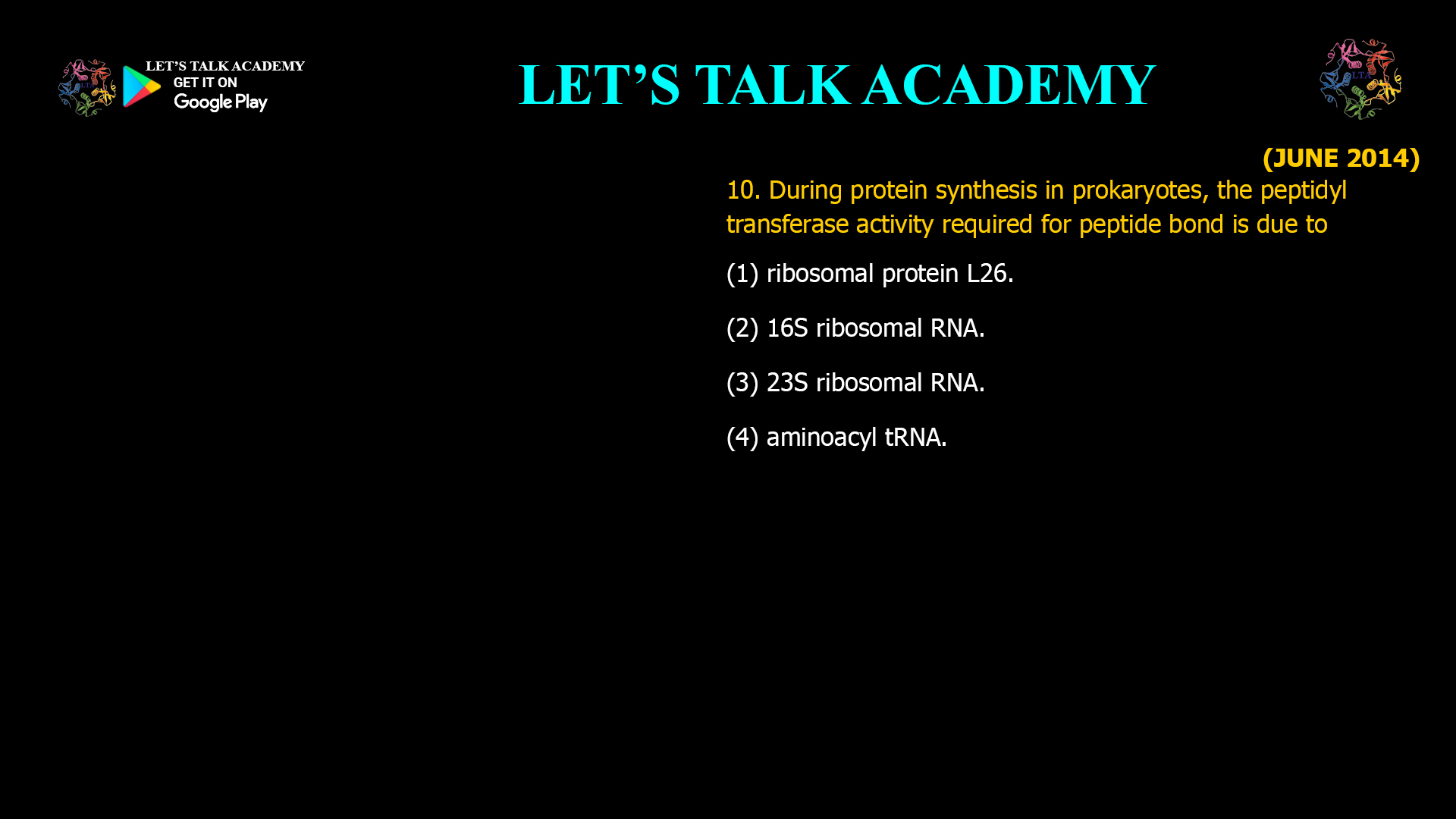
During protein synthesis in prokaryotes, the peptidyl transferase activity required for peptide bond is due to
(1) ribosomal protein L26.
(2) 16S ribosomal RNA.
(3) 23S ribosomal RNA.
(4) aminoacyltRNA.
Introduction
Protein synthesis in prokaryotes is a highly efficient and tightly regulated process, with the ribosome serving as the central molecular machine. One of the most remarkable features of the ribosome is its ability to catalyze the formation of peptide bonds between amino acids, a reaction known as peptidyl transferase activity. This article explores the molecular basis of peptidyl transferase activity in prokaryotes and explains why 23S ribosomal RNA—not ribosomal proteins or other RNAs—is responsible for this essential function.
Understanding the Ribosome’s Structure
The prokaryotic ribosome is composed of two subunits: the small (30S) and the large (50S) subunit. Each subunit consists of ribosomal RNA (rRNA) and a variety of ribosomal proteins. The 30S subunit contains 16S rRNA, while the 50S subunit contains 23S and 5S rRNA. The catalytic core of the ribosome, where peptide bonds are formed, is located within the large subunit.
What Is Peptidyl Transferase Activity?
Peptidyl transferase activity refers to the enzymatic process of forming a peptide bond between the amino acid attached to the incoming tRNA (aminoacyl-tRNA) and the growing polypeptide chain attached to the peptidyl-tRNA. This reaction occurs at the peptidyl transferase center (PTC), a specialized region within the large ribosomal subunit.
The Peptidyl Transferase Center (PTC)
The PTC is a ribozyme, meaning it is an RNA-based enzyme. It is located in the 50S ribosomal subunit and consists of a specific region of 23S rRNA. The PTC is responsible for:
-
Forming peptide bonds between adjacent amino acids.
-
Hydrolyzing the bond between the completed polypeptide and the tRNA at the end of translation.
Remarkably, the catalytic activity of the PTC is not mediated by any ribosomal proteins but is entirely due to the structure and chemistry of the 23S rRNA.
Evidence for RNA-Based Catalysis
The discovery that the PTC is an RNA enzyme was a landmark in molecular biology. Early experiments showed that even after extensive treatment with proteases to remove all ribosomal proteins, the ribosome could still catalyze peptide bond formation. This provided strong evidence that the catalytic activity resides in the rRNA itself.
The PTC is highly conserved across all domains of life, suggesting that it is one of the oldest and most fundamental components of the translational machinery. The structure of the PTC is characterized by a region of about 180 nucleotides in the 23S rRNA, with a core set of highly conserved residues that are essential for its function.
Why Not Ribosomal Proteins or Other RNAs?
Let’s examine each of the options provided in the question:
(1) Ribosomal Protein L26
-
Role: L26 is a ribosomal protein found in the large subunit.
-
Function: While ribosomal proteins are important for ribosome assembly, stability, and regulation, none have been shown to possess catalytic activity for peptide bond formation.
-
Conclusion: L26 does not catalyze peptidyl transferase activity.
(2) 16S Ribosomal RNA
-
Role: 16S rRNA is a component of the small (30S) ribosomal subunit.
-
Function: 16S rRNA is essential for mRNA decoding, tRNA binding, and ensuring the correct codon-anticodon pairing, but it does not participate in peptide bond formation.
-
Conclusion: 16S rRNA is not involved in peptidyl transferase activity.
(3) 23S Ribosomal RNA
-
Role: 23S rRNA is a component of the large (50S) ribosomal subunit.
-
Function: The PTC, located within the 23S rRNA, catalyzes peptide bond formation.
-
Conclusion: 23S rRNA is responsible for peptidyl transferase activity.
(4) Aminoacyl-tRNA
-
Role: Aminoacyl-tRNA delivers amino acids to the ribosome.
-
Function: While aminoacyl-tRNA is the substrate for peptide bond formation, it does not catalyze the reaction.
-
Conclusion: Aminoacyl-tRNA does not possess peptidyl transferase activity.
The Mechanism of Peptide Bond Formation
During translation, the ribosome positions the aminoacyl-tRNA in the A site and the peptidyl-tRNA in the P site. The PTC, located at the interface of these sites, aligns the substrates and facilitates the nucleophilic attack of the amino group of the aminoacyl-tRNA on the carbonyl carbon of the peptidyl-tRNA, resulting in peptide bond formation.
The reaction is facilitated by the precise three-dimensional arrangement of nucleotides in the 23S rRNA, which creates an optimal environment for catalysis. The PTC also ensures the correct positioning of the tRNAs and the growing polypeptide chain.
Evolutionary and Functional Significance
The PTC is considered one of the most ancient parts of the ribosome, predating the last universal common ancestor. Its high degree of conservation across all life forms underscores its fundamental importance in protein synthesis. The fact that the PTC is an RNA enzyme supports the RNA World hypothesis, which posits that early life relied on RNA for both genetic information storage and catalysis.
Summary Table
| Option | Role in Peptidyl Transferase Activity |
|---|---|
| Ribosomal protein L26 | No |
| 16S ribosomal RNA | No |
| 23S ribosomal RNA | Yes |
| Aminoacyl-tRNA | No |
Common Misconceptions
-
Ribosomal proteins catalyze peptide bond formation:
-
Fact: Ribosomal proteins are important for ribosome structure and function, but they do not catalyze peptide bond formation.
-
-
16S rRNA is involved in catalysis:
-
Fact: 16S rRNA is essential for decoding and tRNA binding, but not for peptide bond formation.
-
-
Aminoacyl-tRNA catalyzes the reaction:
-
Fact: Aminoacyl-tRNA is a substrate, not an enzyme.
-
Conclusion
During protein synthesis in prokaryotes, the peptidyl transferase activity required for peptide bond formation is due to the 23S ribosomal RNA. The peptidyl transferase center (PTC) within the 23S rRNA acts as a ribozyme, catalyzing the formation of peptide bonds without the involvement of ribosomal proteins or other RNAs. This remarkable feature highlights the central role of RNA in the origin and evolution of life.
Correct answer:
(3) 23S ribosomal RNA


6 Comments
Suman bhakar
June 12, 2025Done sir ✅
Arushi
June 12, 2025✅
Kirti Agarwal
November 2, 202523 s ribosomal RNA
Deepika Sheoran
November 4, 202523 s ribosomal RNA
Heena Mahlawat
November 6, 202523S ribosomal RNA
MOHIT AKHAND
November 14, 2025Done sir ✅