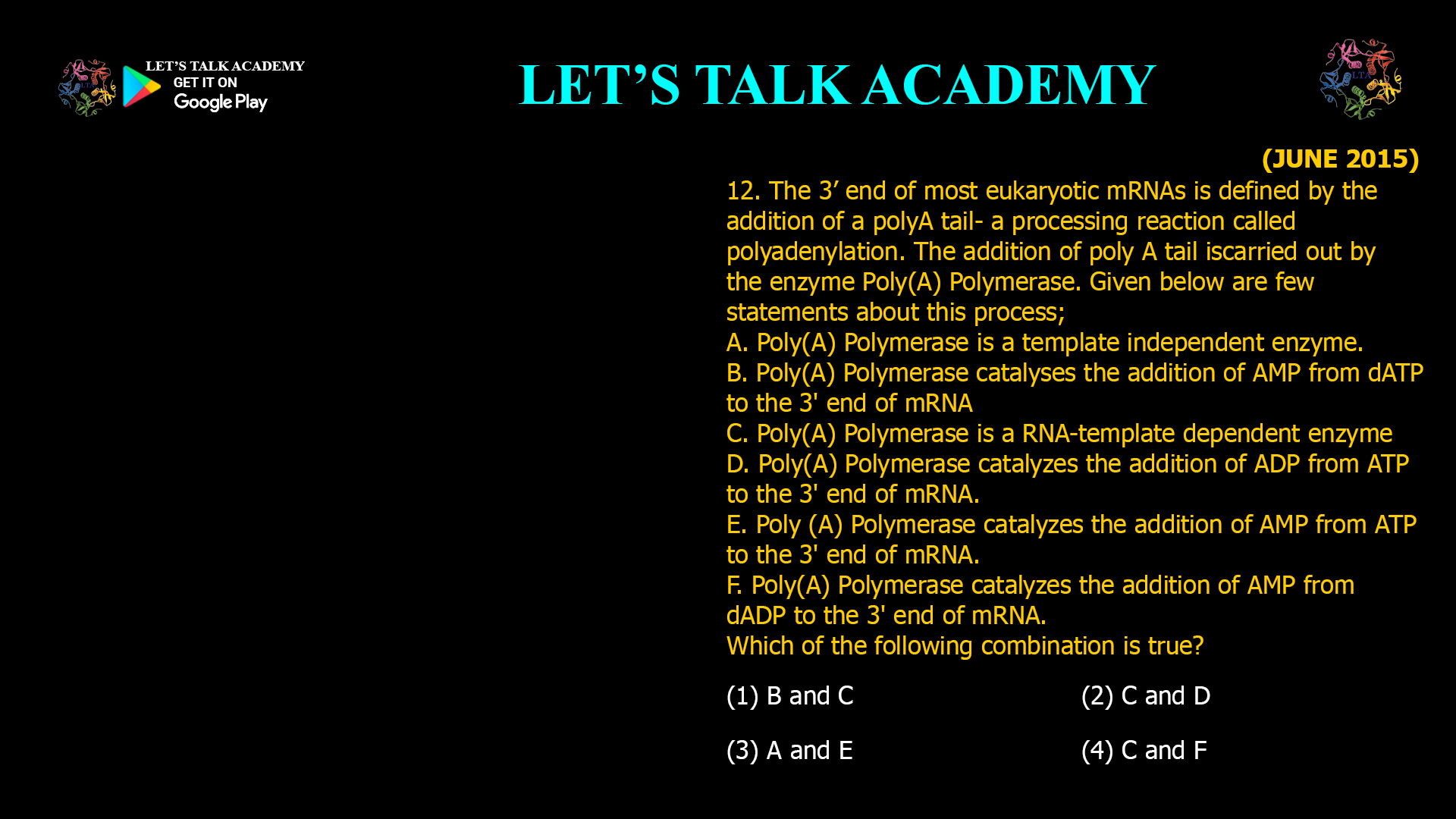
12. The 3’ end of most eukaryotic mRNAs is defined by the addition of a polyA tail- a processing reaction called polyadenylation. The addition of poly A tail is carried out by the enzyme Poly(A) Polymerase. Given below are few statements about this process;
A. Poly(A) Polymerase is a template independent enzyme.
B. Poly(A) Polymerase catalyses the addition of AMP from dATP to the 3′ end of mRNA
C. Poly(A) Polymerase is a RNA-template dependent enzyme
D. Poly(A) Polymerase catalyzes the addition of ADP from ATP to the 3′ end of mRNA.
E. Poly (A) Polymerase catalyzes the addition of AMP from ATP to the 3′ end of mRNA.
F. Poly (A) Polymerase catalyzes the addition of AMP from dADP to the 3′ end of mRNA.
Which of the following combination is true?
(1) B and C (2) C and D
(3) A and E (4) C and F
Understanding Polyadenylation in Eukaryotic mRNA: Role and Mechanism of Poly(A) Polymerase
Polyadenylation is a vital post-transcriptional modification in eukaryotic gene expression, where a stretch of adenine nucleotides, called the poly(A) tail, is added to the 3’ end of most mRNA molecules. This process enhances mRNA stability, nuclear export, and translational efficiency. The enzyme responsible for this addition is Poly(A) Polymerase (PAP), which catalyzes the synthesis of the poly(A) tail in a unique manner.
What is Polyadenylation?
During the maturation of pre-mRNA, the 3’ end is first cleaved at a specific site downstream of a conserved polyadenylation signal sequence (commonly AAUAAA). Following cleavage, Poly(A) Polymerase adds multiple adenosine monophosphates (AMPs) to the newly formed 3’ hydroxyl end, generating the poly(A) tail.
Key Features of Poly(A) Polymerase
-
Template Independence: Unlike most polymerases, Poly(A) Polymerase does not require a nucleic acid template to add adenine residues. It uses ATP as a substrate and adds AMP residues sequentially to the 3’ end of the RNA strand without a complementary RNA or DNA template.
-
Substrate Specificity: PAP catalyzes the addition of AMP residues derived from ATP molecules. It does not use dATP (deoxyadenosine triphosphate) or ADP as substrates, but specifically ATP, transferring AMP to the RNA.
-
RNA-Template Independence: The enzyme’s activity is independent of any RNA template, meaning it does not require a complementary strand to guide the addition of adenines.
Evaluating the Given Statements
-
A. Poly(A) Polymerase is a template independent enzyme.
This is true. PAP adds adenine residues without a nucleic acid template. -
B. Poly(A) Polymerase catalyses the addition of AMP from dATP to the 3′ end of mRNA.
This is false. PAP uses ATP, not dATP. -
C. Poly(A) Polymerase is a RNA-template dependent enzyme.
This is false. PAP is template independent. -
D. Poly(A) Polymerase catalyzes the addition of ADP from ATP to the 3′ end of mRNA.
This is false. PAP adds AMP residues, not ADP. -
E. Poly(A) Polymerase catalyzes the addition of AMP from ATP to the 3′ end of mRNA.
This is true. This correctly describes the enzymatic activity. -
F. Poly(A) Polymerase catalyzes the addition of AMP from dADP to the 3′ end of mRNA.
This is false. dADP is not the substrate.
Correct Combination
The correct combination of true statements is:
(3) A and E
Why Is Polyadenylation Important?
-
mRNA Stability: The poly(A) tail protects mRNA from exonucleolytic degradation, thereby increasing its half-life in the cytoplasm12.
-
Translation Efficiency: Poly(A) tails enhance the recruitment of translation initiation factors, facilitating efficient protein synthesis8.
-
Nuclear Export: Polyadenylation is involved in the export of mature mRNA from the nucleus to the cytoplasm4.
-
Regulation: The length of the poly(A) tail can influence mRNA stability and translational activity, allowing dynamic control of gene expression.
Summary
Polyadenylation is a fundamental step in eukaryotic mRNA processing, performed by the enzyme Poly(A) Polymerase. This enzyme is template independent and catalyzes the addition of AMP residues from ATP to the 3’ end of mRNA. Understanding this process is essential for grasping how cells regulate gene expression post-transcriptionally.
Answer: The correct statements about Poly(A) Polymerase are A and E, making option (3) A and E the right choice.
This detailed explanation highlights the unique enzymatic properties of Poly(A) Polymerase and its critical role in mRNA maturation and gene regulation in eukaryotic cells.


9 Comments
Suman bhakar
June 4, 2025Done sir ✅
Pallavi gautam
June 4, 2025Done
Soniya Shekhawat
June 4, 2025Sir🙏 your notes is sufficient to solve questions easily 👐
Lokesh Kumawat
June 10, 2025Done
Manisha choudhary
November 4, 2025Poly A polymerase template independent enzyme
Poly A polymerase (PAP) catalyzes the addition of AMP from ATP to the 3′ end of mRNA.
statement A and E correct
Heena Mahlawat
November 4, 2025Pap is template independent and incorporates AMP
Roopal Sharma
November 4, 2025PAP independent of template and addition of amp from atp.
Santosh Saini
November 8, 2025Poly (A ) polymerase is a template independent enzymes, Poly A polymerase catalyzes the addition of AMP from ATP to the 3′ end of mRNA
The correct statement are A and E
Sakshi Kanwar
November 8, 2025PAP is a template independent enzymes
PAP catalyzes the addition of AMP from ATP to the 3′ end of mRNA.
Option A AND E