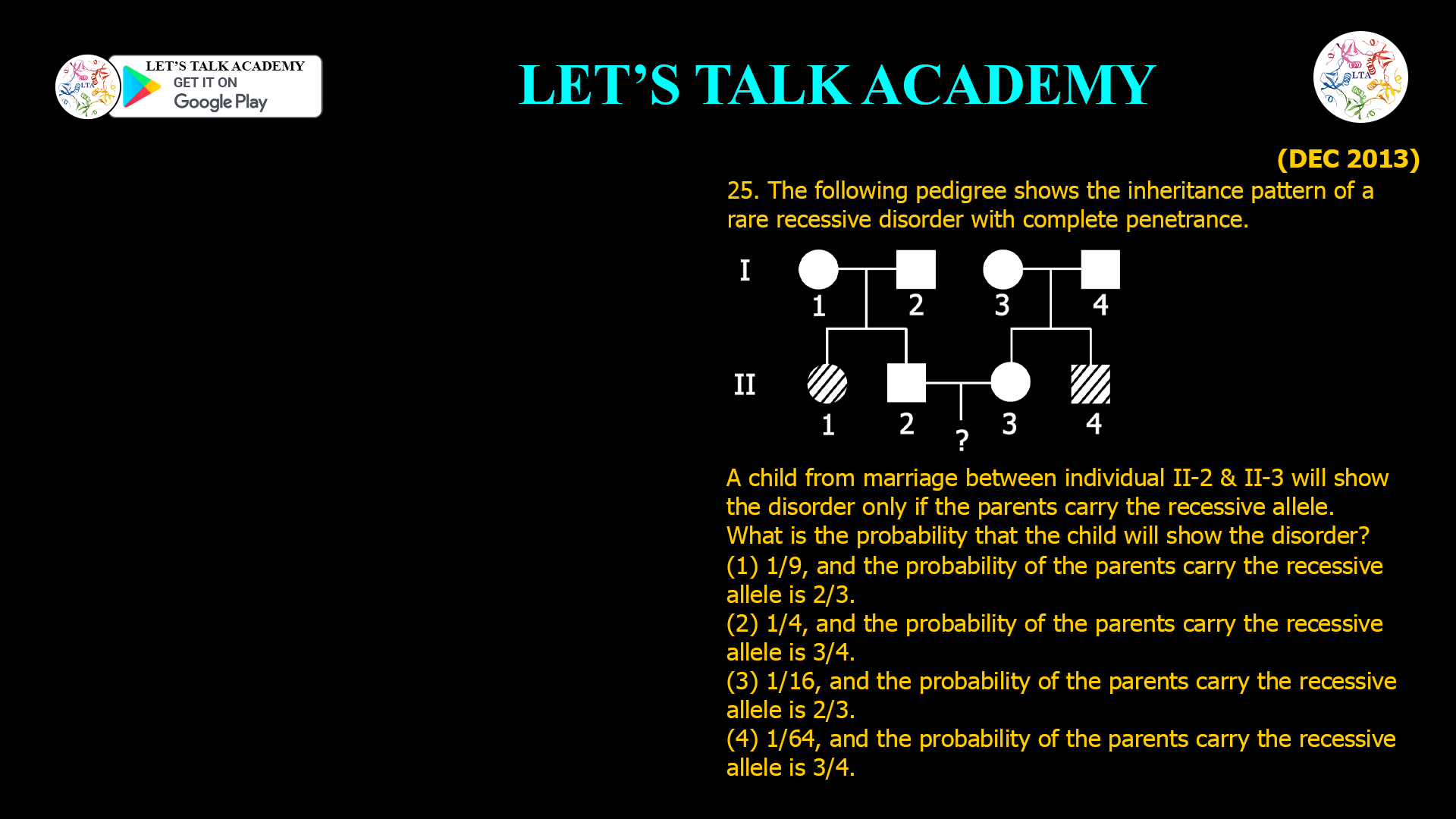
25. The following pedigree shows the inheritance pattern of a rare recessive disorder with complete penetrance.
A child from marriage between individual II-2 & II-3 will show the disorder only if the parents carry the recessive allele. What is the probability that the child will show the disorder?
(1) 1/9, and the probability of the parents carry the recessive allele is 2/3.
(2) 1/4, and the probability of the parents carry the recessive allele is 3/4.
(3) 1/16, and the probability of the parents carry the recessive allele is 2/3.
(4) 1/64, and the probability of the parents carry the recessive allele is 3/4.
Understanding the Pedigree
The disorder is rare, autosomal recessive, and shows complete penetrance. Thus, affected individuals must be homozygous recessive (aa), while unaffected individuals can be either AA or Aa. In the pedigree, both affected individuals in generation II are born to unaffected parents—typical of autosomal recessive inheritance. This implies their parents are heterozygous carriers.
Therefore, in each unaffected sibling of an affected individual, the probability of being a carrier equals 2/3 since among the three unaffected genotypes from an Aa × Aa cross, two are Aa and one is AA.
Stepwise Probability Calculation
- Probability that II‑2 is a carrier (Aa) = 2/3.
- Probability that II‑3 is a carrier (Aa) = 2/3.
- If both are carriers (Aa × Aa), the Mendelian probability that their child is affected (aa) = 1/4.
Overall probability that the child is affected:
P(affected child) = P(both parents carriers) × P(aa | Aa × Aa)
= (2/3 × 2/3) × 1/4 = 4/9 × 1/4 = 1/9.
Thus, the probability that each parent carries the recessive allele is 2/3, and the probability that their child expresses the disorder is 1/9.
Option‑by‑Option Analysis
- Option (1): 1/9, and parents carry the recessive allele with probability 2/3 — Correct.
This matches the calculation above. Each parent has a 2/3 chance of being Aa, giving a 1/9 chance of an affected child. - Option (2): 1/4, and carrier probability 3/4 — Incorrect.
A 1/4 affected probability occurs only when both parents are definitely carriers, which is not the case here. For unaffected siblings, the standard carrier probability is 2/3, not 3/4. - Option (3): 1/16, and carrier probability 2/3 — Incorrect.
If both parents had a 2/3 carrier probability, the affected child probability would be 1/9, not 1/16. A 1/16 probability corresponds to (1/2 × 1/2) × 1/4, inconsistent with this pedigree. - Option (4): 1/64, and carrier probability 3/4 — Incorrect.
A 1/64 probability would imply extremely low carrier probability and does not follow from standard Aa × Aa unaffected‑sibling logic. The 3/4 value for carrier probability is also inconsistent with Mendelian segregation in this context.
Hence, option (1) is the correct answer: affected child probability = 1/9, carrier probability for each parent = 2/3.
SEO‑Friendly Introduction
Pedigree analysis of rare recessive disorders with complete penetrance is a high‑yield topic for CSIR NET Life Sciences and similar genetics examinations. This CSIR NET Dec 2013 question explores how to apply conditional probability to calculate the risk of an affected child (1/9) when both parents are unaffected siblings of affected individuals, each having a 2/3 chance of being a carrier (Aa).


