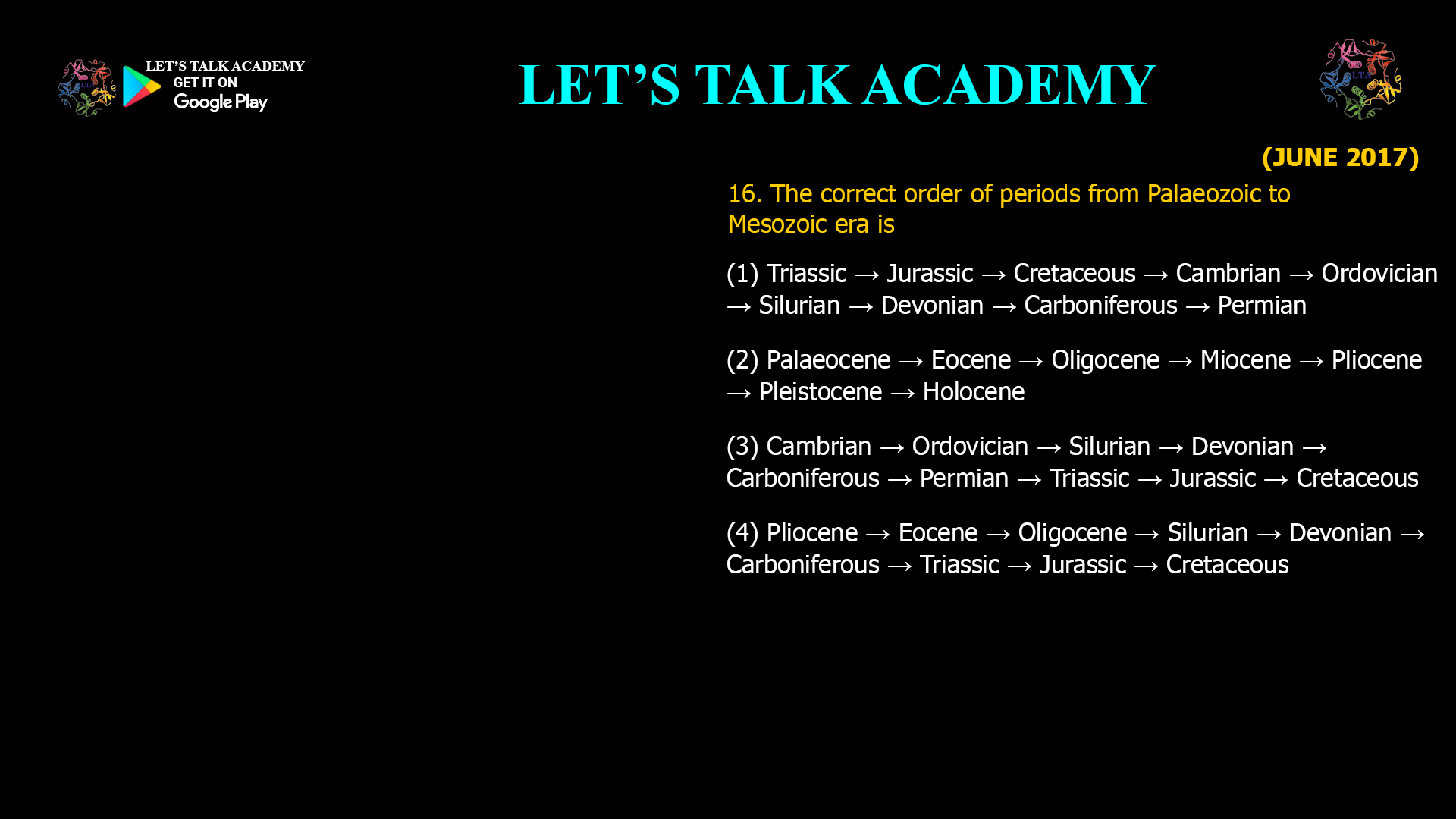
- The correct order of periods from Palaeozoic to Mesozoic era is
(1) Triassic → Jurassic → Cretaceous → Cambrian → Ordovician → Silurian → Devonian
→ Carboniferous → Permian
(2) Palaeocene → Eocene → Oligocene → Miocene → Pliocene → Pleistocene → Holocene
(3) Cambrian → Ordovician → Silurian → Devonian → Carboniferous → Permian → Triassic → Jurassic → Cretaceous
(4) Pliocene → Eocene → Oligocene → Silurian → Devonian → Carboniferous → Triassic → Jurassic → CretaceousIntroduction
Earth’s history is divided into a detailed geological time scale, which helps scientists track the evolution of life and major events that shaped our planet. The Paleozoic and Mesozoic eras are two of the most significant chapters in this timeline, each containing a series of distinct periods marked by dramatic changes in climate, geology, and biodiversity. Understanding the correct order of these periods is crucial for students, educators, and anyone interested in Earth’s past.
Overview of the Paleozoic and Mesozoic Eras
Paleozoic Era
-
Spanning from about 541 to 252 million years ago.
-
Known for the “Cambrian explosion,” the rise of fish and amphibians, and the first forests.
-
Ends with the largest mass extinction in Earth’s history.
Mesozoic Era
-
Lasted from about 252 to 66 million years ago.
-
Called the “Age of Reptiles,” featuring the dominance of dinosaurs.
-
Ends with the Cretaceous–Paleogene extinction event.
Periods of the Paleozoic and Mesozoic Eras
Paleozoic Periods (Oldest to Youngest):
-
Cambrian – Explosion of marine life
-
Ordovician – First vertebrates, diverse marine invertebrates
-
Silurian – First land plants and jawed fish
-
Devonian – Age of fishes, first amphibians
-
Carboniferous – Vast swamp forests, first reptiles
-
Permian – Reptile diversification, ends with mass extinction
Mesozoic Periods (Oldest to Youngest):
-
Triassic – First dinosaurs and mammals
-
Jurassic – Dinosaur dominance, first birds
-
Cretaceous – Flowering plants, ends with dinosaur extinction
The Correct Chronological Order
To correctly arrange the periods from the Paleozoic to the Mesozoic era, you should follow this sequence:
Cambrian → Ordovician → Silurian → Devonian → Carboniferous → Permian → Triassic → Jurassic → Cretaceous
This order traces the progression from the earliest period of the Paleozoic (Cambrian) through to the end of the Mesozoic (Cretaceous).
Evaluating the Options
-
Triassic → Jurassic → Cretaceous → Cambrian → Ordovician → Silurian → Devonian → Carboniferous → Permian
-
Incorrect: Starts with Mesozoic periods, then jumps back to Paleozoic.
-
-
Palaeocene → Eocene → Oligocene → Miocene → Pliocene → Pleistocene → Holocene
-
Incorrect: These are epochs of the Cenozoic era, not periods of Paleozoic or Mesozoic.
-
-
Cambrian → Ordovician → Silurian → Devonian → Carboniferous → Permian → Triassic → Jurassic → Cretaceous
-
Correct: This is the precise chronological order from the Paleozoic through the Mesozoic.
-
-
Pliocene → Eocene → Oligocene → Silurian → Devonian → Carboniferous → Triassic → Jurassic → Cretaceous
-
Incorrect: Mixes epochs from the Cenozoic with periods from the Paleozoic and Mesozoic.
-
The Correct Answer
(3) Cambrian → Ordovician → Silurian → Devonian → Carboniferous → Permian → Triassic → Jurassic → Cretaceous
Conclusion
Understanding the correct order of geological periods from the Paleozoic to the Mesozoic era is essential for grasping the major milestones in Earth’s evolutionary history. The sequence—Cambrian, Ordovician, Silurian, Devonian, Carboniferous, Permian, Triassic, Jurassic, and Cretaceous—marks the rise and fall of dominant life forms and sets the stage for the world as we know it today.
-


1 Comment
Sonal Nagar
November 9, 2025Option 3rd