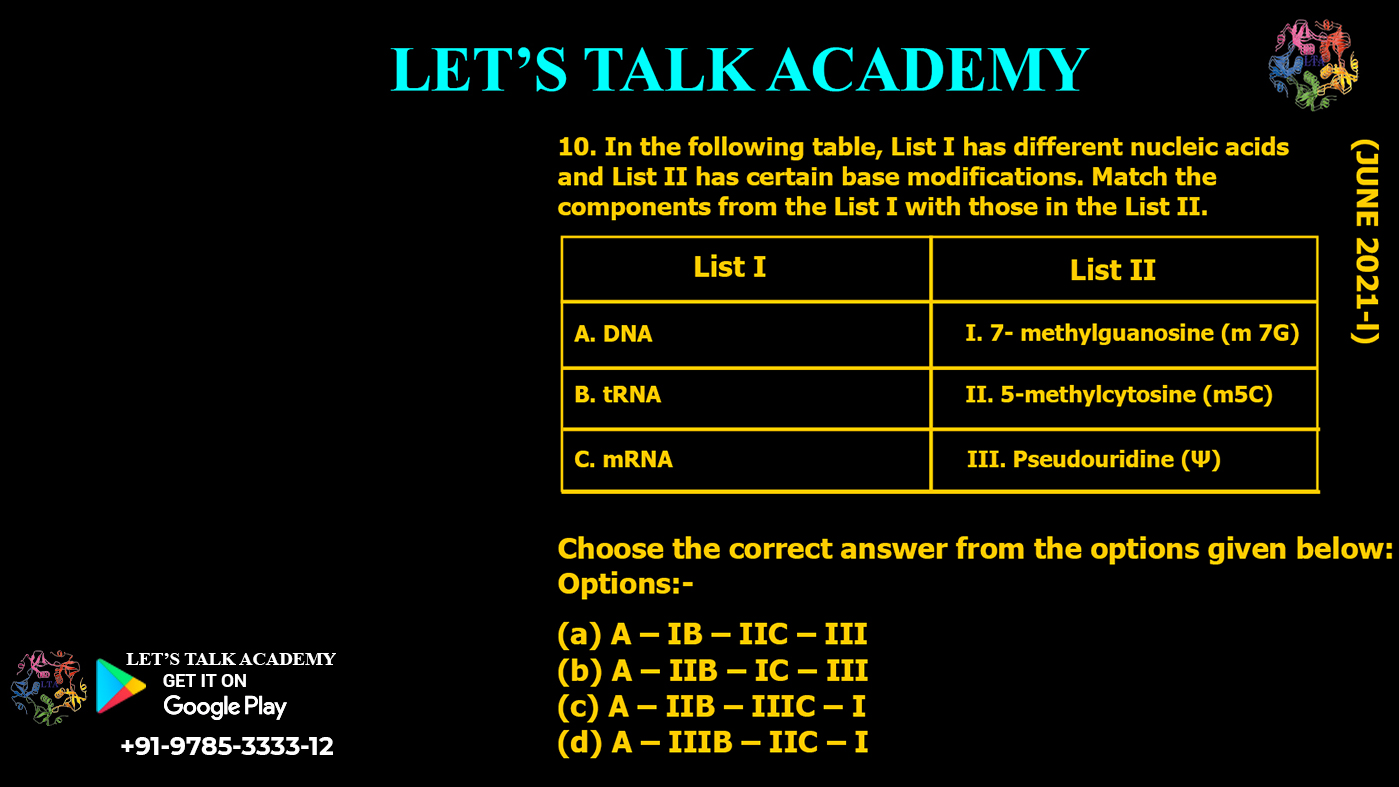
10. In the following table, List I has different nucleic acids and List II has certain base modifications. Match the components from the List I with those in the List II.
List I List II
A. DNA I. 7- methylguanosine (m 7G)
B. tRNA II. 5-methylcytosine (m5C)
C. mRNA III. Pseudouridine (Ψ)
Choose the correct answer from the options given below:
(a) A – IB – IIC – III
(b) A – IIB – IC – III
(c) A – IIB – IIIC – I
(d) A – IIIB – IIC – I
Article:
Introduction to Nucleic Acid Modifications
Nucleic acids, the fundamental molecules of life, are not just simple chains of nucleotides. They are subject to a variety of base modifications that play crucial roles in their structure and function. These modifications influence gene expression, RNA stability, and protein synthesis. In this article, we’ll explore the key base modifications in DNA, tRNA, and mRNA, and how they contribute to cellular processes.
Base Modifications in Nucleic Acids
Each type of nucleic acid in the cell undergoes specific modifications to achieve its unique function. The most common nucleic acids in cellular processes are DNA, tRNA, and mRNA, and each of these can be chemically modified to influence their behavior.
Let’s examine the modifications associated with each type of nucleic acid.
1. DNA Modifications:
In DNA, modifications often regulate gene expression or DNA stability. One such modification is 5-methylcytosine (m5C), which occurs on the cytosine base in the CpG context. This modification plays a significant role in gene silencing, genomic imprinting, and X-chromosome inactivation.
2. tRNA Modifications:
tRNA molecules are essential for protein synthesis. They bring amino acids to the ribosome during translation, and their modifications are crucial for proper function. One important modification in tRNA is pseudouridine (Ψ). This modification enhances the stability and structural integrity of tRNA, ensuring efficient translation.
3. mRNA Modifications:
mRNA molecules serve as the templates for protein synthesis. A key modification in mRNA is the addition of the 7-methylguanosine (m7G) cap at the 5’ end. This cap is crucial for mRNA stability, nuclear export, and initiation of translation. The 5’ cap protects mRNA from degradation and helps in the recognition of the mRNA by the ribosome during translation.
Matching Modifications with Nucleic Acids
Now that we understand the modifications associated with each type of nucleic acid, let’s match them with the components provided in the question:
List I and List II:
-
A. DNA – The modification associated with DNA is 5-methylcytosine (m5C), which is known to play a significant role in regulating gene expression and DNA stability.
-
B. tRNA – The modification associated with tRNA is pseudouridine (Ψ), which is important for the stability and proper function of tRNA during translation.
-
C. mRNA – The modification associated with mRNA is 7-methylguanosine (m7G), which is crucial for the stability and translation of mRNA.
Correct Answer:
Based on the above explanations, the correct matching is:
(b) A – II, B – III, C – I
-
A (DNA) is modified by 5-methylcytosine (m5C).
-
B (tRNA) is modified by pseudouridine (Ψ).
-
C (mRNA) is modified by 7-methylguanosine (m7G).
Conclusion:
The modification of nucleic acids is essential for their proper functioning in cellular processes. Whether it’s DNA, tRNA, or mRNA, these modifications play a critical role in gene regulation, protein synthesis, and molecular stability. Understanding these modifications gives us deeper insight into the biological processes that control life at the molecular level.
Key Takeaways:
-
DNA modification with 5-methylcytosine is important for gene silencing and stability.
-
tRNA modification with pseudouridine enhances stability and function during translation.
-
mRNA modification with 7-methylguanosine is crucial for mRNA stability and translation initiation.
Understanding these modifications not only helps in basic research but also has applications in genetic engineering, drug development, and biotechnology.


2 Comments
Vikram
April 22, 2025Done
yogesh sharma
May 8, 2025Done sir