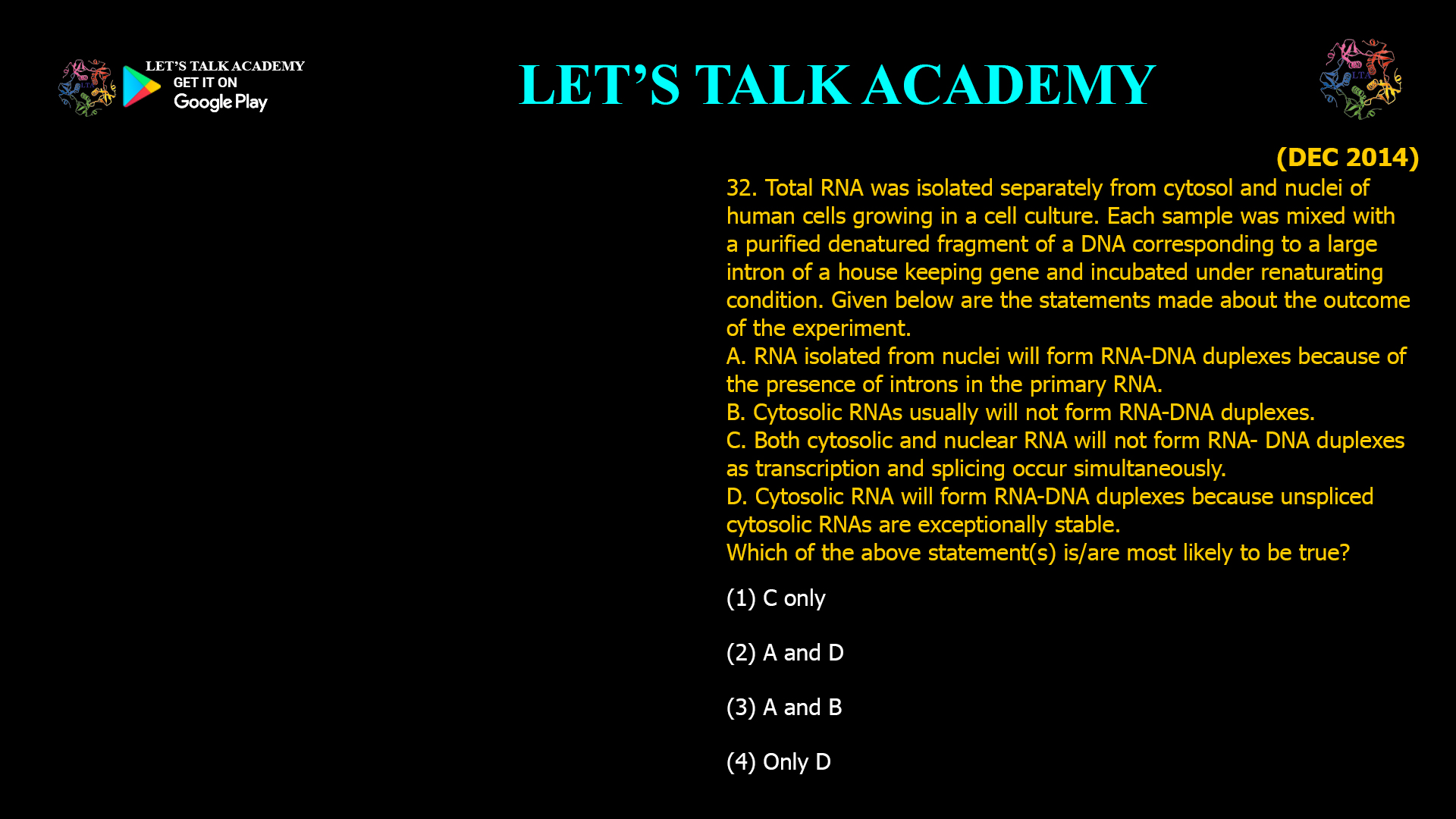
32. Total RNA was isolated separately from cytosol and nuclei of human cells growing in a cell culture. Each sample was mixed with a purified denatured fragment of a DNA corresponding to a large intron of a house keeping gene and incubated under renaturating condition. Given below are the statements made about the outcome of the experiment.
A. RNA isolated from nuclei will form RNA-DNA duplexes because of the presence of introns in the primary RNA.
B. Cytosolic RNAs usually will not form RNA-DNA duplexes.
C. Both cytosolic and nuclear RNA will not form RNA- DNA duplexes as transcription and splicing occur
simultaneously.
D. Cytosolic RNA will form RNA-DNA duplexes because unspliced cytosolic RNAs are exceptionally stable.
Which of the above statement(s) is/are most likely to be true?
(1) C only (2) A and D
(3) A and B (4) only D
The most likely true statements about the RNA-DNA duplex formation in this experiment are:
(3) A and B
Explanation:
A. RNA isolated from nuclei will form RNA-DNA duplexes because of the presence of introns in the primary RNA.
True. Nuclear RNA includes primary transcripts (pre-mRNAs) that still contain introns. When mixed with a DNA fragment corresponding to a large intron, the intron-containing nuclear RNA can hybridize and form RNA-DNA duplexes.
B. Cytosolic RNAs usually will not form RNA-DNA duplexes.
True. Cytosolic RNA is mostly fully processed mature mRNA, which has had introns spliced out. Since the DNA fragment corresponds to an intron, mature cytosolic RNA lacking intron sequences will not hybridize effectively, so duplex formation is minimal or absent.
C. Both cytosolic and nuclear RNA will not form RNA-DNA duplexes as transcription and splicing occur simultaneously.
False. Although transcription and splicing are coupled, splicing is not always complete immediately, and nuclear RNA contains unspliced introns. Therefore, nuclear RNA can form duplexes with intron DNA.
D. Cytosolic RNA will form RNA-DNA duplexes because unspliced cytosolic RNAs are exceptionally stable.
False. Unspliced RNAs are generally not stable in the cytosol; they are rapidly degraded or retained in the nucleus. Hence, cytosolic RNA mostly lacks introns and will not hybridize with intron DNA.
Summary Table
| Statement | True/False | Reason |
|---|---|---|
| A | True | Nuclear RNA contains introns and can hybridize with intron DNA fragments. |
| B | True | Cytosolic RNA is mostly spliced and lacks intron sequences, so no duplex forms. |
| C | False | Nuclear RNA still contains introns; splicing is not always simultaneous and complete. |
| D | False | Unspliced RNAs are unstable and rare in cytosol; cytosolic RNA usually lacks introns. |
Conclusion
Nuclear RNA forms RNA-DNA duplexes with intron DNA due to the presence of introns, while cytosolic RNA generally does not. Therefore, the correct choice is:
(3) A and B


11 Comments
Ekta yadav
June 4, 2025Done sir 👍🏼
Yashika Rajawat
June 4, 2025Cell blowing explanation
Aman
June 4, 2025Gud qustion and my answer is also right thank u sir
Sapna yadav
June 5, 2025Best explanation
Komal Sharma
June 6, 2025Done ✅
Muskan saini
June 6, 2025Done sir
Lokesh kumawat
June 7, 2025Done
Prami Masih
June 8, 2025👍👍👍
Santosh Saini
November 3, 2025(A)RNA isolated from nucleic will form RNA -DNA duplexes because of the presence of introns in the primary RNA. ( B)cytosolic RNAs usually will not form RNA DNA duplexes , statement A and B will be correct
Priya khandal
November 3, 2025A and b is right
Heena Mahlawat
November 5, 2025A and B