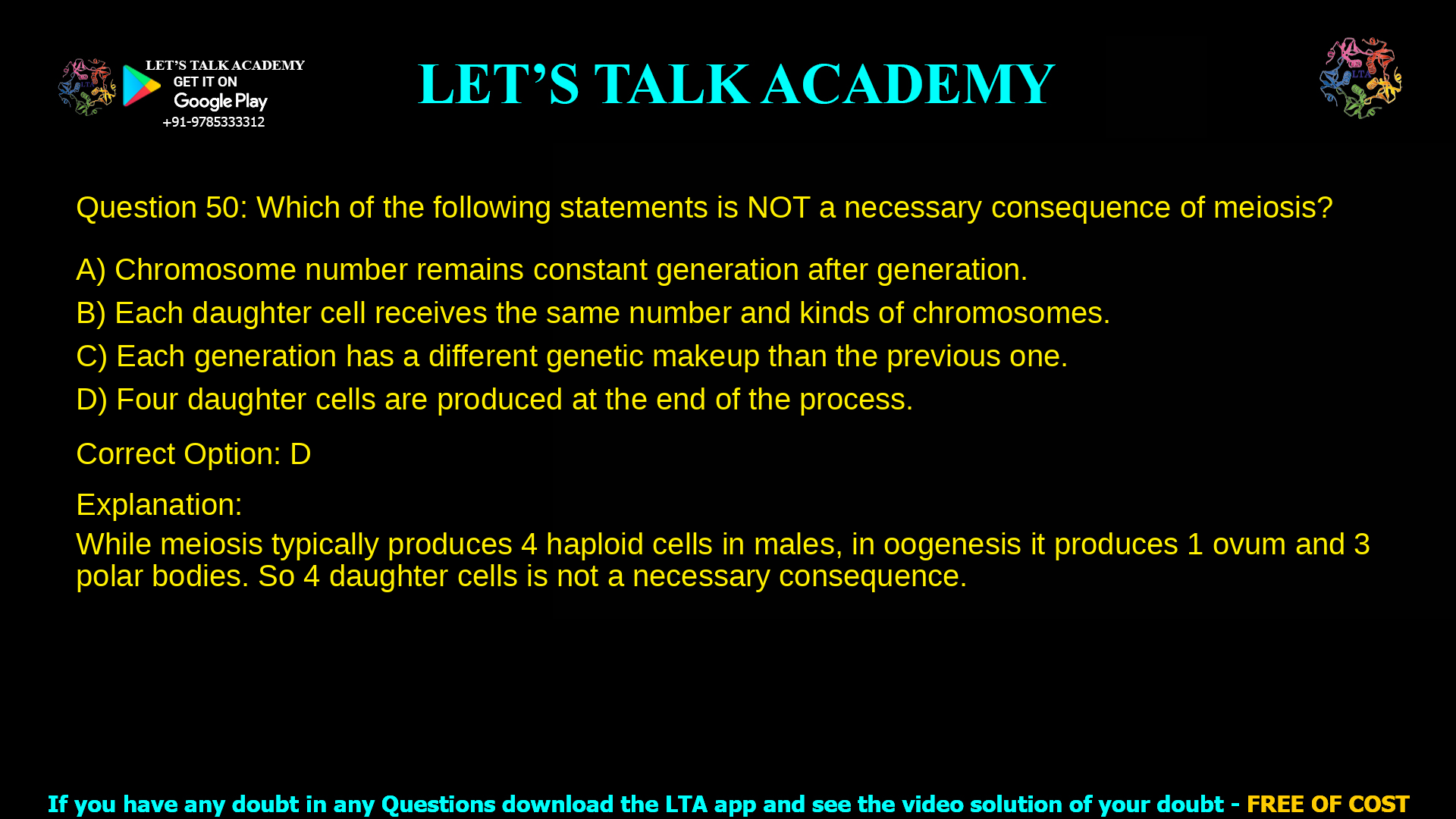
5. Which of the following statements is NOT a necessary consequence of meiosis?
a. Chromosome number remains constant generation after generation.
b. Each daughter cell receives the same number and kinds of chromosomes.
c. Each generation has a different genetic makeup than the previous one.
d. Four daughter cells are produced at the end of the process.
Meiosis produces four genetically diverse haploid daughter cells from a diploid parent cell. The statement that is NOT a necessary consequence of meiosis is option b.
Question Analysis
This multiple-choice question tests core concepts of meiosis from CSIR NET Life Sciences syllabus, focusing on its outcomes in cell division, chromosome reduction, and genetic variation.
Option Breakdown
-
a. Chromosome number remains constant generation after generation. Meiosis reduces diploid (2n) cells to haploid (n) gametes, which restore 2n upon fertilization, maintaining species-specific chromosome number across generations.
-
b. Each daughter cell receives the same number and kinds of chromosomes. All four daughter cells receive the same haploid number (n), but independent assortment and crossing over ensure different kinds of chromosomes, making identical genetic content unnecessary.
-
c. Each generation has a different genetic makeup than the previous one. Recombination during prophase I and random chromosome segregation create novel allele combinations, driving genetic diversity essential for evolution.
-
d. Four daughter cells are produced at the end of the process. One diploid cell undergoes two divisions (meiosis I and II), yielding four haploid cells.
Correct Answer
b is not a necessary consequence, as meiosis prioritizes variation over genetic identity among daughter cells.
Meiosis ensures chromosome number constancy across generations while generating genetic diversity through four unique daughter cells. Understanding not necessary consequence of meiosis clarifies why option b fails in CSIR NET questions.
Meiosis Fundamentals
Meiosis halves chromosome number from diploid to haploid gametes, preventing doubling during fertilization. Two divisions produce four cells, with crossing over introducing variation.
Why Option b Fails
Daughter cells share chromosome number but not kinds due to recombination and assortment, unlike mitosis. This diversity is meiosis’s hallmark, not uniformity.
Exam Relevance
CSIR NET tests these distinctions; meiosis maintains chromosome constancy (a, true) and yields four cells (d, true) with variation (c, true).


