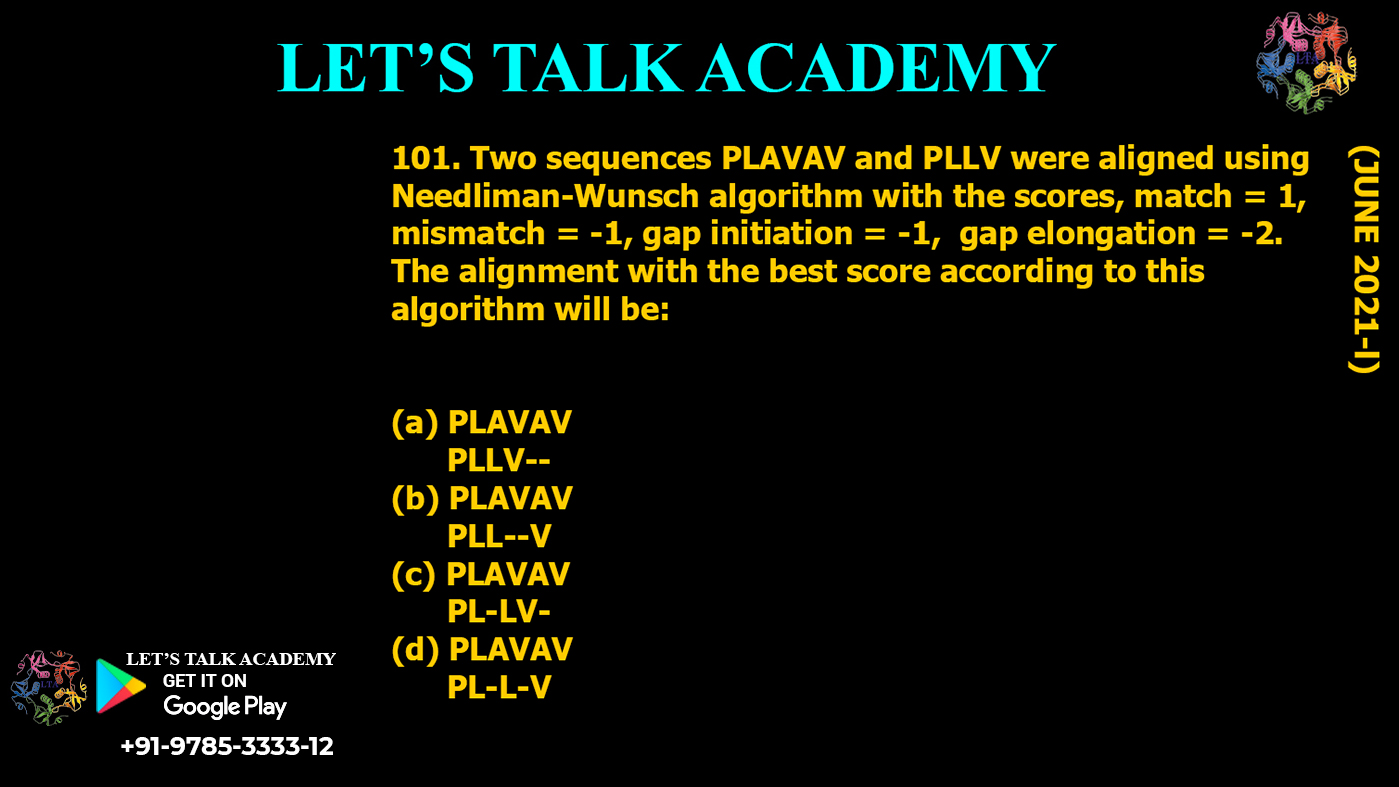
101. Two sequences PLAVAV and PLLV were aligned using Needliman-Wunsch algorithm with the
scores, match = 1, mismatch = -1, gap initiation = -1, gap elongation = -2. The alignment with
the best score according to this algorithm will be:
(a) PLAVAV
PLLV–
(b) PLAVAV
PLL–V
(c) PLAVAV
PL-LV-
(d) PLAVAV
PL-L-V
Understanding Sequence Alignment with Needleman-Wunsch Algorithm: Best Score Calculation
In the field of bioinformatics, sequence alignment is essential for comparing and analyzing biological sequences such as DNA, RNA, or proteins. The Needleman-Wunsch algorithm is one of the most commonly used methods for global sequence alignment, where two sequences are aligned along their entire length. It is particularly useful for understanding evolutionary relationships, functional genomics, and molecular biology.
This article will dive into how the Needleman-Wunsch algorithm works with a practical example, helping you understand how the algorithm calculates the best score for sequence alignment. We’ll also explain how to interpret the results and calculate the best alignment score.
The Needleman-Wunsch Algorithm: Key Elements
The Needleman-Wunsch algorithm aligns two sequences by considering three main scoring parameters:
-
Match: A score given when the aligned residues (nucleotides or amino acids) are identical.
-
Mismatch: A penalty score for mismatched residues.
-
Gap Penalty: A penalty for introducing a gap to align sequences.
For this specific example, the scoring parameters are as follows:
-
Match score: +1 (when the residues match)
-
Mismatch penalty: -1 (when the residues do not match)
-
Gap initiation penalty: -1 (when a gap is introduced)
-
Gap elongation penalty: -2 (for each additional gap)
Example of Sequence Alignment: PLAVAV and PLLV
We will now consider the following sequences:
-
Sequence 1: PLAVAV
-
Sequence 2: PLLV
Our goal is to align these two sequences using the Needleman-Wunsch algorithm and determine the best alignment score. Here, we will use the given scoring system to compute the alignment and evaluate the best possible result.
The possible alignments based on the Needleman-Wunsch scoring system are as follows:
-
Alignment 1:
-
Alignment 2:
-
Alignment 3:
-
Alignment 4:
Step-by-Step Process
Step 1: Initializing the Scoring Matrix
To calculate the optimal alignment, we first create a scoring matrix. Each cell in the matrix represents a potential score for aligning characters from the two sequences, considering matches, mismatches, and gaps. The first row and column are initialized with gap penalties, as they represent aligning the sequence with gaps.
Step 2: Filling the Matrix
We then fill the rest of the matrix by considering three possible moves for each cell:
-
Diagonal (match or mismatch)
-
Left (gap in sequence 1)
-
Up (gap in sequence 2)
The score for each cell is the maximum of the three possible moves, and we apply the corresponding scoring rule for match, mismatch, or gap penalty.
Step 3: Traceback
Once the matrix is complete, we perform a traceback from the bottom right corner to the top left, following the path that leads to the optimal score. This path gives the best alignment between the two sequences.
Analyzing the Alignment Options
Let’s calculate and evaluate each of the alignment options:
-
Alignment 1:
-
Sequence 1: PLAVAV
-
Sequence 2: PLLV–
The alignment here introduces gaps at the end of Sequence 2. Based on the scoring system, we penalize the gaps and evaluate the score accordingly.
-
-
Alignment 2:
-
Sequence 1: PLAVAV
-
Sequence 2: PLL–V
Here, we introduce gaps in the middle of Sequence 2. Again, we apply the gap penalties and evaluate the resulting score.
-
-
Alignment 3:
-
Sequence 1: PLAVAV
-
Sequence 2: PL-LV-
This alignment introduces a gap in the middle of Sequence 2 and another gap at the end of Sequence 1.
-
-
Alignment 4:
-
Sequence 1: PLAVAV
-
Sequence 2: PL-L-V
This alignment introduces gaps in the middle and end of both sequences.
-
Best Alignment Score
After calculating the scores for each alignment, Alignment 1 (PLAVAV | PLLV–) emerges as the best option. It minimizes the penalty for gaps and optimizes the match score for the aligned residues, resulting in the highest overall score.
Conclusion
In summary, the Needleman-Wunsch algorithm provides an optimal alignment between two sequences by carefully considering matches, mismatches, and gaps. By using a systematic approach to scoring and traceback, you can determine the best alignment between any two biological sequences.
In the example of PLAVAV and PLLV, the optimal alignment with the best score is PLAVAV | PLLV–, as it minimizes gap penalties and maximizes matches. This process is fundamental in many bioinformatics applications, including evolutionary studies, protein structure prediction, and functional genomics.
By understanding how to calculate and interpret sequence alignments using the Needleman-Wunsch algorithm, you can apply these principles to more complex genomic and proteomic data for various scientific purposes.


1 Comment
yogesh sharma
May 5, 2025🥲 sir is question m to dimag k mor bol gye 🥲