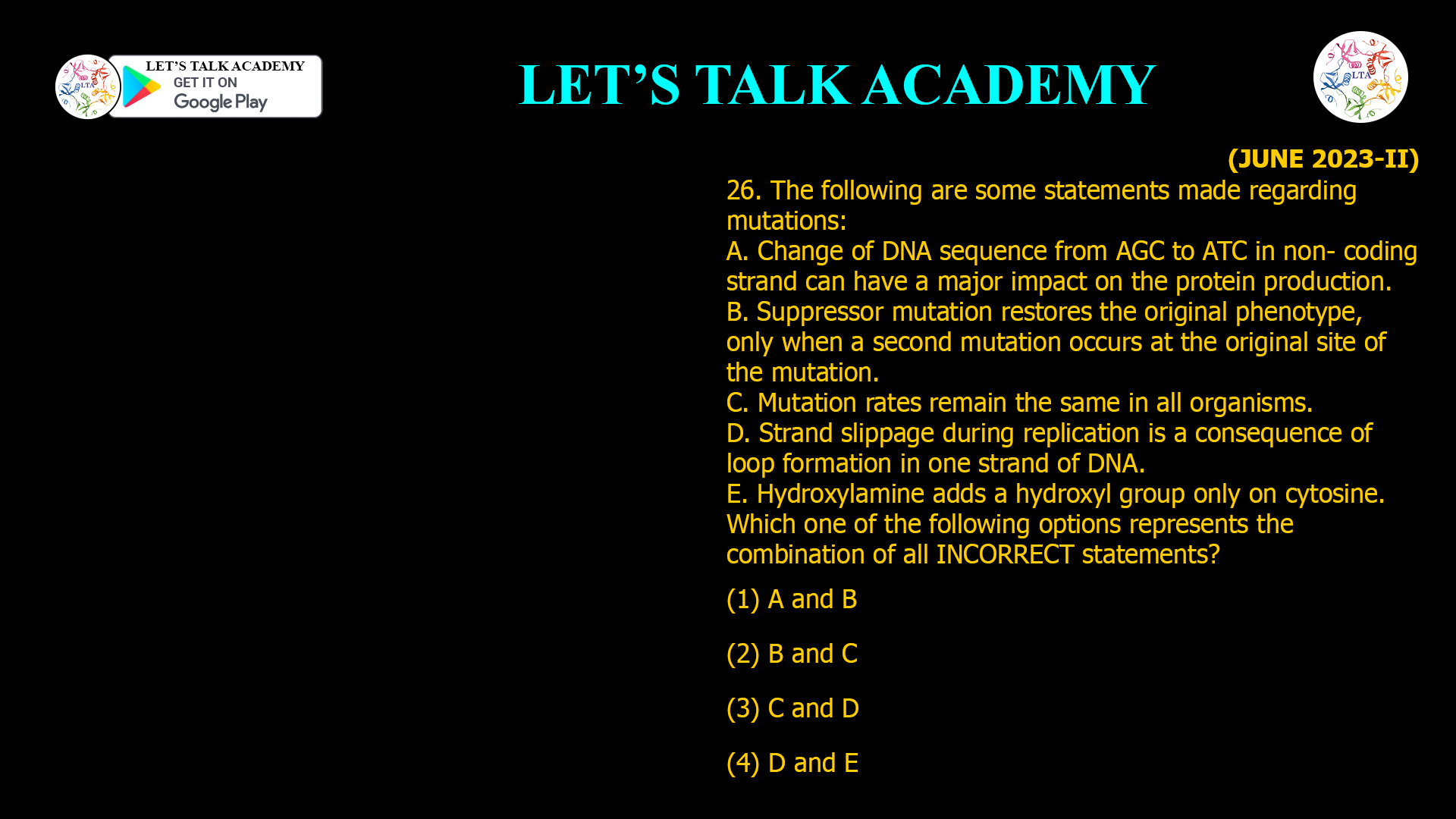
26. The following are some statements made regarding mutations:
A. Change of DNA sequence from AGC to ATC in non- coding strand can have a major impact on the protein production.
B. Suppressor mutation restores the original phenotype, only when a second mutation occurs at the original site of the mutation.
C. Mutation rates remain the same in all organisms.
D. Strand slippage during replication is a consequence of loop formation in one strand of DNA.
E. Hydroxylamine adds a hydroxyl group only on cytosine.
Which one of the following options represents the combination of all INCORRECT statements?
(1) A and B
(2) B and C
(3) C and D
(4) D and E
Mutations represent permanent changes in DNA sequences that can alter protein production and organismal phenotypes, forming. This question evaluates understanding of mutation mechanisms, mutagens, and variability across organisms through five statements. The task requires identifying all incorrect statements to select the right combination, with the correct answer being option (2) B and C.
Statement A Analysis
Statement A claims: “Change of DNA sequence from AGC to ATC in non-coding strand can have a major impact on the protein production.” This is correct because the non-coding (template) strand directs mRNA synthesis. Original template AGC transcribes to mRNA UCG (Serine), but ATC transcribes to UAG (stop codon), causing premature termination and truncated protein.
Statement B Analysis
Statement B states: “Suppressor mutation restores the original phenotype, only when a second mutation occurs at the original site of the mutation.” This is incorrect. Suppressor mutations restore phenotype via a second mutation at a different site (intergenic or intragenic), distinct from reversion mutations at the original site.
Statement C Analysis
Statement C asserts: “Mutation rates remain the same in all organisms.” This is incorrect as rates vary widely; prokaryotes show lower per-generation rates than vertebrates, influenced by genome size and replication fidelity.
Statement D Analysis
Statement D describes: “Strand slippage during replication is a consequence of loop formation in one strand of DNA.” This is correct; repetitive sequences cause loop outs in the nascent strand during replication, leading to insertions/deletions.
Statement E Analysis
Statement E says: “Hydroxylamine adds a hydroxyl group only on cytosine.” This is correct; hydroxylamine specifically hydroxylates cytosine to hydroxylaminocytosine, promoting C-to-T transitions.
Correct Option Breakdown
-
Option (1) A and B: Incorrect, as A is correct.
-
Option (2) B and C: Correct, both B and C are incorrect.
-
Option (3) C and D: Incorrect, as D is correct.
-
Option (4) D and E: Incorrect, both correct.


