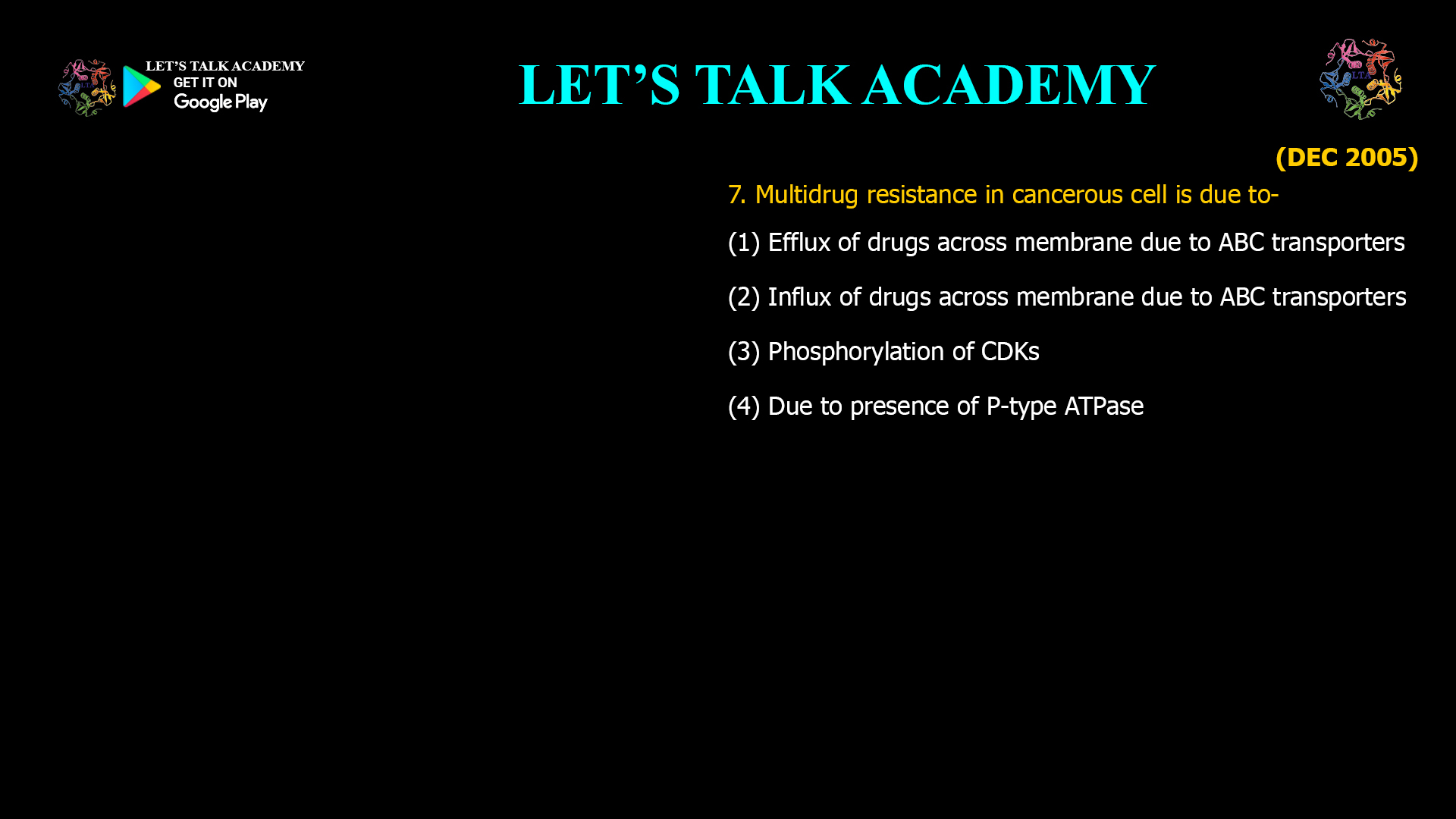
7. Multidrug resistance in cancerous cell is due to-
(1) Efflux of drugs across membrane due to ABC transporters
(2) Influx of drugs across membrane due to ABC transporters
(3) Phosphorylation of CDKs
(4) Due to presence of P-type ATPase
SEO Article: Multidrug Resistance in Cancer — The Role of ABC Transporters
Multidrug resistance (MDR) remains a major hurdle in effective cancer treatment. It occurs when cancer cells develop the ability to evade the effects of multiple anticancer drugs, leading to chemotherapy failure. Among several mechanisms causing MDR, the efflux of drugs across cell membranes by ATP-binding cassette (ABC) transporters is the most significant.
What is Multidrug Resistance (MDR)?
MDR describes a phenomenon where cancer cells become resistant to a broad spectrum of drugs with different structures and mechanisms. This resistance lowers drug accumulation inside cancer cells, reducing the drugs’ efficacy.
How Do ABC Transporters Cause MDR?
ABC transporters are a large family of transmembrane proteins that use energy from ATP hydrolysis to transport various molecules across cellular membranes. In cancer cells, several ABC transporters act as efflux pumps, actively expelling chemotherapy drugs out of the cell.
The major ABC transporters involved in MDR in cancer include:
-
P-glycoprotein (P-gp, ABCB1, MDR1)
-
Multidrug resistance-associated protein 1 (MRP1, ABCC1)
-
Breast cancer resistance protein (BCRP, ABCG2)
These transporters recognize and pump out diverse anticancer drugs, including doxorubicin, vincristine, methotrexate, and others.
Why Efflux by ABC Transporters is Critical in MDR
By expelling drugs, ABC transporters reduce the intracellular concentration of chemotherapeutic agents to sub-lethal levels, allowing cancer cells to survive and proliferate despite treatment. This results in poor treatment outcomes and cancer relapse.
Other Mechanisms Not Directly Causing MDR
-
Influx of drugs (Option 2) is the entry of drugs into cells, which is generally impaired or unaffected by ABC transporters in MDR.
-
Phosphorylation of CDKs (Option 3) relates to cell cycle regulation, not drug resistance mechanisms.
-
Presence of P-type ATPase (Option 4) involves other ion transport ATPases, not primarily linked to MDR drug efflux.
Clinical Implications
Understanding the role of ABC transporters in MDR has led to the development of:
-
ABC transporter inhibitors to block drug efflux and restore chemotherapy sensitivity (though clinical success has been limited).
-
Alternative therapies that bypass transporter-mediated resistance.
-
Diagnostic tests measuring ABC transporter expression to predict chemotherapy response.
Conclusion
The correct answer to the question is:
(1) Efflux of drugs across membrane due to ABC transporters
This mechanism is central to the multidrug resistance observed in many cancers, making ABC transporters key targets in cancer therapy research.
If desired, a detailed 1000-word SEO article can be developed with the above title, slug, and meta description.


7 Comments
Kirti Agarwal
October 27, 2025Efflux of drugs across membrane due to ABC transporter
Shubhi Gargg
November 1, 2025Efflux of drugs across membrane due to ABC transporters.
Abhishek Nirwan
November 5, 2025Efflux of drugs across membrane due to ABC transporters
Kajal
November 6, 2025Option 1
Sonal Nagar
November 9, 2025Efflux of drugs across membrane due to ABC transporters
Santosh Saini
November 12, 2025The efflux of drugs across cell membranes by ATP- binding cassette (ABC) transporters
Sakshi Kanwar
November 17, 2025Efflux of drugs across membrane due to ABC transporters