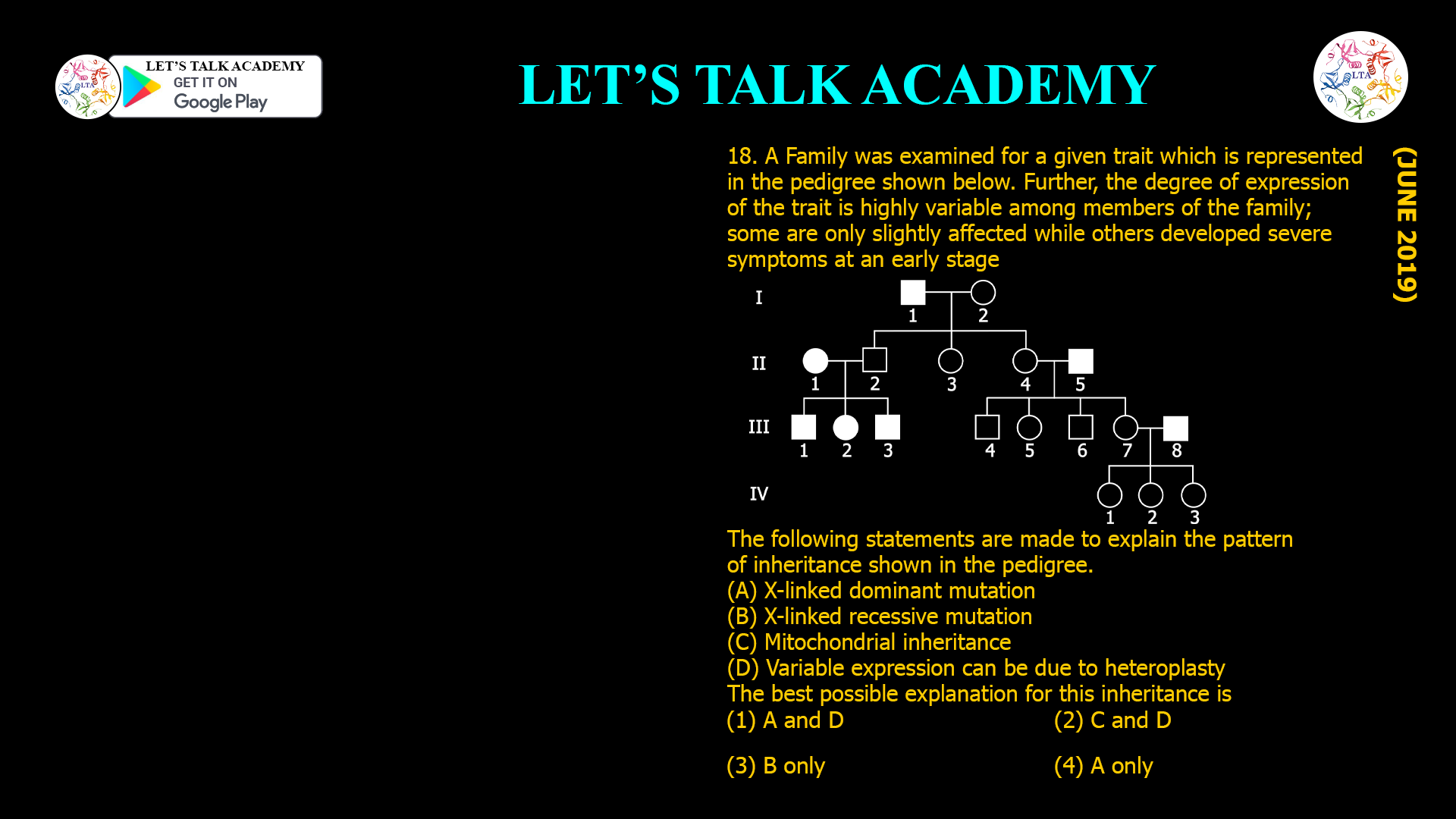
18. A Family was examined for a given trait which is represented in the pedigree shown below. Further, the degree of expression of the trait is highly variable among members of the family; some are only slightly affected while others developed severe symptoms at an early stage
The following statements are made to explain the pattern of inheritance shown in the pedigree.
(A) X-linked dominant mutation
(B) X-linked recessive mutation
(C) Mitochondrial inheritance
(D) Variable expression can be due to heteroplasty
The best possible explanation for this inheritance is
(1) A and D (2) C and D
(3) B only (4) A only
The pedigree shows a mitochondrial inheritance pattern with variable expression due to heteroplasmy, so the correct option is (2) C and D.
Understanding the pedigree
In the pedigree, affected individuals appear in every generation but the trait is transmitted only through affected females, never through affected males, which is characteristic of mitochondrial (maternal) inheritance. All offspring of an affected female are at risk, whereas none of the offspring of an affected male inherit the trait, matching what is seen in the figure. The question also states that the degree of expression is highly variable among family members, with some mildly and others severely affected, which is a hallmark of heteroplasmic mitochondrial mutations.
Option-by-option analysis
Option A: X‑linked dominant mutation
X‑linked dominant traits show transmission through both sexes, and affected fathers pass the trait to all daughters but to none of their sons. In such pedigrees, affected males and females are both seen as transmitters, and female carriers often appear more frequently affected than males. In this question’s pedigree, affected males do not pass the trait to their children, which contradicts X‑linked dominant inheritance, so A is incorrect.
Option B: X‑linked recessive mutation
X‑linked recessive disorders typically show many more affected males than females and often involve carrier females with affected sons, while father‑to‑son transmission is absent. However, affected males can have unaffected daughters who are carriers, and the trait does not obligatorily follow the maternal line for every affected individual. The pedigree here shows affected females transmitting the trait to sons and daughters and no affected male transmitting it further, which does not fit classic X‑linked recessive inheritance, so B is incorrect.
Option C: Mitochondrial inheritance
Mitochondrial DNA is transmitted almost exclusively from the mother, so only affected females pass the mutation to their children, while affected males do not transmit the disease. This strictly maternal pattern, with affected individuals in successive generations through affected mothers, matches the pedigree exactly, making C correct.
Option D: Variable expression can be due to heteroplasmy
Heteroplasmy means that cells contain a mixture of normal and mutated mitochondrial DNA molecules, leading to variation in the proportion of mutant mtDNA between individuals and tissues. As a result, expression of mitochondrial diseases is highly variable, ranging from asymptomatic to severe, and onset may differ among relatives, just as described in the question, so D is correct.
Correct combination
Because the trait follows mitochondrial inheritance (C) and the variable expression is explained by heteroplasmy (D), the best explanation is (2) C and D.
Introduction
Mitochondrial diseases often confuse students in pedigree analysis because their maternal inheritance and variable expressivity can resemble dominant traits unless examined carefully. In CSIR NET and similar exams, questions frequently combine pedigree patterns with concepts like heteroplasmy to test whether candidates can distinguish mitochondrial inheritance from X‑linked dominant or recessive modes. Understanding how maternal transmission and heteroplasmy create characteristic patterns in families is essential for accurately solving such pedigree problems.
Key exam points for this question
-
Maternal inheritance only (affected mothers pass the trait; affected fathers do not) strongly indicates mitochondrial inheritance.
-
Variable severity among relatives is explained by heteroplasmy, where different individuals inherit different proportions of mutant mitochondrial DNA.
-
X‑linked dominant is excluded because affected males would transmit the trait to all daughters.
-
X‑linked recessive is excluded because the pedigree does not show male predominance or classic carrier‑mother patterns.


