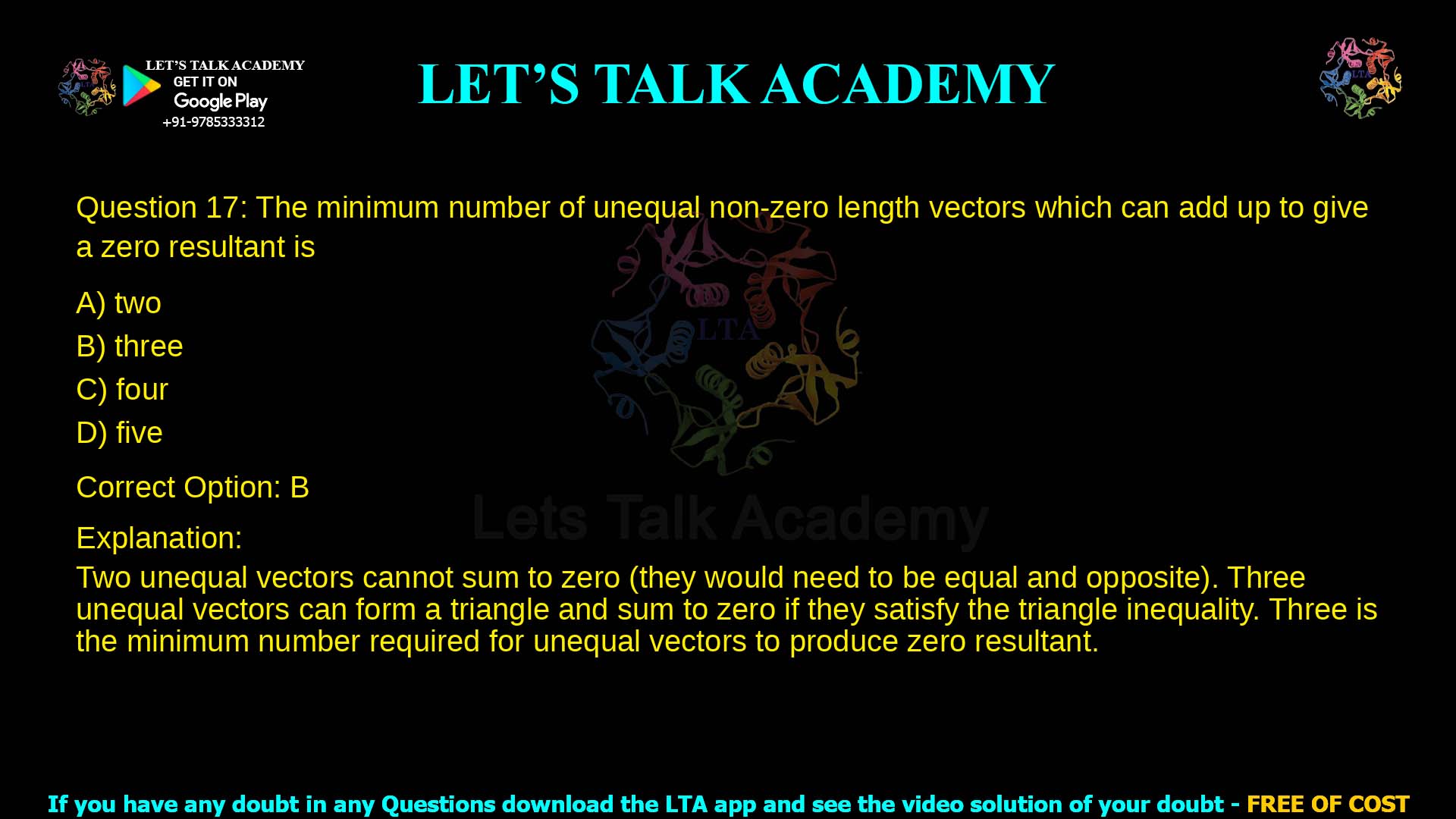
2. The minimum number of unequal non-zero length vectors which can add up to give
a zero resultant is
a. two
b. three
c. four
d. five
Concept Overview
In vector addition, the resultant is zero if the given vectors form a closed polygon when drawn head-to-tail.
For unequal and non-zero vectors, the smallest such combination occurs when three vectors form a closed triangle.
Option Analysis
Option a: Two
Two non-zero vectors can sum to zero only if they are equal in magnitude and opposite in direction.
If magnitudes differ, they cannot cancel each other completely, leaving a non-zero resultant.
Option b: Three (Correct)
Three unequal non-zero vectors can give a zero resultant when they form a closed triangle.
When placed head to tail, their vector sum equals zero, since:
A⃗ + B⃗ + C⃗ = 0
or equivalently,
C⃗ = −(A⃗ + B⃗).
Example: Vectors of magnitudes 3N, 4N, and 5N can satisfy this condition
if arranged at appropriate angles to form a closed triangle.
Option c: Four
Four unequal vectors can also result in zero resultant (for instance, forming a closed quadrilateral or a tetrahedral configuration),
but since three already suffice, three is considered the minimum number for the coplanar case.
Option d: Five
Five or more vectors can sum to zero, but they exceed the minimum necessary number.
Vector Addition Concept
Vectors add according to the parallelogram or polygonal law.
For a zero resultant, the vectors must form a closed polygon.
Unequal non-zero vectors cannot satisfy this condition with just two vectors,
but can with three that obey the triangle inequality (a + b > c, etc.).
Conclusion
Therefore, the minimum number of unequal non-zero vectors whose resultant is zero is three.


