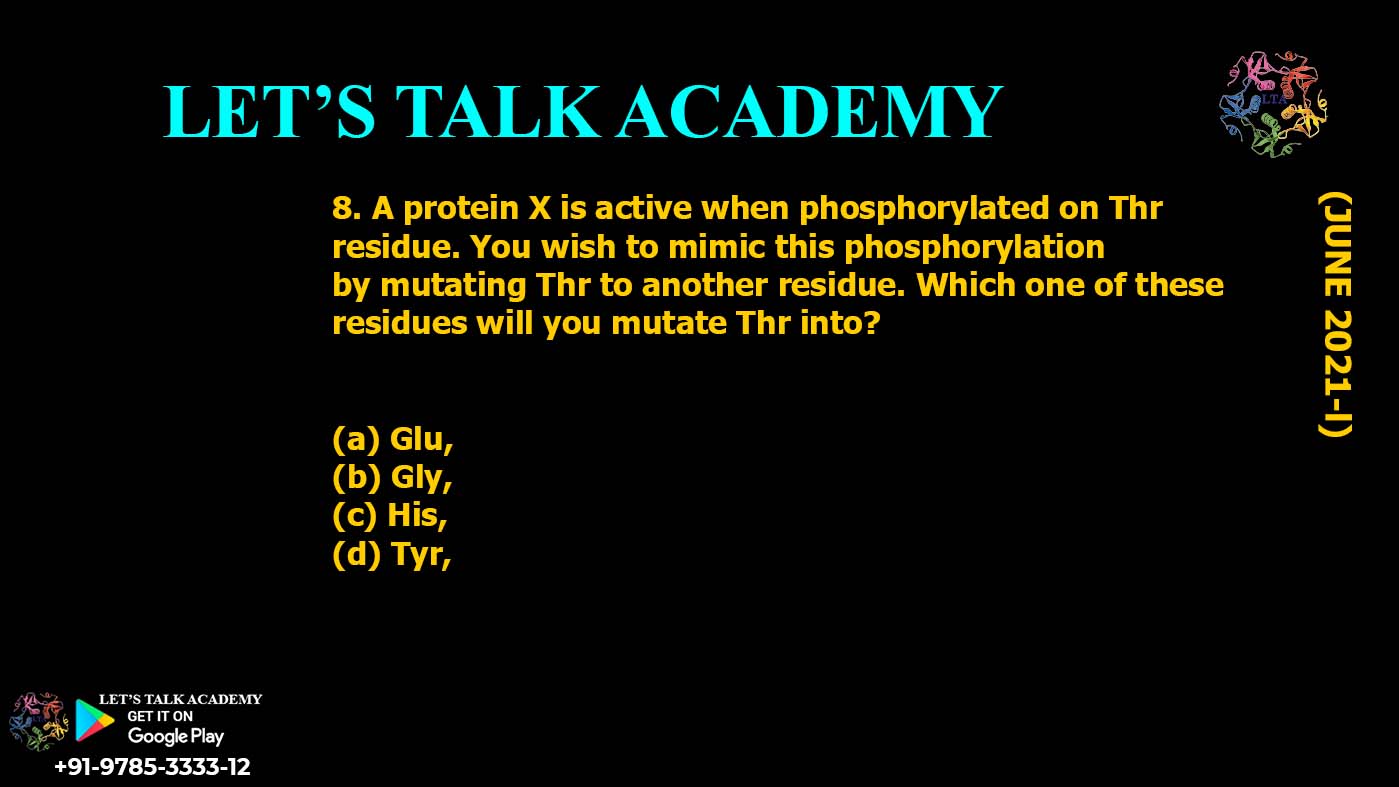
8. A protein X is active when phosphorylated on Thr residue. You wish to mimic this phosphorylation
by mutating Thr to another residue. Which one of these residues will you mutate Thr into?
(a) Glu,
(b) Gly,
(c) His,
(d) Tyr,
Article:
Introduction to Protein Phosphorylation and Its Role in Cellular Activity
Protein phosphorylation is a critical post-translational modification that regulates various cellular processes, including signal transduction, enzyme activation, and cellular localization. One of the most common phosphorylation sites in proteins is the hydroxyl group of threonine (Thr), serine (Ser), or tyrosine (Tyr) residues. Phosphorylation typically leads to a functional change in the protein, either by activating or deactivating its activity.
In some experimental settings, researchers aim to mimic the effects of phosphorylation without the need for actual kinase activity. This can be achieved by substituting threonine (Thr) with an amino acid that mimics the negative charge introduced by phosphorylation. This substitution can help maintain the protein’s active conformation and study its behavior without directly modifying the protein’s phosphorylation state.
In this article, we will explore which amino acid residue substitution would best mimic the phosphorylation of a threonine residue and why.
The Role of Threonine in Protein Phosphorylation
Threonine (Thr) is an amino acid that is commonly phosphorylated in proteins. When a kinase enzyme adds a phosphate group to the hydroxyl group of threonine, it changes the protein’s structure and function. The added phosphate group carries a negative charge, which can alter the protein’s interaction with other molecules and its overall activity.
Because of this negative charge, researchers have sought to identify amino acids that can replicate this modification when threonine is mutated. The key to choosing the best amino acid for this substitution is finding one that can maintain or mimic the negative charge and maintain the protein’s active form.
Which Amino Acid Substitution Best Mimics Phosphorylation?
The amino acid substitution that will mimic the phosphorylation of threonine should ideally maintain the negative charge introduced by the phosphate group. Let’s examine the options:
-
(a) Glutamate (Glu): Glutamate is an acidic amino acid with a carboxyl group (-COOH) in its side chain. This carboxyl group can lose a proton to become negatively charged, similar to the negative charge introduced by phosphorylation. Therefore, glutamate is often used to mimic the phosphorylation of threonine, as its side chain can replicate the negative charge effect of the phosphate group.
-
(b) Glycine (Gly): Glycine is a small, non-polar amino acid that lacks any charged side chains. It cannot mimic the negative charge of phosphorylation, as it does not have the ability to introduce any charge into the protein structure. Therefore, glycine is not suitable for mimicking threonine phosphorylation.
-
(c) Histidine (His): Histidine is a polar amino acid with an imidazole ring that can gain or lose a proton depending on the pH, but it does not possess a consistent negative charge like glutamate. While histidine can be involved in catalytic activity, it is not typically used to mimic the negative charge associated with phosphorylation.
-
(d) Tyrosine (Tyr): Tyrosine is similar to threonine in that it has a hydroxyl group in its side chain. While tyrosine can also be phosphorylated, it does not mimic the same negative charge effect as glutamate. The hydroxyl group of tyrosine does not carry a negative charge when mutated, and thus it does not serve as an effective mimic for threonine phosphorylation.
Conclusion: Which Mutation Best Mimics Phosphorylation?
To mimic the phosphorylation of threonine, you should mutate threonine (Thr) to glutamate (Glu). The reason for this is that glutamate contains a carboxyl group that can carry a negative charge, similar to the negative charge introduced by phosphorylation. This allows the protein to maintain its active conformation in the same way as when it is phosphorylated.
The correct answer to the question is:
(a) Glu (Glutamate)
This substitution helps replicate the functional consequences of threonine phosphorylation without the need for actual phosphorylation.
Why Glutamate Is the Ideal Substitute for Phosphorylation Mimicry
Glutamate’s ability to carry a negative charge makes it the ideal residue for mimicking phosphorylation. By substituting threonine with glutamate, researchers can study the effects of phosphorylation on protein function in a controlled environment, enabling investigations into protein structure, activity, and interactions. This approach is widely used in the study of signal transduction pathways, enzyme regulation, and drug design.


2 Comments
Akshay mahawar
April 26, 2025Done 👍
yogesh sharma
May 8, 2025Done sir