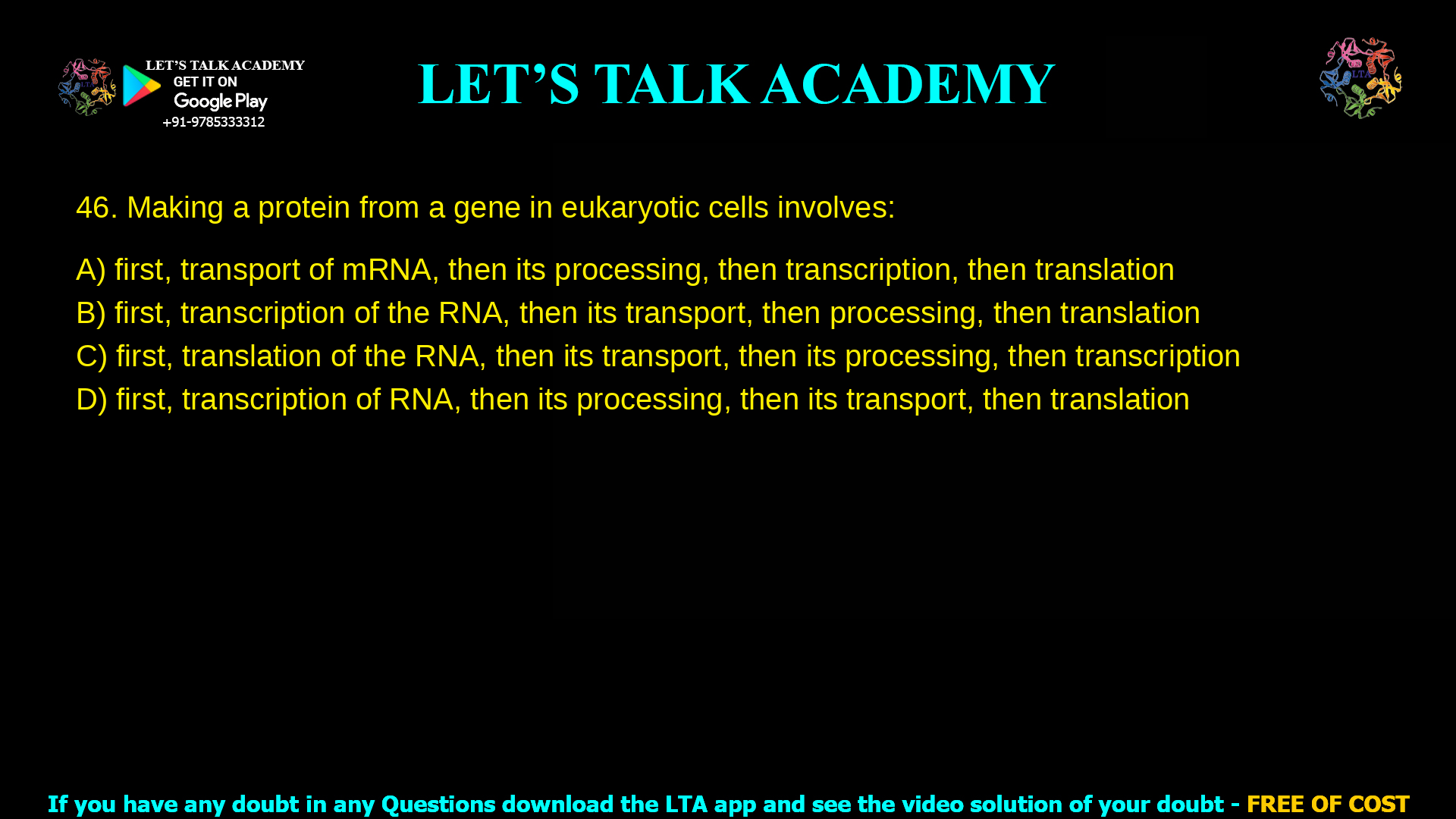
1. Making a protein from a gene in eukaryotic cells involves:
a. first, transport of mRNA, then its processing, then transcription, then
translation
b. first, transcription of the RNA, then its transport, then processing, then
translation
c. first, translation of the RNA, then its transport, then its processing, then
transcription
d. first, transcription of RNA, then its processing, then its transport, then
translation
Correct Answer: d. first, transcription of RNA, then its processing, then its transport, then translation
Protein synthesis in eukaryotic cells follows a precise sequence starting in the nucleus and completing in the cytoplasm.
Option Analysis
Option a places transport before processing and transcription after, which reverses the nuclear events where transcription initiates the process.
Option b sequences transport before processing, but eukaryotic pre-mRNA undergoes processing like splicing and capping in the nucleus prior to export.
Option c begins with translation, impossible since ribosomes reside in the cytoplasm while transcription occurs in the nucleus.
Option d accurately reflects the pathway: transcription produces pre-mRNA, nuclear processing matures it, transport via nuclear pores delivers it to cytoplasm, and ribosomes perform translation.
In eukaryotic cells, making a protein from a gene involves a coordinated central dogma pathway: transcription creates pre-mRNA from DNA, followed by processing, nuclear export or transport, and cytoplasmic translation into polypeptide chains.
Eukaryotic Protein Synthesis Steps
-
Transcription: RNA polymerase II synthesizes pre-mRNA from the gene in the nucleus, using DNA as template.
-
Processing: Pre-mRNA gains 5′ cap, poly-A tail, and intron splicing to form mature mRNA, all within nucleus.
-
Transport: Mature mRNA exits nucleus through nuclear pores to reach cytoplasmic ribosomes.
-
Translation: Ribosomes decode mRNA codons using tRNA to assemble amino acids into protein.
CSIR NET Exam Relevance
This sequence distinguishes eukaryotic from prokaryotic synthesis, where coupling allows simultaneous transcription and translation. Mastery aids questions on gene expression regulation, vital for CSIR NET Life Sciences molecular biology section.


