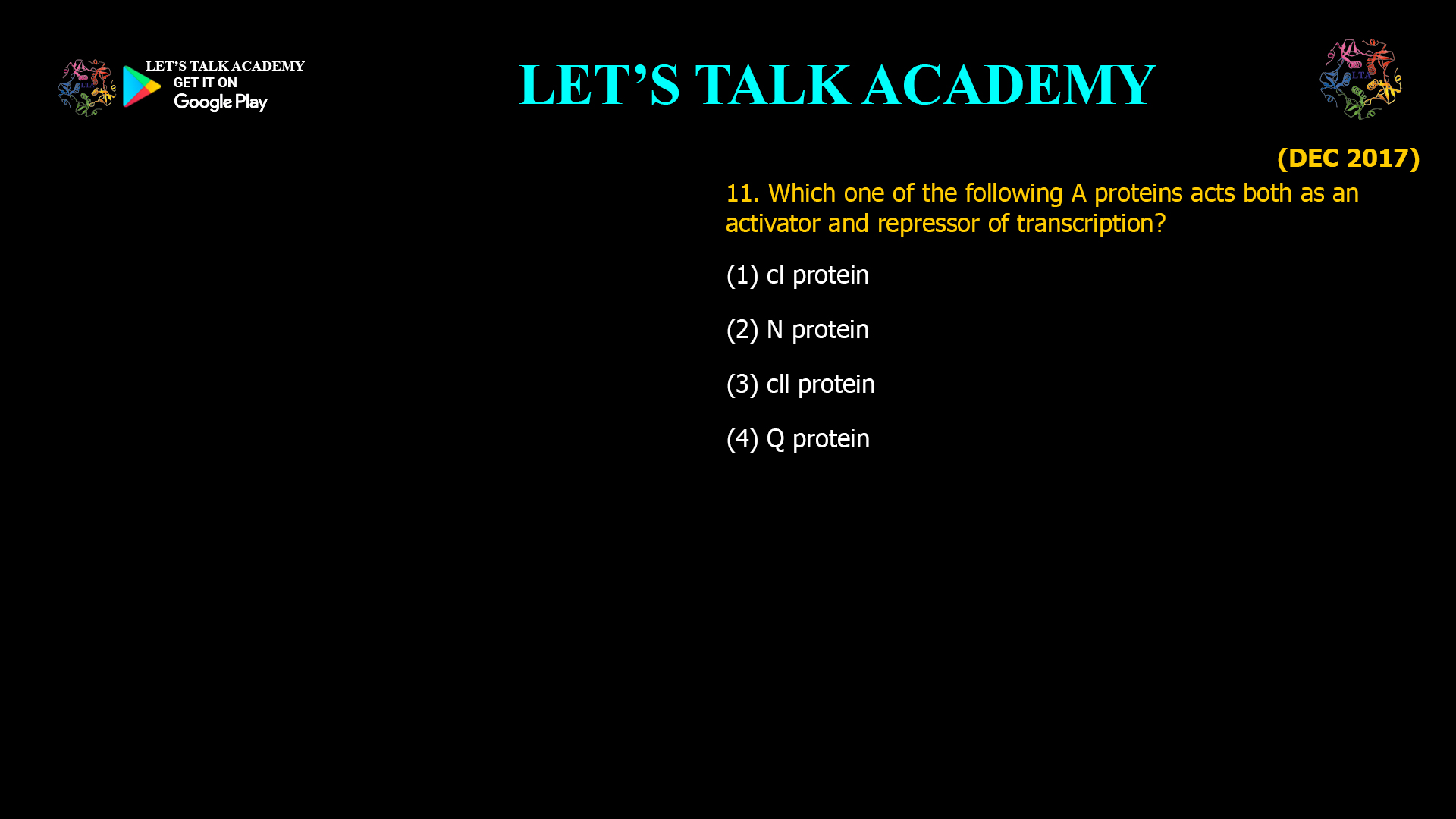
11. Which one of the following A proteins acts both as an activator and repressor of transcription?
(1) cl protein (2) N protein
(3) Cll protein (4) Q protein
Discover how the lambda phage CI protein functions uniquely as both a transcriptional activator and repressor. Explore its critical role in regulating the lysogenic and lytic cycles of lambda phage.
Bacteriophage lambda (λ phage) is a classic model for studying gene regulation in viruses. One of the most fascinating aspects of its genetic control is the role of specific proteins that regulate transcription, switching the phage between lysogenic and lytic life cycles. Among these regulatory proteins, one stands out for its dual functionality: the CI protein, also known as the lambda repressor.
The Question: Which Protein Acts Both as an Activator and Repressor?
Among the major regulatory proteins of lambda phage:
-
CI protein
-
N protein
-
CII protein
-
Q protein
The CI protein uniquely acts as both a transcriptional activator and a repressor.
Understanding the CI Protein’s Dual Role
The lambda CI protein is a DNA-binding protein that controls the switch between the lysogenic and lytic cycles by regulating transcription at multiple promoters.
-
As a repressor: CI binds to operator sites (OR1 and OR2) overlapping the lytic promoter P_R, physically blocking RNA polymerase from transcribing lytic genes such as cro. This repression prevents the expression of genes required for the lytic cycle, maintaining the prophage in a dormant state.
-
As an activator: CI also binds to operator sites in a way that promotes transcription from the P_RM promoter, which drives expression of the cI gene itself. This positive autoregulation ensures sufficient levels of CI to maintain lysogeny. The activation occurs because CI stabilizes RNA polymerase binding at P_RM, enhancing transcription.
This dual function depends on the precise location and orientation of CI binding sites relative to the promoters, allowing it to either block or facilitate RNA polymerase access.
Why Other Proteins Do Not Have This Dual Role
-
N protein is an antiterminator that allows RNA polymerase to read through termination signals, enabling transcription of delayed early genes. It does not act as a repressor.
-
CII protein is a transcriptional activator that promotes expression of the cI gene and integrase during lysogeny establishment but does not repress transcription.
-
Q protein is an antiterminator that activates late gene transcription during the lytic cycle; it does not repress transcription.
Molecular Mechanism Behind CI’s Function
CI binds as a dimer to three operator sites (OR1, OR2, and OR3) with varying affinities:
-
Binding to OR1 and OR2 represses the lytic promoter P_R and activates the repressor maintenance promoter P_RM.
-
At high concentrations, CI also binds OR3, which represses P_RM to prevent overproduction of CI, a form of negative autoregulation.
This sophisticated binding pattern allows CI to finely tune its own expression and the expression of lytic genes, acting as a molecular switch controlling the phage life cycle.
Biological Significance
The ability of CI to act both as an activator and repressor is crucial for:
-
Maintaining the prophage state during lysogeny.
-
Preventing premature entry into the lytic cycle.
-
Allowing rapid induction of the lytic cycle when conditions favor phage replication.
This dual regulatory role exemplifies one of the simplest yet most elegant gene regulatory systems known.
Summary Table: Regulatory Proteins of Lambda Phage
| Protein | Role in Transcription Regulation | Activator? | Repressor? | Dual Role? |
|---|---|---|---|---|
| CI | Represses lytic genes; activates its own expression | Yes | Yes | Yes |
| N | Antiterminator for early gene transcription | No | No | No |
| CII | Activates lysogeny establishment genes | Yes | No | No |
| Q | Antiterminator for late gene transcription | No | No | No |
Conclusion
The CI protein of lambda phage is the key transcriptional regulator that acts both as an activator and a repressor. Its unique ability to repress lytic genes while simultaneously activating its own expression ensures the stable maintenance of lysogeny and precise control over the phage life cycle. This dual functionality makes CI a paradigmatic example of a transcription factor with complex regulatory roles.


