Introns in Eukaryotic Genes: Found in rRNA, tRNA, and mRNA Encoding Genes
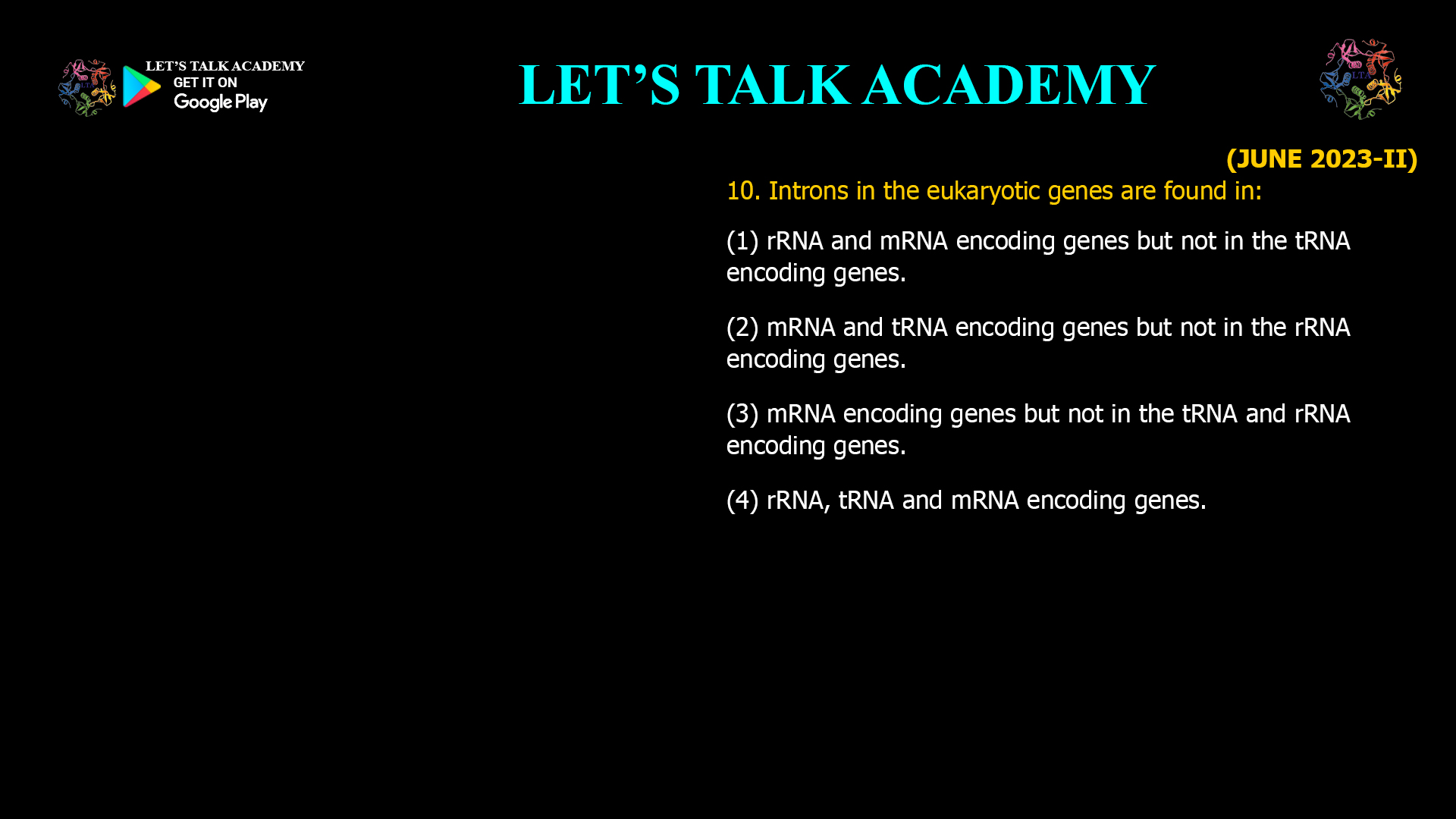
10. Introns in the eukaryotic genes are found in:
(1) rRNA and mRNA encoding genes but not in the tRNA encoding genes.
(2) mRNA and tRNA encoding genes but not in the rRNA encoding genes.
(3) mRNA encoding genes but not in the tRNA and rRNA encoding genes.
(4) rRNA, tRNA and mRNA encoding genes.
Introns are non-coding sequences found within eukaryotic genes that play a crucial role in the regulation of gene expression and RNA maturation. Unlike prokaryotic genes, eukaryotic genes are often interrupted by these intervening sequences, which must be precisely removed during RNA processing to produce functional RNA molecules. Introns are present in genes encoding all three major types of RNA: ribosomal RNA (rRNA), transfer RNA (tRNA), and messenger RNA (mRNA), making option (4) — rRNA, tRNA and mRNA encoding genes — the correct answer to the question of where introns are found in eukaryotic genes.
What Are Introns?
Introns, short for intervening sequences, are stretches of DNA within a gene that do not code for proteins or functional RNA. They are transcribed into the primary RNA transcript but are removed before the RNA becomes mature and functional. The sequences that remain after intron removal are called exons.
Presence of Introns in Different RNA Genes
-
mRNA Encoding Genes: Introns are most commonly studied in protein-coding genes, where they are found within the pre-mRNA. These introns are removed by a complex cellular machinery called the spliceosome, which recognizes specific splice sites at the intron boundaries and excises them to produce mature mRNA ready for translation.
-
tRNA Encoding Genes: Introns are also present in tRNA genes, although less frequently than in mRNA genes. These introns are typically located near the anticodon loop and are removed by specialized enzymes rather than the spliceosome. The proper removal of tRNA introns is essential for the correct folding and function of tRNA molecules.
-
rRNA Encoding Genes: Some rRNA genes contain introns as well, including self-splicing group I introns that can excise themselves without the spliceosome. These introns contribute to the complex regulation of ribosomal RNA maturation and function.
Importance of Introns in Eukaryotic Gene Expression
Introns are not just “junk” DNA; they have significant biological roles:
-
Alternative Splicing: Introns allow for alternative splicing, a process where different combinations of exons are joined to produce multiple protein variants from a single gene, increasing protein diversity without increasing gene number.
-
Regulation of Gene Expression: Introns can influence the timing and efficiency of gene expression. Their presence affects transcription regulation and RNA stability.
-
Evolutionary Significance: The emergence of introns is a major evolutionary feature distinguishing eukaryotes from prokaryotes. They contribute to genome complexity and adaptability.
How Are Introns Removed?
The removal of introns, called splicing, involves:
-
Recognition: The spliceosome identifies the 5′ and 3′ splice sites and a branch point sequence within the intron.
-
Cleavage and Ligation: The intron is cut out, often forming a lariat structure, and the exons are joined together to form a continuous coding sequence.
Some introns, such as group I and group II introns found in rRNA and organellar genes, are self-splicing and do not require spliceosomes.
Summary
Introns are found in eukaryotic genes encoding rRNA, tRNA, and mRNA, reflecting their fundamental role in gene regulation and RNA processing. Their presence enables complex gene expression mechanisms like alternative splicing, which enhances protein diversity and cellular function. Understanding introns is key to grasping the intricacies of eukaryotic molecular biology.
Correct answer: (4) rRNA, tRNA and mRNA encoding genes.


11 Comments
Suman bhakar
June 4, 2025✅✅
Heena Mahlawat
November 4, 2025rRNA, mRNA, tRNA
Prami Masih
June 7, 2025👍👍👍👍
Bhanwar Jaat
June 17, 2025👍
Sonam Saini
October 31, 2025Right answer is 4 trna mrna rrna coding gene hai
Manisha gujar2
November 3, 20254 is correct
Manisha choudhary
November 4, 2025Sir aap n likhwaya tha splicing feature of all RNA
Means sb m introne hoga
m RNA, r RNA,t RNA encoding gene 4th option is correct answer
Roopal Sharma
November 4, 2025Rrna,trna and mrna all contains introns
Pooja
November 4, 2025rRNA, tRNA and mRNA encoding genes
Santosh Saini
November 8, 2025rRNA, tRNA, and mRNA encoding genes
Sakshi Kanwar
November 8, 2025rRNA, tRNA and mRNA encoding genes.