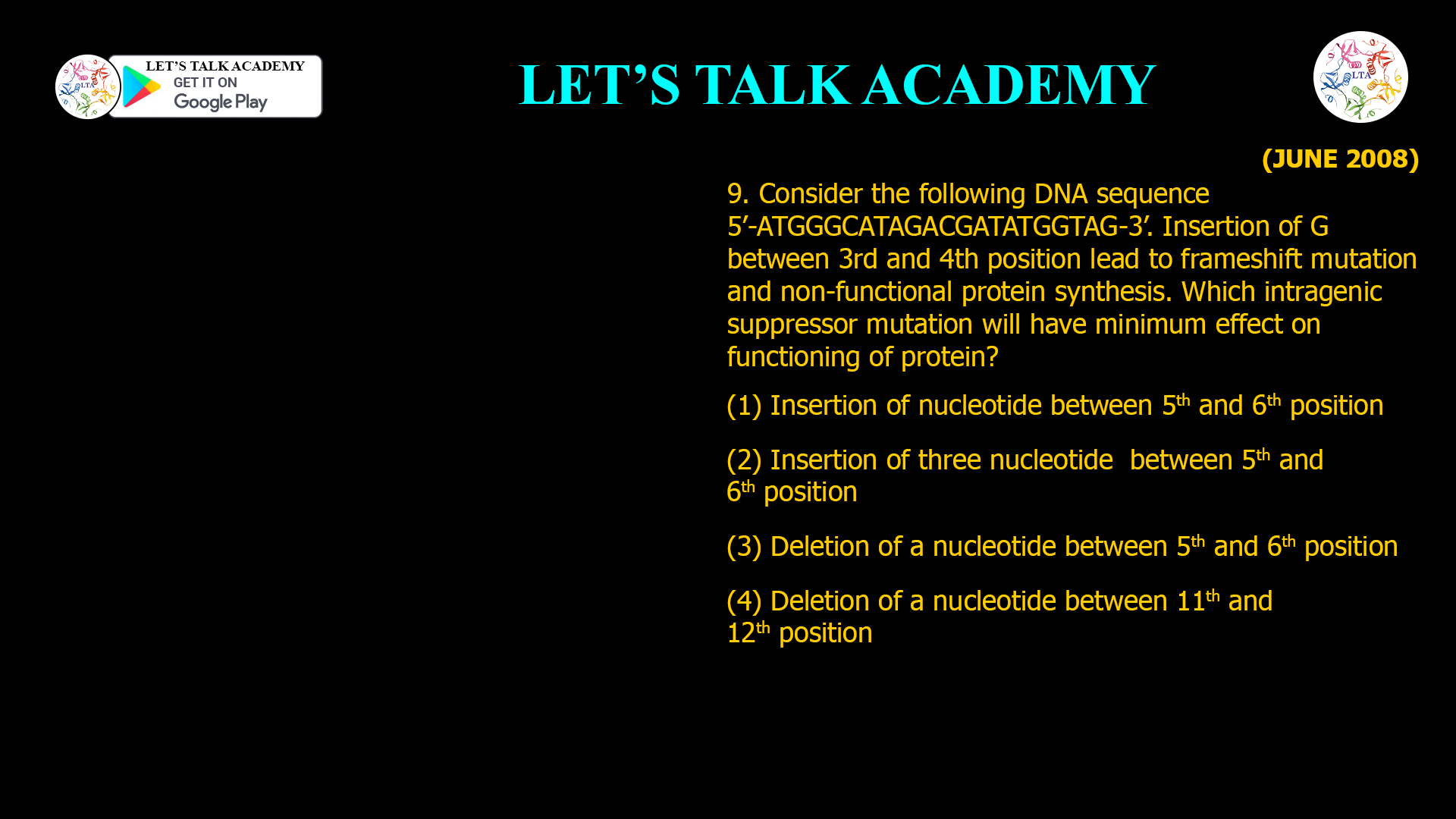
9. Consider the following DNA sequence 5’-ATGGGCATAGACGATATGGTAG-3’. Insertion of G between 3rd and 4th position lead to frameshift mutation and non-functional protein synthesis. Which intragenic suppressor mutation will have minimum effect on functioning of protein?
(1) Insertion of nucleotide between 5th and 6th position
(2) Insertion of three nucleotide between 5th and 6th position
(3) Deletion of a nucleotide between 5th and 6th position
(4) Deletion of a nucleotide between 11th and 12th position
Insertion or deletion of nucleotides that are not in multiples of three causes a frameshift mutation, disrupting the reading frame and generally producing non-functional proteins. In this question, insertion of G between the 3rd and 4th nucleotides causes a frameshift. To restore functionality, an intragenic suppressor mutation near the first mutation should ideally counteract the reading frame shift with minimal disruption downstream.
Explanation of options:
-
Insertion of a nucleotide between the 5th and 6th position: This would add another nucleotide and cause another frameshift mutation, compounding the reading frame disruption rather than fixing it, thus likely worsening protein function.
-
Insertion of three nucleotides between the 5th and 6th position: Inserting three nucleotides (one codon) will add an extra amino acid but will not shift the reading frame further. This helps restore the original reading frame downstream of the insertion. So, it counters the frameshift caused by the single nucleotide addition at position 3-4, preserving normal reading frame from position 6 onwards.
-
Deletion of a nucleotide between 5th and 6th position: This would cause another frameshift by removing a nucleotide close to the original insertion mutation, restoring the reading frame but potentially shifting the codon boundaries and affecting the sequence significantly over a stretch.
-
Deletion of a nucleotide between the 11th and 12th position: Although this deletion can restore the reading frame after the original mutation, it occurs further downstream and may cause more extensive downstream amino acid changes before the frame is corrected, likely impacting function more.
Among these, option 2—the insertion of three nucleotides between the 5th and 6th positions—is the best intragenic suppressor mutation to minimize disruption of protein function by restoring the reading frame without causing another frameshift, only adding one amino acid.
Introduction: Frameshift mutations caused by single nucleotide insertions or deletions disrupt the three-nucleotide reading frame of DNA sequences, producing non-functional proteins. Intragenic suppressor mutations near the original site can restore this frame. This article explores which types of suppressor mutations best minimize protein function disruption using a practical DNA sequence example.
Detailed Explanation:
A frameshift mutation occurs when nucleotides are inserted or deleted in numbers not divisible by three, altering the reading frame downstream. Here, insertion of a single G nucleotide between the 3rd and 4th positions causes such a frameshift. To suppress this, further mutations can restore the reading frame and thus proper protein translation.
Four mutant options are considered:
-
Inserting a single nucleotide (Option 1) causes another frameshift, worsening the problem.
-
Inserting three nucleotides (Option 2) adds one amino acid but restores the frame perfectly. This is typically the least disruptive.
-
Deleting a nucleotide near the first mutation (Option 3) also restores the frame but causes further changes in amino acid sequence.
-
Deleting a nucleotide downstream (Option 4) corrects the frame later but lets the incorrect reading frame continue longer, causing more dysfunction.
Option 2 is the ideal intragenic suppressor mutation since it restores the original reading frame immediately with minimal sequence disruption, allowing normal protein function with just one additional amino acid.
This explanation combines detailed mutation mechanism knowledge and practical assessment for minimal functional disruption in protein synthesis by intragenic suppressor mutations.


