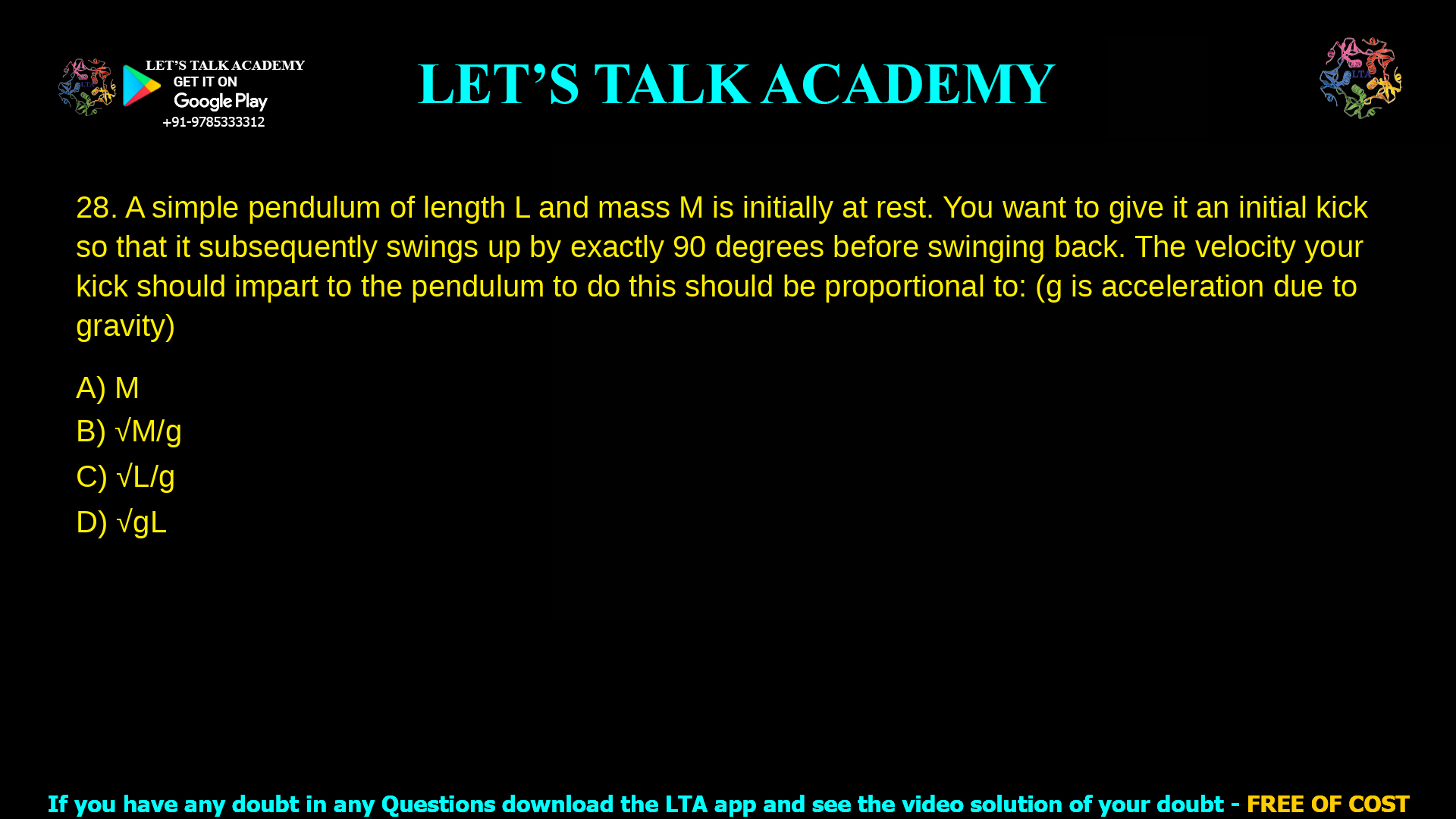
13. A simple pendulum of length L and mass M is initially at rest. You want to give it an
initial kick so that it subsequently swings up by exactly 90 degrees before swinging
back. The velocity your kick should impart to the pendulum to do this should be
proportional to: (g is acceleration due to gravity)
a. M
b. √M/g
c. √L/g
d. √gL
In this article, the focus is on finding the initial velocity of a simple pendulum to reach 90 degrees and understanding how this speed depends on the pendulum’s length and the acceleration due to gravity. Using conservation of energy, the solution shows that the required initial speed is proportional to √(gL), independent of the mass of the bob, which is a frequent concept in competitive exam MCQs on the simple pendulum. Each option of the given question is analyzed so that the role of length, gravity, and mass in determining the initial velocity of a simple pendulum to reach 90 degrees becomes completely clear.
Correct Answer Explanation
The correct option is (d) √(gL). The initial kick must give the bob a speed proportional to √(gL) so that it just reaches 90° (horizontal) before turning back.
Step-by-Step Physics Solution
At the lowest point, just after the kick, the bob of mass M has kinetic energy K = ½Mv².
Taking the lowest point as zero gravitational potential energy, when the bob rises to 90° (string horizontal), its center of mass gains height h = L, so the gain in potential energy is ΔU = MgL.
To “just” reach 90°, all initial kinetic energy must convert into this potential energy at the turning point, so by conservation of mechanical energy: ½Mv² = MgL ⇒ v² = 2gL ⇒ v ∝ √(gL). Hence the required velocity scales as √(gL), independent of mass.
Option-by-Option Analysis
(a) M
This suggests the velocity is proportional to mass, but the equation ½Mv² = MgL shows mass cancels out, so the required speed does not depend on M. Thus (a) is incorrect.
(b) M/g
Here velocity would increase with M and decrease with g, contradicting the energy relation where M cancels and v actually grows with g. This is wrong both dimensionally (speed cannot depend on M) and physically.
(c) L/g
This dependence is the same as the time period formula T ∝ √(L/g), not the launch speed to reach a given height. The required speed from energy is v ∝ √(gL), so the factor of g is in the numerator, not the denominator. Option (c) is incorrect.
(d) √(gL)
From conservation of energy, v² = 2gL, so v ∝ √(gL). This matches the correct scaling with both g and L, and is dimensionally a speed. Thus (d) is the correct answer.
Quick Comparison Table
| Option | Proportionality form | Mass dependence? | Gravity dependence? | Correct? |
|---|---|---|---|---|
| (a) | M | Depends on M (wrong) | None (wrong) | No |
| (b) | M/g | Depends on M (wrong) | ∝1/g (wrong sign) | No |
| (c) | L/g | No M (ok) | ∝1/g (wrong sign) | No |
| (d) | √(gL) | Mass cancels (correct) | ∝√g (correct) | Yes |


