- A 20-week old infant was exposed to the following stimuli and the responses were measured.
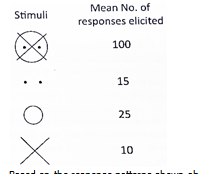
Based on the response patterns shown above to the given stimuli, select the correct theory that best describes the observed responses.
(1) Heterogenous summation
(2) Gestalt principle
(3) Supernormal stimuli
(4) Sign stimulusHow Infants Respond to Sensory Stimuli
From birth, infants possess functional sensory systems, enabling them to see, hear, touch, taste, and smell. However, their ability to interpret and make sense of these stimuli—known as perceptual knowledge—develops with time and experience. Early on, infants are particularly sensitive to certain cues in their environment, and their responses can be strikingly consistent across individuals.
The Concept of Sign Stimulus
A sign stimulus is a specific type of environmental cue that reliably triggers a fixed, innate behavioral response in an animal—or, in this case, a human infant. This concept is rooted in ethology, where it describes how certain stimuli elicit instinctive behaviors without prior learning or experience.
In infants, sign stimuli might include:
-
The sound of a caregiver’s voice, which can trigger turning or smiling.
-
The sight of a face, leading to focused attention and social engagement.
-
Specific tactile sensations, such as gentle stroking, which can soothe or calm the baby.
These responses are not learned but are hardwired into the infant’s nervous system, ensuring that the baby reacts appropriately to critical cues in their environment. This mechanism is essential for early bonding, communication, and survival.
Why Not Other Theories?
Let’s briefly examine why the other options are less applicable:
-
Heterogenous summation: Refers to the combined effect of multiple different stimuli, not the specific triggering of a response by a single, key stimulus.
-
Gestalt principle: Focuses on how the mind organizes sensory information into wholes, rather than on specific triggers for innate behaviors.
-
Supernormal stimuli: Involves exaggerated versions of sign stimuli that elicit even stronger responses, but the basic response mechanism is still rooted in the concept of the sign stimulus.
Real-World Examples
-
Rooting Reflex: When an infant’s cheek is touched, they turn their head and open their mouth—an automatic response to a sign stimulus that helps with feeding.
-
Visual Tracking: Infants will follow a moving face or object with their eyes, demonstrating sensitivity to visual sign stimuli.
Conclusion
The best theory to describe the observed response patterns in a 20-week-old infant exposed to various stimuli is the sign stimulus concept. This theory explains how specific environmental cues can reliably trigger innate responses, forming the foundation for early sensory and perceptual development.
Correct answer: (4) Sign stimulus
-


