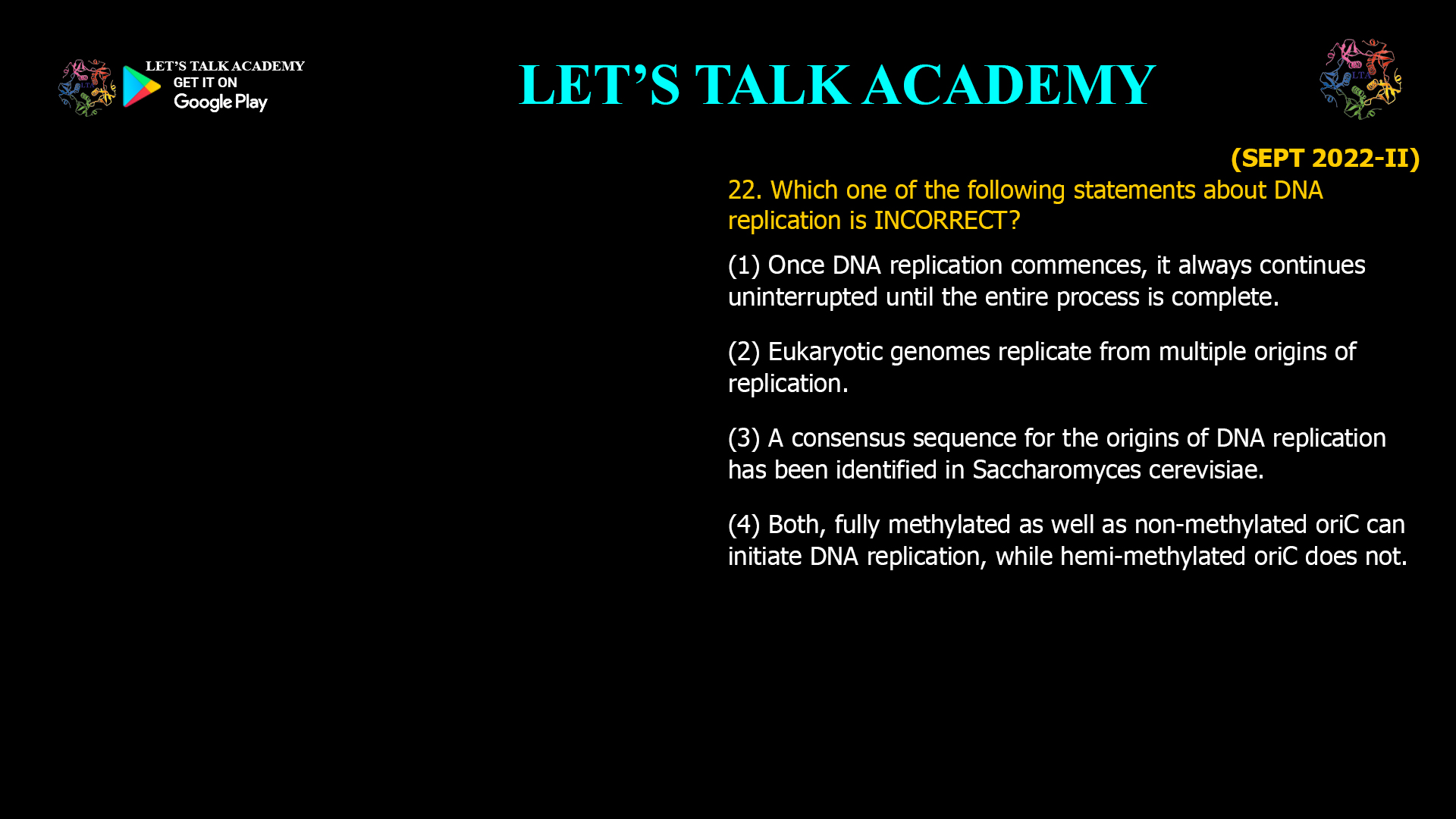
- Which one of the following statements about DNA replication is INCORRECT?
(1) Once DNA replication commences, it always continues uninterrupted until the entire process is complete.
(2) Eukaryotic genomes replicate from multiple origins of replication.
(3) A consensus sequence for the origins of DNA replication has been identified in Saccharomyces cerevisiae.
(4) Both, fully methylated as well as non-methylated oriC can initiate DNA replication, while hemi-methylated oriC does not.
Analysis of Each Statement
(1) Once DNA replication commences, it always continues uninterrupted until the entire process is complete.
-
This statement is incorrect. DNA replication can be paused or stalled due to DNA damage, replication stress, or other cellular signals. Replication forks can stall and restart, and the process is tightly regulated to ensure genome integrity. Therefore, replication is not always uninterrupted from start to finish.
(2) Eukaryotic genomes replicate from multiple origins of replication.
-
This is correct. Eukaryotic chromosomes are large and linear, requiring multiple origins of replication to ensure timely and complete DNA duplication during S phase.
(3) A consensus sequence for the origins of DNA replication has been identified in Saccharomyces cerevisiae.
-
This is correct. In budding yeast (S. cerevisiae), origins of replication (ARS elements) contain well-defined consensus sequences recognized by the Origin Recognition Complex (ORC).
(4) Both fully methylated as well as non-methylated oriC can initiate DNA replication, while hemi-methylated oriC does not.
-
This is correct. In E. coli, fully methylated oriC is competent for initiation; hemi-methylated oriC (after replication) is temporarily inactive to prevent re-initiation; non-methylated oriC can also initiate replication under certain conditions.
Correct Answer
(1) Once DNA replication commences, it always continues uninterrupted until the entire process is complete.
Conclusion
The incorrect statement is option (1). DNA replication is a complex and regulated process that can be paused or stalled in response to cellular conditions. The other statements accurately reflect current understanding of DNA replication mechanisms in prokaryotes and eukaryotes.


25 Comments
Manisha choudhary
July 28, 2025Done sir 👍🏻
Vanshika Sharma
July 29, 2025Statement one is incorrect
Surbhi Rajawat
July 29, 2025Answer is 1st because DNA replication is a complex process which requires regulations and checks and repairs at various steps.
Mansukh Kapoor
July 29, 2025The correct answer is 1st because a DNA replication can be interrupted by DNA damage or by the stress in the DNA or by many other factors
anurag giri
July 29, 2025Ans 1 bcoz in dna replication many times wrong nt many natural factors dna regulation etc steps
Khushi Vaishnav
July 29, 2025Option A
Because replication can be paused or stalled by the dna damage or by stress factors
Aman Choudhary
July 29, 2025One is correct answer dna may be interrupted by dntps shortening , enzyme strees etc.
Priti Khandal
July 29, 2025Done sir a Option is incorrect 👍👍
Priya Khandal
July 29, 2025A option is incorrect done sir
Khushi Agarwal
July 30, 2025Option A is incorrect answer bcz replication kbhi b pause ho skta hh dur to dn damage, supercoiled etc. so ye process kbhi b interrupt ho skta hai
shruti sharma
July 30, 2025option a is iccorrect beacuse, dna replication can be pause and stalled
Divya Mandhania
July 30, 2025Correct answer is one because is a complex process that can be paused or stalled by any cellular condition
Aafreen
July 30, 2025Ans-1 :-DNA replication can be paused or interrupted by various factors like stress, lack of nucleotides, or specific regulatory signals. It does not always proceed uninterruptedly.
Deepika Sheoran
July 30, 2025Option 1 is correct because Dna replication is a highly regulated process,and it can be interrupted or stalled by various factors, including dna damage , replication stress and environmental factors .
Pratibha Sethiya
July 30, 2025Correct option is option (1)
Bcz DNA replication can be paused and stalled by various factors , including DNA damage , replication stress , environmental factors
Diksha Chhipa
July 31, 2025Replication process can be stop if dna damage or replication stress occur . Consensus seq which are not change with time means conserved seq which is recognised in secromycease cerivise. Eukaryotic cell has multiple site of ori.
Anisha jakhar
July 31, 2025Statement A is the incorrect statement.
Swati Choudhary
July 31, 2025option A is incorrect as DNA may be damaged causing disruption the continuation of replication temporarily.
Santosh Saini
July 31, 2025Statement 1st is incorrect
Dipti Sharma
August 1, 2025Correct answer is 1 bcz
Dna replication is a complex process which can not always uninterrupted from start to finish.
Khushi Mehra
August 1, 2025Answer is 1
Dna replication can be paused due to some conditions, mutation, or damage in dna
Avni
August 1, 2025DNA replication can be paused so option 1 is incorrect
Soniya Shekhawat
August 3, 2025Option 1st is incorrect because replication will be a paused by the DNA damage ,replication stress, cellular signals, lack of nucleotides.
Anjani sharma
August 5, 2025dna replication can be pause and stalled ,answer 1st is incorrect
Deepika Sheoran
November 6, 2025Because DNA replication is a highly regulated process and it can be interrupted or stalled by various factors, including DNA damages, replication stress and environmental factors.