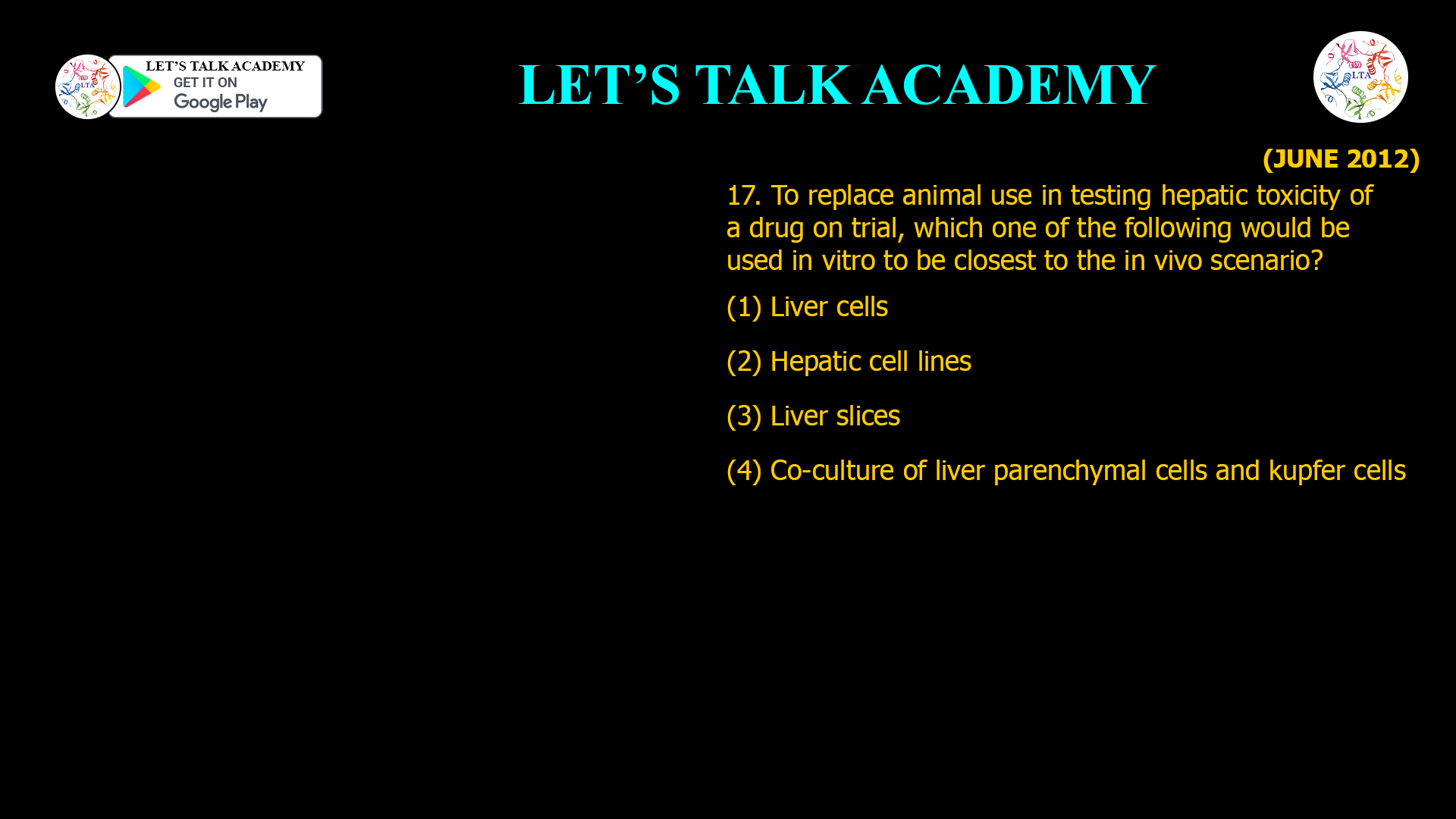
17. To replace animal use in testing hepatic toxicity of a drug on trial, which one of the following would be used in vitro to be closest to the in vivo scenario?
(1) Liver cells
(2) Hepatic cell lines
(3) Liver slices
(4) Co-culture of liver parenchymal cells and kupfer cells
To replace animal use in testing the hepatic toxicity of a drug and achieve the closest in vivo scenario, the most suitable in vitro option among the given choices is the co-culture of liver parenchymal cells (hepatocytes) and Kupffer cells. This model better mimics the liver’s complex cellular interactions and immune responses during toxicity than the other options.
Explanation of each option:
-
Liver cells (primary hepatocytes): These are isolated functional liver cells used for toxicity testing. While they retain many liver-specific functions, they typically lack the non-parenchymal cells such as Kupffer cells that are important to simulate the liver’s immune responses. Hepatocytes alone can metabolize drugs but don’t fully replicate the liver microenvironment.
-
Hepatic cell lines: These immortalized cells are easier to culture but often lose many liver-specific functions and drug metabolism capacities. They do not fully represent the liver’s complexity and are less predictive of in vivo toxicity.
-
Liver slices: These are thin slices of liver tissue maintaining multiple cell types and tissue architecture. They can mimic the in vivo environment well initially but have a limited culture period (usually up to 24-48 hours), and metabolic activities decline over time.
-
Co-culture of liver parenchymal cells and Kupffer cells: This model combines primary hepatocytes with Kupffer cells, the liver-resident macrophages, to enable assessment of both metabolic and immune-mediated hepatotoxicity. It offers a more physiologically relevant and stable platform for extended toxicity testing closer to in vivo conditions.
In summary, the co-culture system (option 4) is closest to the in vivo scenario because it reflects the liver’s multicellular environment, including metabolic and immune responses, which are crucial for accurately predicting drug-induced liver toxicity.
Introduction:
The development of new drugs requires rigorous testing for hepatic toxicity to ensure safety. Traditionally, animal models have been used, but ethical considerations and species differences have driven the search for effective in vitro alternatives. Among various in vitro systems, co-culturing liver parenchymal cells (hepatocytes) with Kupffer cells closely replicates the liver’s complex microenvironment, metabolic functions, and immune responses, making it the most reliable replacement for animal testing in predicting hepatotoxicity.
This article explains that while liver cells, hepatic cell lines, and liver slices have limitations, the co-culture of hepatocytes and Kupffer cells offers a closer simulation of in vivo liver function for drug toxicity testing, making it the preferred in vitro model.


