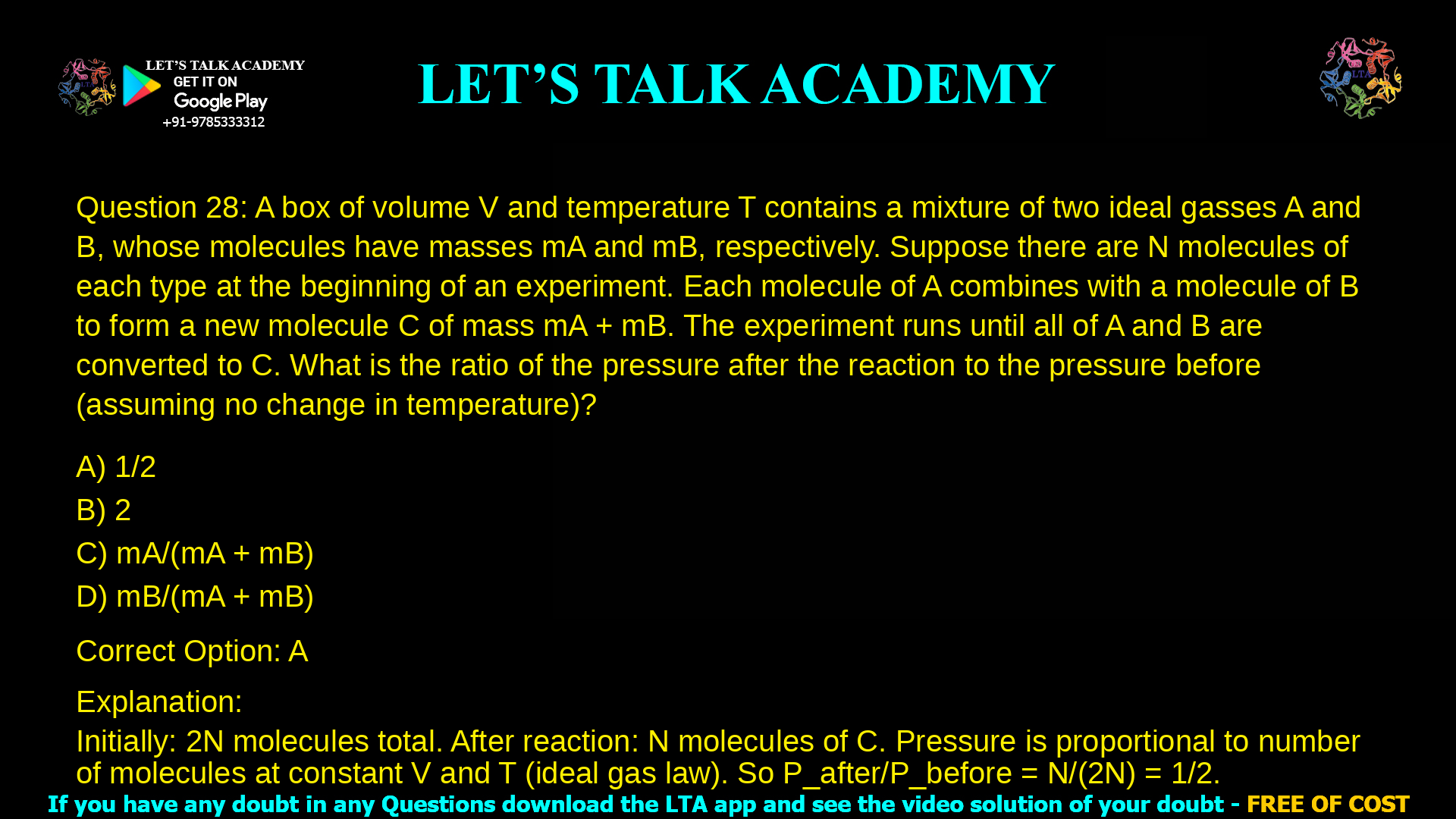
13. A box of volume V and temperature T contains a mixture of two ideal gasses A
and B, whose molecules have masses mA and mB, respectively. Suppose there are N
molecules of each type at the beginning of an experiment. Each molecule of A
combines with a molecule of B to form a new molecule C of mass mA + mB. The
experiment runs until all of A and B are converted to C. What is the ratio of the
pressure after the reaction to the pressure before (assuming no change in
temperature)?
a. 1/2
b. 2
c. mA/(mA + mB)
d. mB/(mA + mB)
Ideal Gas Pressure Ratio After Reaction: CSIR NET Physics Solution
The pressure ratio after the reaction is 1/2. For ideal gases in a fixed volume and temperature, pressure depends solely on the number of molecules, which halves from 2N to N.
Problem Breakdown
A box of fixed volume V at constant temperature T holds N molecules each of ideal gases A (mass mA) and B (mB). They react completely: A + B → C (mass mA + mB), yielding N molecules of C. Initial pressure follows the ideal gas law PiV=(2N)kT, so Pi=2NkTV, where k is Boltzmann’s constant. Final pressure is Pf=NkTV. The ratio Pf/Pi=1/2.
Option Analysis
- a. 1/2: Correct, as molecule count halves while V and T stay fixed; pressure halves.
- b. 2: Incorrect; doubling would require molecule count to double, opposite of the reaction.
- c. mA/(mA + mB): Incorrect; ideal gas pressure ignores molecular masses, depending only on particle number and collisions.
- d. mB/(mA + mB): Incorrect for the same reason—masses irrelevant for ideal gases.
In CSIR NET physics preparation, mastering ideal gas pressure ratio after reaction is key for questions on gas laws and chemical combinations. This problem involves a box of volume V and temperature T with N molecules each of ideal gases A (mass mA) and B (mB). They fully react to form N molecules of C (mass mA + mB). What is the pressure after reaction to pressure before ratio?
Step-by-Step Solution
Apply the ideal gas law PV=nRT or P=NkTV (molecules form). Initially, 2N molecules yield Pi=2NkTV. Post-reaction, N molecules of C give Pf=NkTV. Ratio Pf/Pi=1/2, independent of masses since ideal gases assume point particles with pressure from collisions only. Volume and temperature unchanged confirm halving.
Options breakdown:
- a. 1/2: Matches molecule reduction.
- b. 2: Wrong; implies more molecules.
- c. mA/(mA+mB): Irrelevant, masses don’t affect ideal pressure.
- d. mB/(mA+mB): Same error.
CSIR NET aspirants: Focus on particle count changes in reactions for ideal gas pressure ratio problems.


