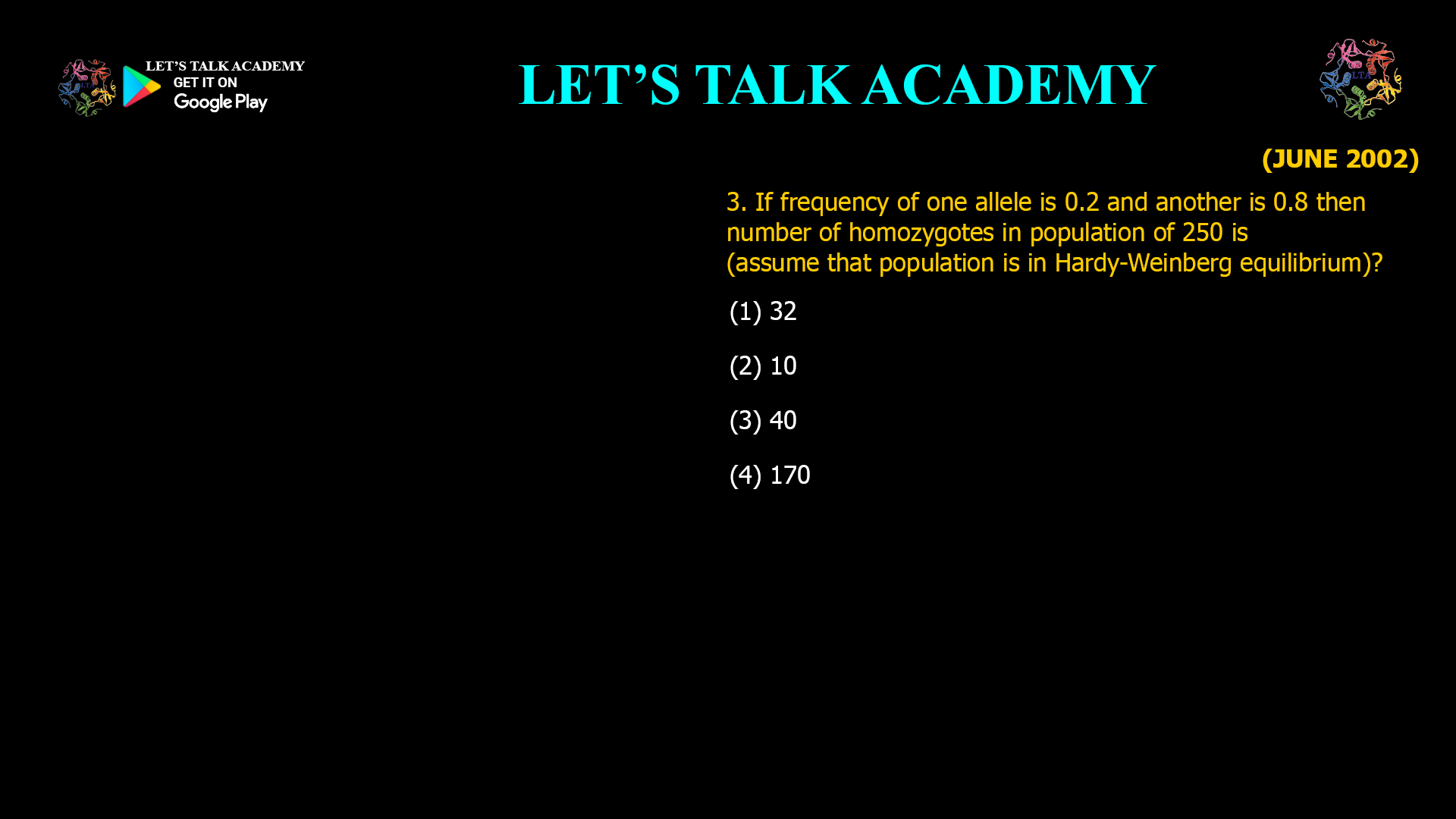
- If frequency of one allele is 0.2 and another is 0.8 then number of homozygotes in population of 250 is (assume that population is in Hardy-Weinberg equilibrium)?
(1) 32 (2) 10
(3) 40 (4) 170Calculating Homozygotes in a Hardy-Weinberg Population: Step-by-Step Guide
The Hardy-Weinberg equilibrium is a cornerstone of population genetics, providing a mathematical framework to predict genotype frequencies from allele frequencies in a non-evolving population. If you know the frequencies of two alleles in a population, you can easily calculate the expected number of homozygotes and heterozygotes. Let’s walk through a practical example using a population of 250 individuals with two alleles at frequencies 0.2 and 0.8.
Step 1: Understanding the Hardy-Weinberg Equation
The Hardy-Weinberg equation for a gene with two alleles (let’s call them A and a) is:
p2+2pq+q2=1
Where:
-
p = frequency of allele A
-
q = frequency of allele a
-
p2 = frequency of homozygous AA
-
q2 = frequency of homozygous aa
-
2pq = frequency of heterozygous Aa
Step 2: Assigning Allele Frequencies
Given:
-
Frequency of one allele (p) = 0.2
-
Frequency of the other allele (q) = 0.8
Check: p+q=0.2+0.8=1
Step 3: Calculating Genotype Frequencies
-
Homozygous for allele 1 (AA): p2=(0.2)2=0.04
-
Homozygous for allele 2 (aa): q2=(0.8)2=0.64
-
Heterozygotes (Aa): 2pq=2×0.2×0.8=0.32
Step 4: Calculating Number of Homozygotes in the Population
Total population = 250
-
Number of AA homozygotes: 0.04×250=10
-
Number of aa homozygotes: 0.64×250=160
-
Total number of homozygotes: 10+160=170
Step 5: Identifying the Correct Answer
From the options provided:
-
(1) 32
-
(2) 10
-
(3) 40
-
(4) 170
The correct answer is (4) 170.
Why This Matters
Knowing how to calculate genotype frequencies using the Hardy-Weinberg principle is essential for:
-
Predicting genetic disease risk in populations
-
Understanding population structure and evolution
-
Detecting deviations from equilibrium, which may indicate evolutionary forces at work
Conclusion
If the frequency of one allele is 0.2 and the other is 0.8 in a population of 250 individuals at Hardy-Weinberg equilibrium, the number of homozygotes in the population is 170. This includes both types of homozygotes (AA and aa).
Correct answer: (4) 170
-