Function of the Carboxyl-Terminal Domain (CTD) of RNA Polymerase II: Identifying the Non-Associated Role
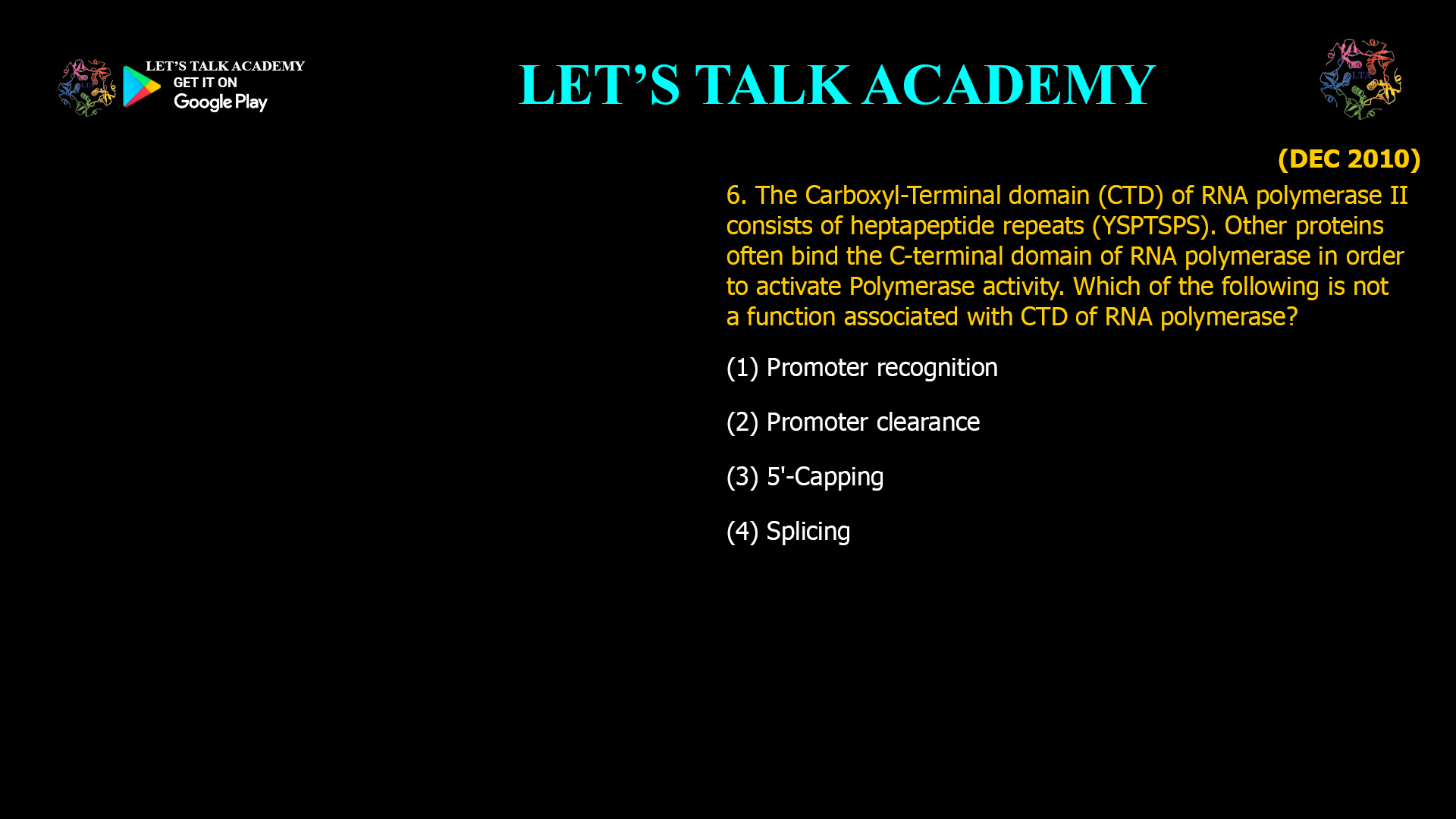
6. The Carboxyl-Terminal domain (CTD) of RNA polymerase II consists of heptapeptide repeats (YSPTSPS). Other proteins often bind the C-terminal domain of RNA polymerase in order to activate Polymerase activity. Which of the following is not a function associated with CTD of RNA polymerase?
(1) Promoter recognition
(2) Promoter clearance
(3) 5′-Capping
(4) Splicing
Correct Answer:
(1) Promoter recognition
Detailed Explanation:
The Carboxyl-Terminal Domain (CTD) of the largest subunit of RNA polymerase II (RPB1) consists of multiple repeats of the heptapeptide sequence YSPTSPS. This domain is unique to RNA polymerase II and plays a crucial role in coordinating transcription with RNA processing events.
Functions associated with the CTD include:
-
Promoter clearance:
The CTD undergoes dynamic phosphorylation changes during transcription initiation and elongation. Phosphorylation of Ser5 in the heptad repeats is important for promoter clearance, allowing RNA polymerase II to transition from initiation to productive elongation. -
5′-Capping:
The phosphorylated CTD serves as a platform to recruit capping enzymes early during transcription, ensuring that the nascent pre-mRNA receives the 5′ cap modification necessary for stability and translation. -
Splicing:
The CTD also recruits splicing factors and coordinates co-transcriptional splicing of pre-mRNA, linking transcription elongation to RNA processing .
Why Promoter Recognition Is Not a CTD Function:
-
Promoter recognition is primarily mediated by general transcription factors (GTFs) such as TFIID (which includes TBP) and other components of the pre-initiation complex that bind to promoter DNA elements.
-
The CTD itself does not directly recognize promoter DNA sequences; rather, it acts as a scaffold for recruiting factors once RNA polymerase II is positioned at the promoter .
Summary Table
| Function | Associated with CTD? | Explanation |
|---|---|---|
| Promoter recognition | No | Mediated by general transcription factors, not CTD. |
| Promoter clearance | Yes | CTD phosphorylation facilitates transition from initiation to elongation. |
| 5′-Capping | Yes | CTD recruits capping enzymes for 5′-end modification. |
| Splicing | Yes | CTD recruits splicing factors coordinating co-transcriptional splicing. |
Conclusion
The CTD of RNA polymerase II does not participate in promoter recognition. Instead, it plays essential roles in promoter clearance, 5′-capping, and splicing by recruiting and coordinating various transcription and RNA processing factors during the transcription cycle.


9 Comments
Suman bhakar
June 4, 2025✅✅
Manisha gujar2
November 3, 2025Promoter recognition
Divya rani
November 4, 2025Promotor recognition is the feature of transcription factor sigma.
Manisha choudhary
November 4, 2025CTD of RNA polymerase -2 recruit splicing factor
Coordinating co-transcription splicing
Promoter recognition general transcription factor dwara hota h CTD kaa koi role nhi hota promoter recognition m
Roopal Sharma
November 4, 2025Promoter recognistion
Heena Mahlawat
November 4, 2025Promoter recognition
Pooja
November 4, 2025Promoter recognition
Santosh Saini
November 8, 2025The CTD of RNA polymerase II does not participate in promoter recognition
Sakshi Kanwar
November 8, 2025Promoter recognition