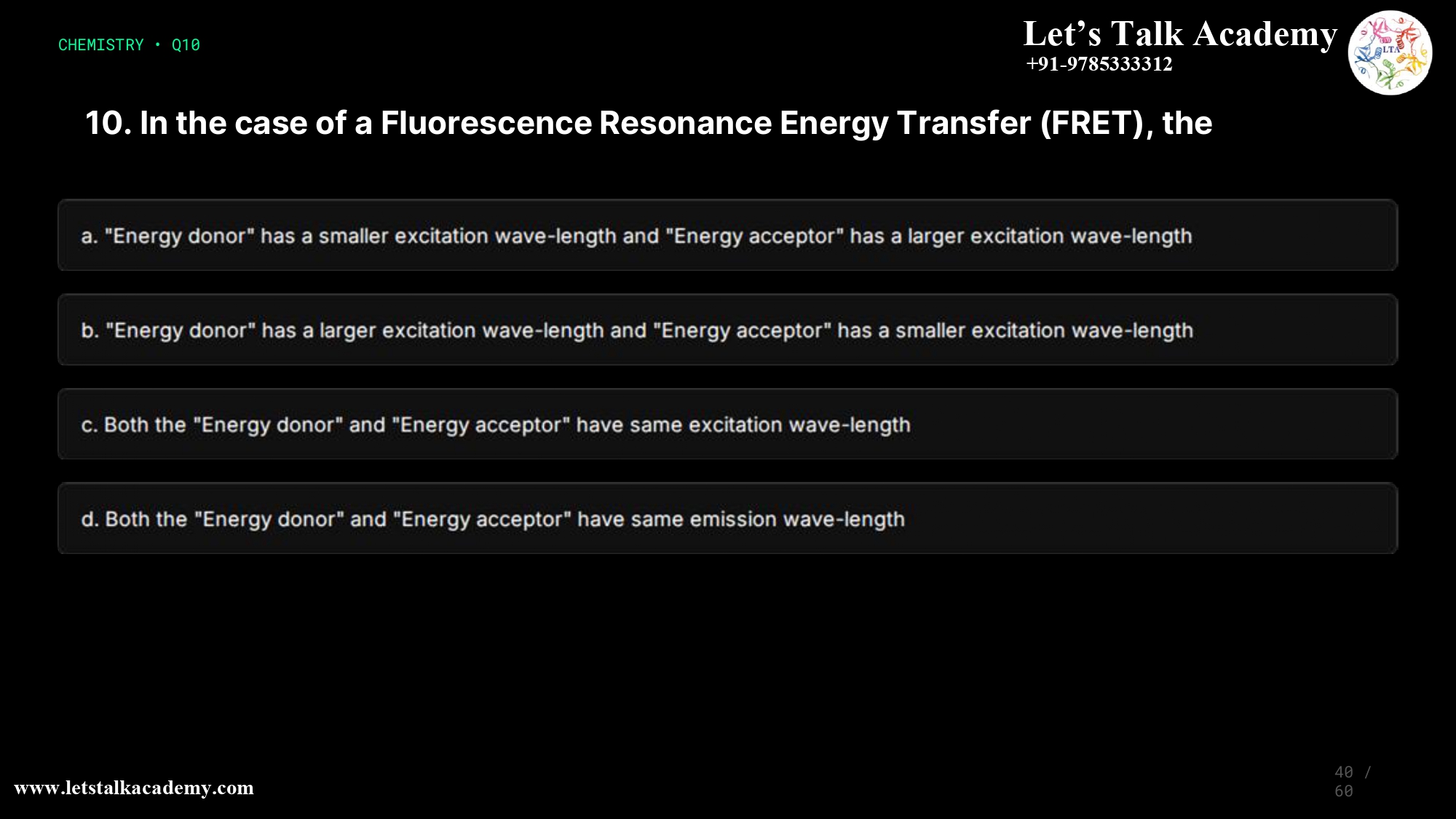
10. In the case of a Fluorescence Resonance Energy Transfer, the
a. The “Energy donor” has a smaller excitation wave-length and “Energy acceptor” has
a larger excitation wave-length
b. The “Energy donor” has a larger excitation wave-length and “Energy acceptor” has a
smaller excitation wave-length
c. Both the “Energy donor” and “Energy acceptor” have same excitation wave-length
d. Both the “Energy donor” and “Energy acceptor” have same emission wave-length
The correct answer is: a. The “Energy donor” has a smaller excitation wavelength and “Energy acceptor” has a larger excitation wavelength.
Introduction
Fluorescence Resonance Energy Transfer (FRET) excitation wavelength relationship defines how energy transfers from donor to acceptor fluorophores through non-radiative dipole-dipole coupling when their spectra overlap appropriately. This technique measures molecular distances (1-10 nm) in biological systems, crucial for studying protein interactions in molecular biology. The donor’s emission must overlap the acceptor’s absorption, driven by excitation wavelength differences.
FRET Mechanism Overview
FRET occurs when a donor fluorophore, excited at its shorter wavelength, emits light that overlaps the acceptor’s longer-wavelength absorption spectrum. Efficiency depends on spectral overlap integral J(λ)=∫FD(λ)ϵA(λ)λ4dλ, distance (inverse sixth power), and dipole orientation. Common pairs like CFP-YFP show donor excitation ~430 nm and acceptor ~510 nm.
Detailed MCQ Solution
Question: In the case of a Fluorescence Resonance Energy Transfer, the…
a. The “Energy donor” has a smaller excitation wavelength and “Energy acceptor” has a larger excitation wavelength
b. The “Energy donor” has a larger excitation wavelength and “Energy acceptor” has a smaller excitation wavelength
c. Both the “Energy donor” and “Energy acceptor” have same excitation wavelength
d. Both the “Energy donor” and “Energy acceptor” have same emission wavelength
Option (a) – Donor smaller, acceptor larger (Correct)
The donor absorbs/excites at shorter (smaller) wavelengths (higher energy), emitting in a range that overlaps the acceptor’s longer-wavelength (lower energy) absorption. This ensures efficient resonance energy transfer without direct acceptor excitation by donor light. Matches FRET pairs like FITC (exc ~490 nm) to TRITC (exc ~550 nm), making (a) correct.
Option (b) – Donor larger, acceptor smaller
Reversing wavelengths violates energy transfer direction; higher-energy acceptor excitation wouldn’t overlap donor emission from lower-energy input. FRET requires donor emission to excite acceptor, not vice versa, so (b) is incorrect.
Option (c) – Same excitation wavelength
Identical excitation prevents selective donor excitation without acceptor crosstalk, causing direct acceptor fluorescence that masks FRET signal. Minimal direct acceptor excitation at donor wavelength is a key FRET criterion, so (c) is incorrect.
Option (d) – Same emission wavelength
FRET demands distinct emissions: donor quenched, acceptor emits at longer wavelength (Stokes shift observed). Same emission confuses donor/acceptor signals, defeating distance measurement, so (d) is incorrect.
FRET Pair Selection Criteria
-
Spectral overlap: Donor emission matches acceptor absorption (larger exc wavelength for acceptor).
-
Distance sensitivity: Efficiency E=11+(r/R0)6, R0 ~5 nm typical.
-
Minimal crosstalk: Low donor-acceptor emission overlap, no direct acceptor excitation.
-
High quantum yield: Donor brightness essential for detectable transfer.
Donor-Acceptor Wavelength Comparison
| Parameter | Energy Donor | Energy Acceptor | |
|---|---|---|---|
| Excitation wavelength | Smaller/shorter (~400-500 nm) | Larger/longer (~500-600 nm) | |
| Emission wavelength | Matches acceptor excitation | Stokes shifted, longer | |
| Example pair | CFP (exc 433 nm) | YFP (exc 514 nm) | |
| Role in FRET | Excited first, energy donor | Receives energy, emits |


