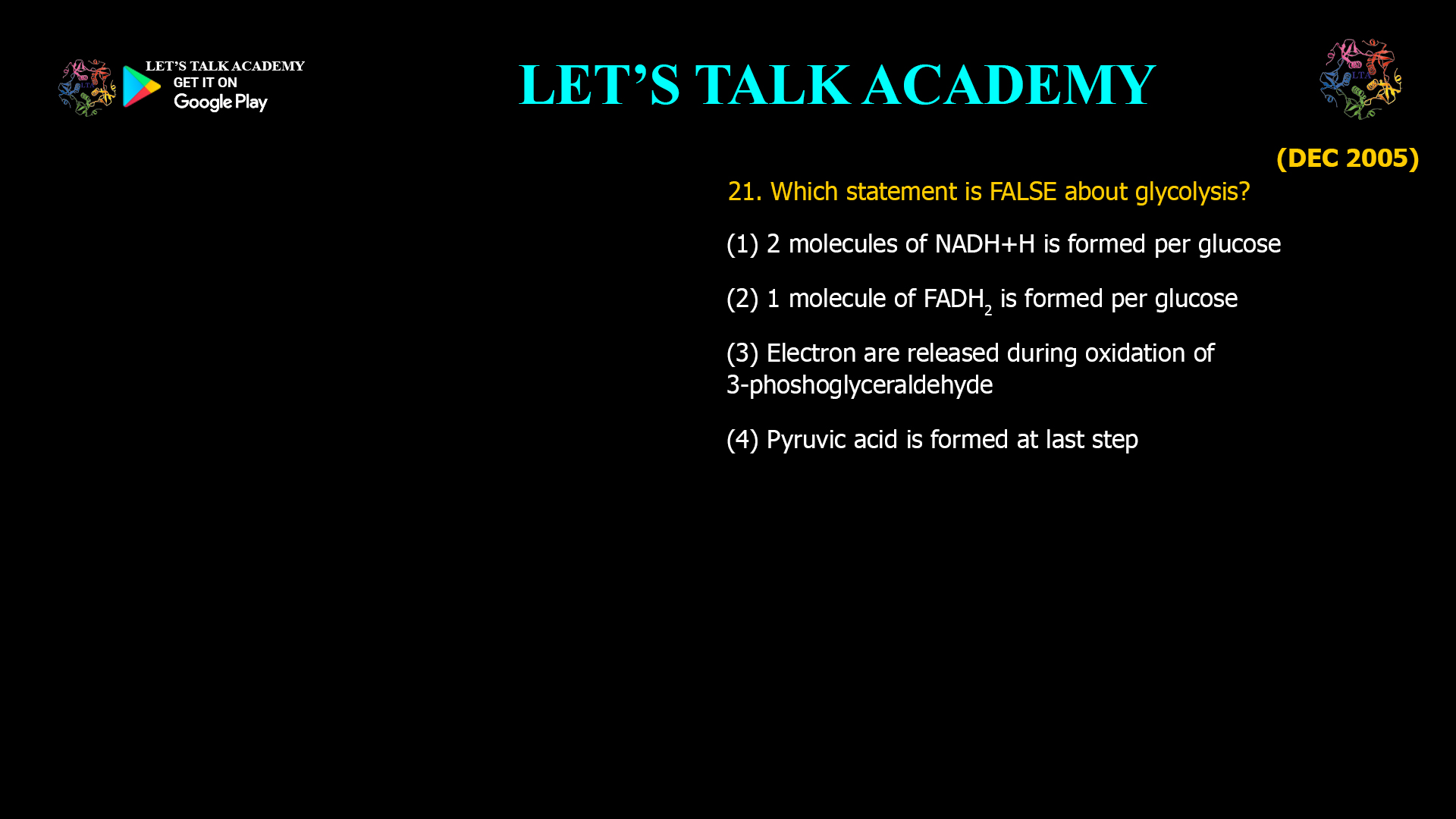
- Which statement is FALSE about glycolysis?
(1) 2 molecules of NADH+H is formed per glucose
(2) 1 molecule of FADH2 is formed per glucose
(3) Electron are released during oxidation of 3-phoshoglyceraldehyde
(4) Pyruvic acid is formed at last step
Glycolysis is a central metabolic pathway that breaks down glucose into pyruvate, producing energy-rich molecules like ATP and NADH. Understanding the key biochemical events during glycolysis is essential for grasping cellular energy metabolism.
This article evaluates four statements about glycolysis to identify which one is false, clarifying common misconceptions about NADH and FADH2 production, electron release, and pyruvate formation.
Statement 1: Two Molecules of NADH + H⁺ Are Formed Per Glucose
This statement is true. During glycolysis, each glucose molecule is split into two triose phosphates, each undergoing oxidation catalyzed by glyceraldehyde-3-phosphate dehydrogenase. This step produces two molecules of NADH + H⁺ per glucose.
Statement 2: One Molecule of FADH2 Is Formed Per Glucose
This statement is false. FADH2 is not produced during glycolysis. Instead, FADH2 is generated in the citric acid cycle (Krebs cycle) during the oxidation of succinate to fumarate. Glycolysis produces NADH but not FADH2.
Statement 3: Electrons Are Released During Oxidation of 3-Phosphoglyceraldehyde
This statement is true. The oxidation of glyceraldehyde-3-phosphate (also called 3-phosphoglyceraldehyde) involves the transfer of electrons to NAD⁺, producing NADH. This is a key redox reaction in glycolysis.
Statement 4: Pyruvic Acid Is Formed at the Last Step
This statement is true. The final product of glycolysis is pyruvate (pyruvic acid), formed by the enzyme pyruvate kinase catalyzing the conversion of phosphoenolpyruvate (PEP) to pyruvate.
Summary Table
Statement True/False 1. 2 molecules of NADH + H⁺ formed per glucose True 2. 1 molecule of FADH2 formed per glucose False 3. Electrons released during oxidation of 3-phosphoglyceraldehyde True 4. Pyruvic acid formed at last step True
Conclusion
The false statement about glycolysis is:
(2) One molecule of FADH2 is formed per glucose
FADH2 is not produced during glycolysis but in the citric acid cycle.
Correct answer: (2) 1 molecule of FADH2 is formed per glucose


26 Comments
Rohittt meena
June 24, 2025👍🏻👍🏻
Kirti Agarwal
September 18, 2025FADH2 is form during glycolysis is incorrect statement
Neha Yadav
September 20, 20251 molecule of FADH2 formed per glucose is false statement about glycolysis
Bhawna Choudhary
September 21, 2025FADH2 is not produced during glycolysis because FADH2 is generated in the kreb cycle during the oxidation of succinate to fumarate
Sonal Nagar
September 21, 20251 molecule of FADH2 is formed per glucose
Manisha choudhary
September 22, 2025False statement is FADH2 formation duringi glycolysis
FADH2 glycolysis k doran nhi kreb cycle k doran bnta h 2 molecule succinate s fumerate bnate time
Pallavi Ghangas
September 22, 2025no fadh2 is formed in glycolysis
Aakansha sharma Sharma
September 22, 2025FADH2 is form during glycolysis is incorrect statement
Aafreen Khan
September 23, 2025FADH2 formed during glycolysis is incorrect.
It form in kreb cycle during the oxidation of succinate to fumarate
Dharmpal Swami
September 23, 2025FADH2 form in krebs cycle
Anurag Giri
September 23, 2025FADH2 is not produced during glycolysis but in the citric acid cycle
Heena Mahlawat
September 24, 2025Fadh2 formed per glucose is incorrect
Minal Sethi
September 24, 20251 molecule of FADH2 is formed per glucose
incorrect statement
Nilofar Khan
September 24, 2025Correct answer is (2) One molecule of FADH2 is formed per glucose. Because FADH2 not produce during glycolysis, it form during kreb cycle
Deepika sheoran
September 24, 2025FADH2 is formed per glucose incorrect statement but FADH2 from in citric cycle.
Soniya Shekhawat
September 24, 2025FADH 2 is not form in a glycolysis instead it is formed in kreb cycle during oxidation of succinate to fumarate.
Mohd juber Ali
September 24, 2025Statement 2 is false bcz glycolysis not produce fadh2
Succinate➡️fumarate (kreb cycle )
FADH2 generate during oxidation of succinate to fumarate
Devika
September 25, 20252nd is false
Payal Gaur
September 25, 2025Option b is incorrect FADH2 is not form in glycolysis
Kavita Choudhary
September 25, 20251 molecule of FADH is formed per guloces is false
Avni
September 25, 2025(2) One molecule of FADH2 is formed per glucose is incorrect because FADH2 is not produced during glycolysis but in the citric acid cycle.
Muskan Yadav
September 26, 2025One molecule of FADH2 is formed per glucose is incorrect.
FADH2 is not produced during glycolysis but in the citric acid cycle
Arushi Saini
September 27, 2025The false statement about glycolysis is:
One molecule of FADH2 is formed per glucose
Kajal
October 2, 2025FADH2 not produced during glycolysis
Santosh Saini
October 5, 2025Statement 2nd is incorrect because FADH2 is not produced during glycolysis, FADH2 is generate in TCA cycle
Sakshi Kanwar
November 26, 20251 molecule of FADH2 formed per glucose