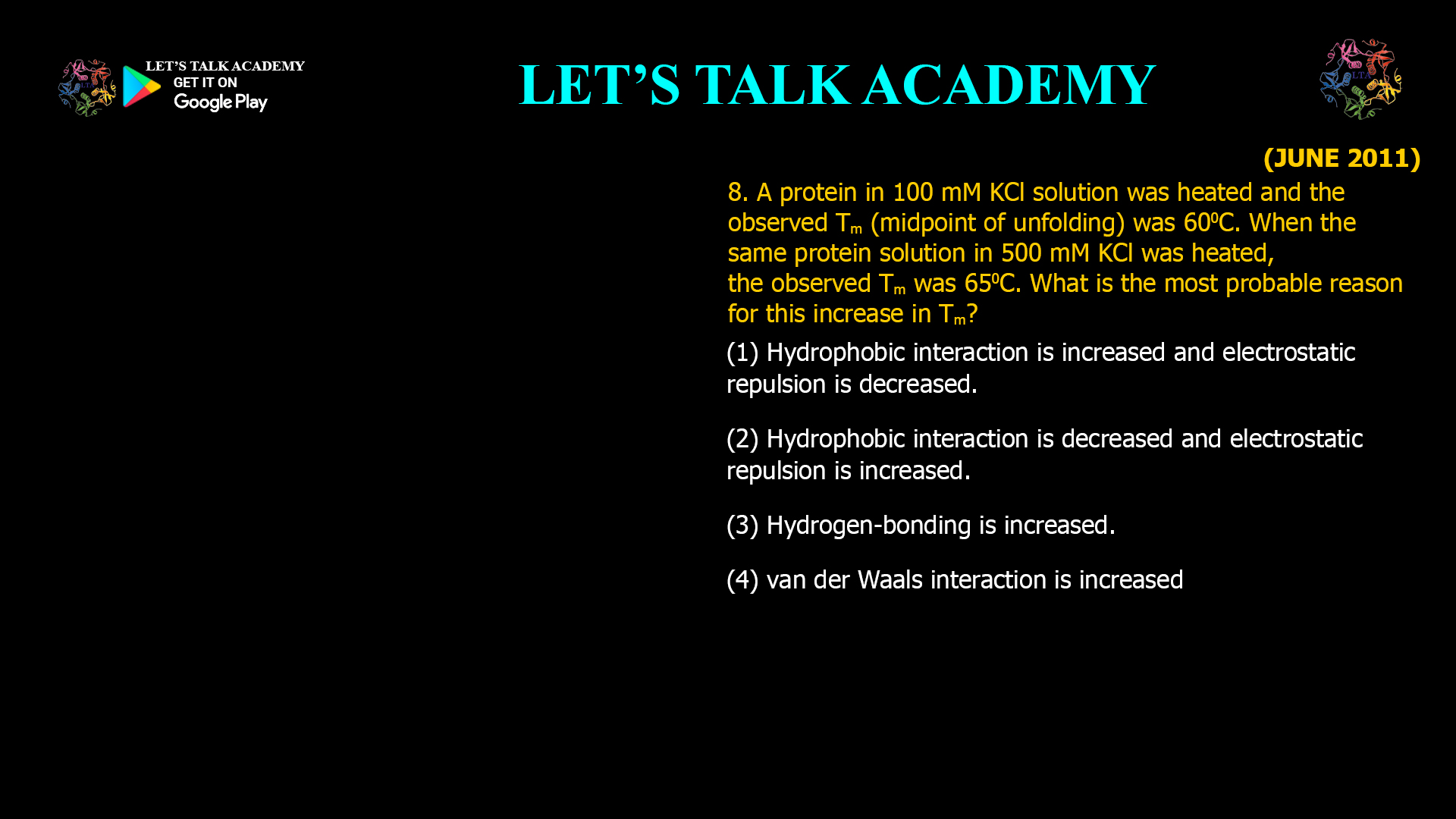
- A protein in 100 mM KCl solution was heated and the observed Tm (midpoint of unfolding) was 600C.
When the same protein solution in 500 mM KCl was heated, the observed Tm was 650C. What is the most probable reason for this increase in Tm?
(1) Hydrophobic interaction is increased and electrostatic repulsion is decreased.
(2) Hydrophobic interaction is decreased and electrostatic repulsion is increased.
(3) Hydrogen-bonding is increased.
(4) van der Waals interaction is increasedIntroduction
The thermal stability of proteins, often measured by the melting temperature (Tm), is influenced by environmental factors such as salt concentration. Experimental observations show that increasing KCl concentration from 100 mM to 500 mM raises the Tm of a protein from 60°C to 65°C, indicating enhanced stability.
This article explains the molecular basis for this increase in Tm, focusing on the interplay between hydrophobic interactions and electrostatic forces in the presence of varying salt concentrations.
Salt Concentration and Protein Stability: Key Concepts
Proteins fold into their native structures stabilized by a balance of forces:
-
Hydrophobic interactions: Nonpolar residues cluster inside the protein to avoid water, crucial for structural integrity.
-
Electrostatic interactions: Charged residues attract or repel each other, influencing folding and stability.
-
Hydrogen bonding and van der Waals forces: Also contribute but are less affected by salt concentration.
Salt ions in solution modulate these interactions by screening electrostatic charges and influencing the solvent environment.
How Increased KCl Concentration Raises Tm
-
Electrostatic Screening Reduces Repulsion:
At low salt concentrations, charged groups on the protein surface may repel each other, destabilizing the folded state. Increasing KCl concentration increases ionic strength, which screens these charges, reducing electrostatic repulsion and allowing the protein to adopt a more compact, stable conformation. -
Enhanced Hydrophobic Interactions:
Salt ions affect water structure and reduce the solubility of nonpolar groups (a phenomenon known as “salting out”). This promotes stronger hydrophobic interactions by encouraging nonpolar side chains to cluster more tightly inside the protein core, stabilizing the folded state. -
Overall Effect on Stability:
The combined effect of decreased electrostatic repulsion and increased hydrophobic interactions leads to a higher energy barrier for unfolding, thereby increasing the Tm.
Supporting Evidence from Molecular Dynamics and Experimental Studies
-
Molecular dynamics simulations show that increasing salt concentration leads to more compact and stable protein structures due to enhanced hydrophobic packing and reduced electrostatic potential energy.
-
Experimental data confirm that proteins in higher ionic strength solutions often exhibit higher melting temperatures and improved thermal stability.
-
The van der Waals energy may decrease slightly with temperature, but the dominant stabilizing effect comes from electrostatic screening and hydrophobic interactions.
Why Other Options Are Less Likely
-
Hydrogen bonding is relatively insensitive to salt concentration changes and unlikely to cause the observed Tm increase.
-
van der Waals interactions are weak and generally less influenced by ionic strength compared to electrostatics and hydrophobic effects.
Summary Table
Factor Effect of Increased KCl Concentration Hydrophobic interactions Increased, stabilizing protein core Electrostatic repulsion Decreased due to ionic screening Hydrogen bonding Minimal change van der Waals interactions Minor effect Resulting protein stability Increased Tm (higher thermal stability)
Conclusion
The most probable reason for the observed increase in protein melting temperature (Tm) upon raising KCl concentration from 100 mM to 500 mM is the increase in hydrophobic interactions coupled with a decrease in electrostatic repulsion. Salt ions screen charged groups on the protein surface, reducing destabilizing repulsions, while promoting tighter hydrophobic packing, thereby enhancing protein thermal stability.
Keywords
protein stability, melting temperature, Tm, salt concentration, KCl effect, hydrophobic interactions, electrostatic screening, protein folding, thermal denaturation, molecular dynamics, ionic strength, protein thermal stability
Correct answer:
(1) Hydrophobic interaction is increased and electrostatic repulsion is decreased. -